In brief
- Four more Australians have been confirmed safe following devastating flooding in Nepal.
- It follows news that officials had contacted an Australian in Tibet.
Four more Australians have been confirmed safe in the Nepal-Tibet region following devastating flooding and the Department of Foreign Affairs and Trade has revised the number of missing Australians down to 38.
At least 1,114 people have been killed in Nepal after a glacial collapse triggered devastating flash floods, with nearly 4,000 people still unaccounted for.
Six Australians have now been located since the floods hit the Nepal-China border last Wednesday. Officials were in contact with an Australian in Tibet on Tuesday after another Australian, Cara Severino, was found safe in Nepal over the weekend.
According to the ABC, one of the four other Australians located was found in Nepal. The remaining three were found outside of the location where the flooding took place. Their welfare is currently not known.
Australian aid supplies aboard a Royal Australian Air Force plane that departed earlier this week were due to arrive in Nepal on Wednesday morning.
News that makes sense
Your trusted source for staying up-to-date with the world around you. Get free daily news updates and analysis, straight to your inbox.
Search and rescue efforts continue
Nepali rescue teams are digging, drilling and blasting through debris in a desperate race against time to free around 100 hydropower workers believed trapped in multiple tunnels.
Authorities said 279 people had been rescued from the ruins of hydropower projects, but at least 639 more were still missing, some of whom are believed to be trapped in tunnels.
Specialised rescue teams from India, China and the United States are involved in the tunnel rescue attempts.
"The plan today is to get on a helicopter and go to the hydro tunnels where they believe there's still life," Ferrin Cole, a member of the US crisis response team currently in Nepal, told ANI news agency.
"We have high-technology listening equipment to listen for sounds of life. And then the safety teams to go in and check."
So far, rescuers have recovered only bodies from tunnels blocked by sludge, and hopes of finding survivors are fading, with officials fearing many are buried under debris left by the floods that tore through towns and valleys near the Chinese border.
"The hope of finding survivors is decreasing," Phanindra Paudel, a senior official at the government's National Emergency Operation Center, said via the Reuters news agency.
"We pray and are hopeful. Hope is hope!"
Excavators worked into the night on Tuesday, but an army update noted that "a large amount of water started flowing" into a hole they were digging, forcing them to start a new opening.
Nepal's Prime Minister Balendra Shah has called the catastrophe "unimaginable and heartbreaking".
With mortuaries overflowing in Nepal, authorities have begun burying hundreds of unidentified bodies after DNA sampling.
At least 17 bodies have also been pulled from rivers downstream in India.
Police, using a drone to search for survivors, said on Tuesday that they had located 24 corpses inside a single house in Nuwakot district.
Foreign minister Shisir Khanal said he still hoped some of the thousands missing could be alive.
"Miracles do happen," he told the Agence France-Presse (AFP) news agency in an interview. "At this point, I do not want to completely give up hope."
'Find their bodies'
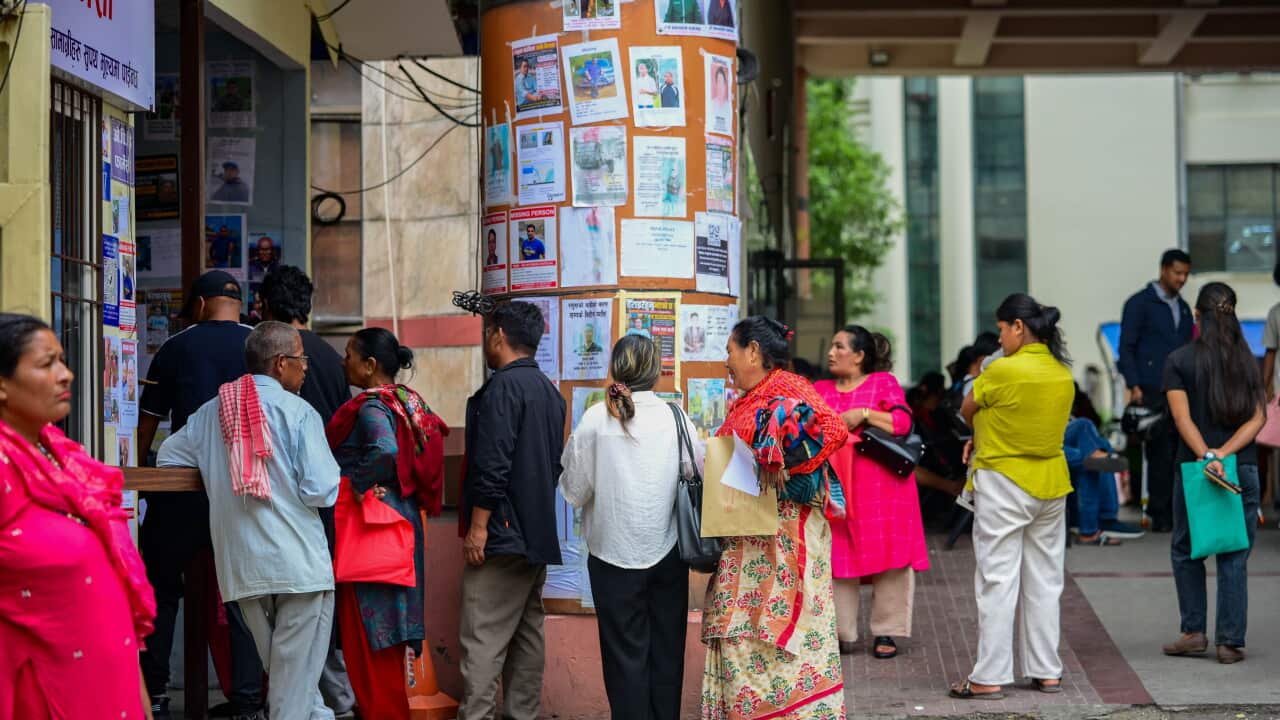
In the capital Kathmandu, crowds lined up to search for their missing relatives.
Debu Sapkota, a 58-year-old driver, posted photos of his 83-year-old mother-in-law and her granddaughter, alongside dozens of others.
Sapkota said he had little hope they survived after witnesses saw them being carried away by the torrent.
"I am here hoping to find their bodies," he said.
Some, believing they will never find their missing relatives, held symbolic funerals in accordance with Nepali Hindu customs.
"We searched everywhere, went to morgues across the country, but could not find his body," said Jeevan Shrestha, as his 12-year-old nephew set fire to a tiny straw effigy representing his missing father.
Nepali families held symbolic funerals on Wednesday to "liberate the souls" of relatives missing since deadly flash floods swept away their villages and homes in the Himalayan region a week ago.
After days of searching shelters and mortuaries, relatives of some of the missing lost hope and began conducting last rites, burning straw effigies in Hindu rituals.
"We had to do this to set his soul free, so that he is at peace and happy wherever he is," said Dolma Newar Tamang, flanked by her sobbing son, at a funeral for her husband.
He had been en route to China when the disaster struck.
"I saw the news and called him," she told AFP.
"I called repeatedly, but he never picked up."
Focus shifts to rehabilitation
Aid needs are enormous. Entire communities have been swept away, leaving families homeless and using makeshift shelters as heavy rain lashes down.
Roads and dozens of bridges have been smashed, and power plants destroyed.
"There are too many challenges," police officer E Hawadi said in the badly affected Nuwakot district.
Shah said the focus would shift from search, rescue and relief operations towards rehabilitation and reconstruction.
"The government is now focusing on rehabilitation while working to protect the lives of people in the affected areas and providing necessary medical treatment and psychological counselling," Shah said in a late-night post on social media on Tuesday.
The disaster left at least 2.2 million tonnes of debris, according to a preliminary estimate by the United Nations Development Programme (UNDP), including parts of buildings, rocks and sediment.
The UNDP said the amount of debris was equivalent to six Empire State Buildings, illustrating the scale of the destruction and the challenge communities face as they clear homes, roads and public spaces and begin to rebuild.
Residents in affected areas walked through the ruins of what had once been bustling villages and towns, trying to salvage whatever they could of their belongings.
"My husband and I were able to escape safely. But we could not pick up anything," Shanta Sunar, 45, a small shopkeeper and survivor from Nuwakot, said.
"We have lost whatever we had. But we are lucky nothing happened to us."
UN spokesperson Stephane Dujarric said aid agencies were "very concerned" about the growing public health risk from overcrowded shelters, contaminated water and damaged health facilities, particularly for women and children during the monsoon season.
Shah said his government had stepped up surveillance and response measures to prevent possible outbreaks of disease in flood-affected areas.
Climate change
The Himalayan region faces severe risks from future glacial floods, a senior UN official said on Tuesday.
AFP photographers in Nuwakot on Tuesday saw people scouring the mud for usable items and stringing up plastic sheeting for shelter amid the ruins.
Foreigners missing among the list include 583 in Nepal and 261 in China, coming from more than 30 nations.
They include tourists who had come to trek in the Himalayas, as well as Hindu pilgrims seeking spiritual peace at Tibet's sacred Mount Kailash.
Nepal's economy is already under pressure, with limited resources to respond to a disaster of this scale.
Kathmandu has warned reconstruction costs could run into the "billions of dollars".
There is growing anger at the scale of the destruction that has hit Nepal, a largely rural nation of 30 million people.
The country has contributed little to the greenhouse gas emissions driving global warming, but is among those suffering its consequences.
Khanal, the foreign minister, told AFP that the "disaster should be seen as a warning signal to the risk that climate change poses to Nepal", adding that support should be seen "from a perspective of climate justice".
Scientists say the Himalayas, the world's highest mountain range, are warming rapidly as global temperatures rise, accelerating glacier melt.
Glaciers in the wider Himalayan and Hindu Kush ranges are a crucial water source for around 240 million people in the mountainous regions, as well as for another 1.65 billion people in the South Asian and Southeast Asian river valleys below.
"It impacts the entirety of the Himalayan region's civilisation," Khanal said.
For the latest from SBS News, download our app and subscribe to our newsletter.







