Shouting "we will vote" and "no pasaran" (Spanish for "they shall not pass"), the protesters refused to move as the day wore on, further angered by news that police had seized "close to 10 million ballot papers" destined for the October 1 vote.
Over in Madrid, supporters of the referendum in Catalonia, a region deeply divided over independence, prepared to gather Wednesday evening in the central Puerta del Sol square known for hosting scores of anti-austerity protests during the Spanish economic crisis.
Spain's conservative Prime Minister Mariano Rajoy called for calm, while his government's spokesman accused separatists of "looking for legitimacy they don't have in street protests".
But Catalan President Carles Puigdemont retorted that Madrid had imposed a "de facto" state of emergency to stop the referendum.
News that makes sense
Your trusted source for staying up-to-date with the world around you. Get free daily news updates and analysis, straight to your inbox.
The opposition Socialist party's Catalan leader, Miquel Iceta, meanwhile, asked the regional and central governments to "stop an escalation that is leading to disaster".
Among those arrested by the Guardia Civil police was Josep Maria Jove, secretary general of economic affairs and Catalonia's deputy vice president, a regional government spokesman said.
The others work in various Catalan government departments and are suspects in a probe into "disobedience, misfeasance and embezzlement", the High Court in Catalonia said.
Launched in February, the probe centres around allegations that confidential data was stolen to provide separatists with information on Catalan tax payers, a judicial source who refused to be named said.
'They declared war'
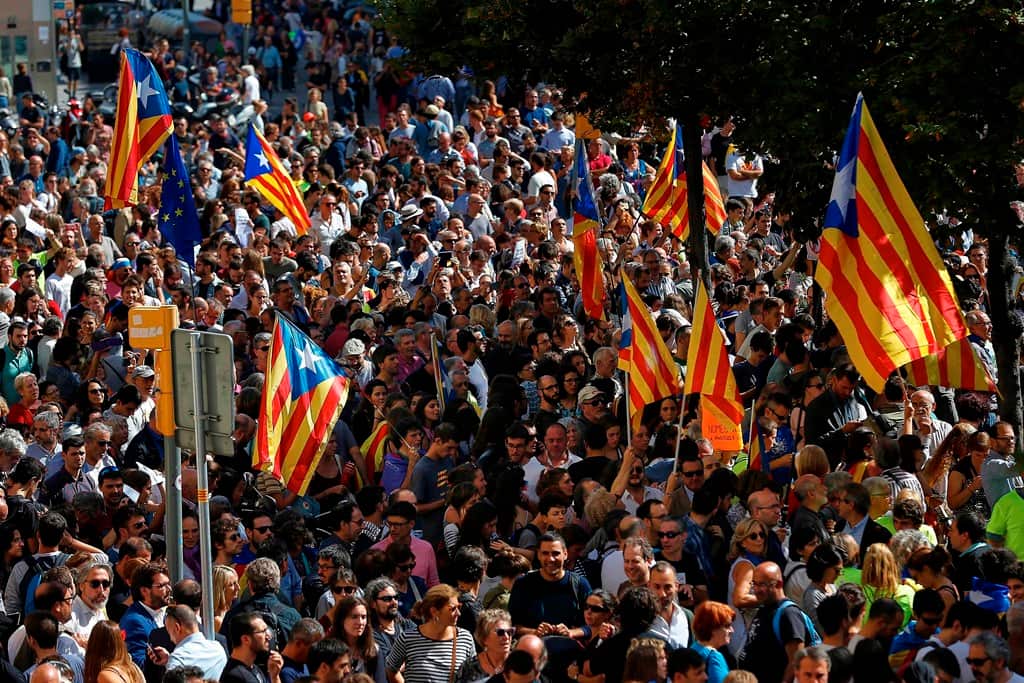
In central Barcelona, thousands gathered near Jove's office, many draped in red and yellow Catalan flags, chanting "Independence!"
Hundreds more were in front of the department of foreign affairs, where they blocked the departure of Guardia Civil vehicles for hours.
To shouts of "Get out, get out, get out Spanish police", protesters also gathered in front of the headquarters of the radical CUP party, part of Catalonia's ruling separatist coalition, where police said they were carrying out an "operation".
Anna Sola, an unemployed 45-year-old in a wheelchair, said she rushed out to protest after hearing about Jove's arrest on the news and through text messages from friends.
"They are attacking our institutions, those that we voted for, just for simply doing what the people want," she said.
Barcelona Mayor Ada Colau, meanwhile, called on people to continue protesting "peacefully" against what she labelled Rajoy's "repressive strategy".
Threats and seizures
Polls show that while Catalans are sharply divided on whether they want independence or not, a large majority would like to vote to settle the matter.
But Madrid is against it, pointing to the constitution which states that the unity of the Spanish nation is "unbreakable" and that only the central government has the power to call a referendum on any matter.
Separatists in Catalonia, a region with its own language and customs, have retorted they have a democratic right to decide on their future.
The police operation comes a day after officers seized over 45,000 notifications destined for Catalans selected to staff polling stations.
Madrid has also suspended all leave and vacation for police deployed in Catalonia until October 5.
And it has threatened to arrest mayors who facilitate the vote if they do not comply with a criminal probe in the matter and has tightened control over the region's finances.
The measures are making it harder and harder for Catalonia's executive to stage the vote.
'Leading to disaster'
Tensions also reached the parliament in Madrid on Wednesday, where Gabriel Rufian, a lawmaker for the pro-separatist Catalan Republican Left (ERC), told Rajoy to take his "dirty hands off Catalan institutions" before storming out of the assembly with fellow lawmakers.
But Rajoy defended his government's position, saying it was "fulfilling its obligation".
Pro-separatist parties captured 47.6 percent of the vote in a September 2015 Catalan election which was billed as a proxy vote on independence, giving them a narrow majority of 72 seats in the 135-seat Catalan parliament.But a survey commissioned by the regional government in July showed that 49.4 percent of Catalans were against independence while 41.1 percent were in favour.







