(Transcript from SBS World News Radio)
Leaders from the G7 countries have made commitments on climate change, pressed Greece to accept economic reforms and struck a firm tone on Russia's role in Ukraine.
As Aileen Phillips reports, those are just some of the world's most pressing problems tackled at a summit in Germany.
(Click on the audio tab above to hear the full report)
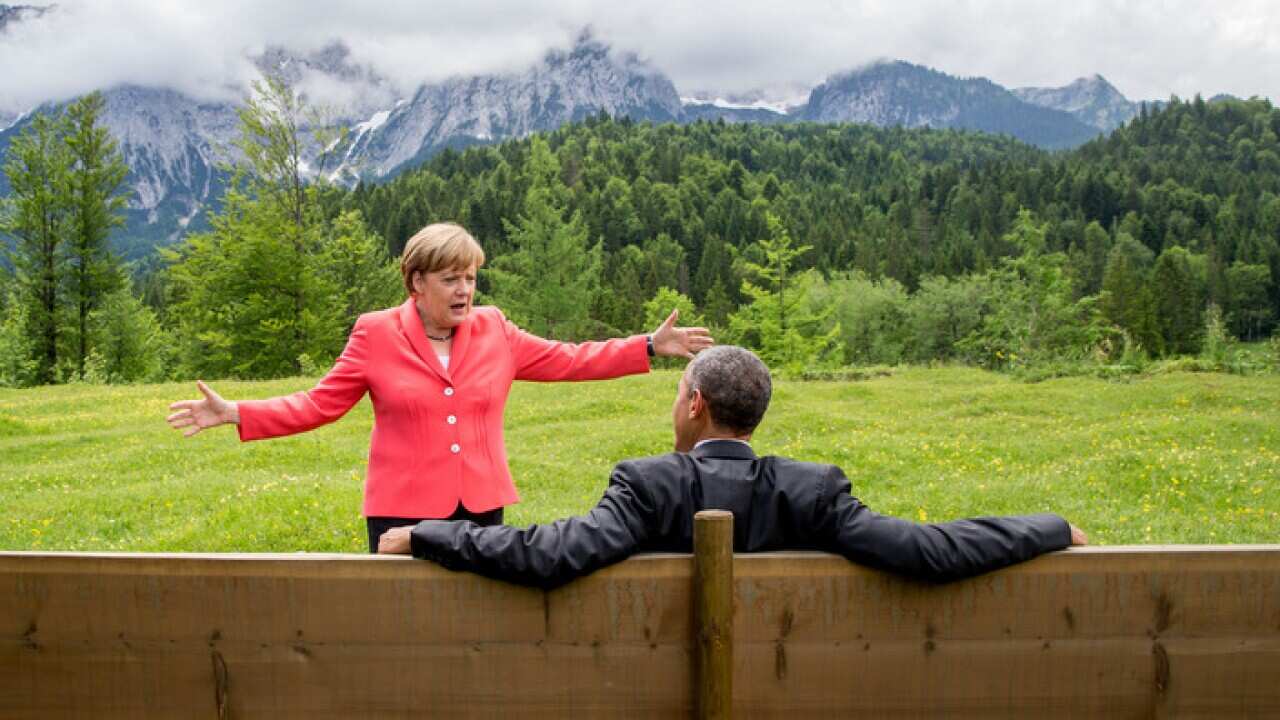
A key issue that German Chancellor Angela Merkel wanted action on during the G7 summit she was hosting at Elmau Castle in southern Germany was climate change.
Now, the G7 leaders have agreed to wean their economies off carbon fuels and support a global target for limiting the rise in average global temperatures.
A communique issued at the end of the summit says the G7 supports global-emissions cuts of 40 to 70 per cent by the middle of the century from 2010 levels.
The agreement marks a major step in the battle against global warming and raises the chances of a United Nations climate deal later this year.
Ms Merkel says real progress has been made.
"The G7 has clearly stated that we need binding rules at the heart of the agreement. The world doesn't have binding rules. That is why this has to be the aim of the UN conference in Paris. We want to ensure that all countries are in a position to take development paths so that the global temperature remains under a rise of two degrees Celsius."
At the summit in the Bavarian Alps, the leaders also discussed threats to global security posed by militant groups in the Middle East.
They reiterated their commitment to fighting the self-proclaimed Islamic State, also known as IS or ISIL.
United States president Barack Obama met with Iraq prime minister Haider al-Abadi on the sidelines.
Mr Obama says better cooperation, coordination and intelligence will help slow the flow of foreign fighters and training more new Iraqi forces is a big part of the solution.
"If we can cut off some of that foreign-fighter flow, then we're able to isolate and wear out ISIL forces that are already there, because we're taking a lot of them off the battlefield but, if they're being replenished, then it doesn't solve the problem over the long term."
Britain's Prime Minister David Cameron says his country is very much part of the joint effort to defeat I-S.
He says Britain has a three-pronged approach to deal with the threat.
"First, help to train Iraqi security forces so they can defeat ISIL on the ground. We've already been training Kurdish forces, and we will deploy an additional 125 military personnel to expand this training across Iraq. Second, clear political support for Prime Minister Abadi and his efforts to lead an inclusive government that brings the country together against the common enemy that is ISIL. Finally, we discussed what more we can do to stop the spread of this poisonous ideology by tackling its root causes at home and abroad."
Dominating the talks on the first day was the issue of the Russia-Ukraine conflict.
And as the summit wrapped up, the group of seven top powers turned its attention back to the crisis, closing ranks against Russia.
Mr Obama issued one of the strongest warnings yet.
"Ultimately, this is going to be an issue for Mr Putin. He's got to make a decision: Does he continue to wreck his country's economy and continue Russia's isolation in pursuit of a wrong-headed desire to recreate the glories of the Soviet empire?"
France's President Francoise Hollande has pleaded with Russia to fully implement the Minsk agreement.
"If it is shown, first of all, that Russia has continued to arm and to have a military presence in the east of Ukraine, if it is also shown that it's partly already the case that the eastern region does not take the steps to respect the stages of the Minsk agreement, then we could justify increasing sanctions."
Angela Merkel says the leaders are ready to strengthen sanctions against Russia over its involvement in the Ukraine conflict if necessary.
Share


