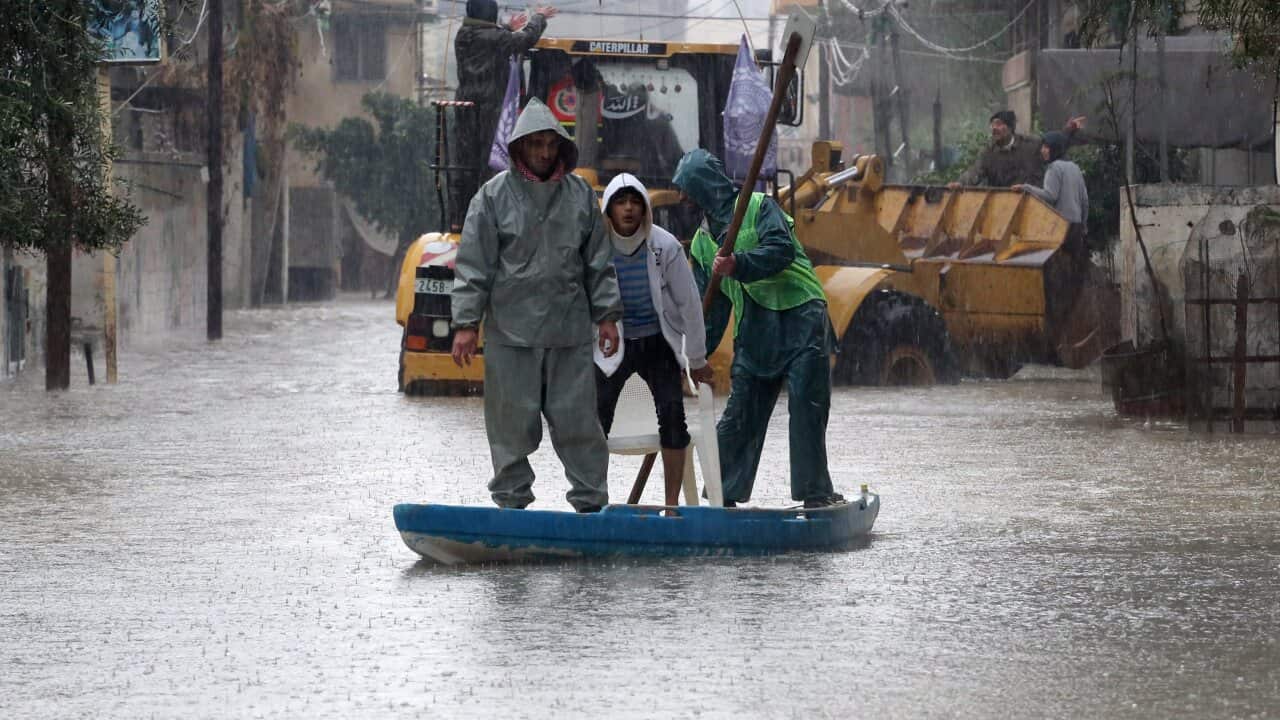
The heaviest snowfall in decades has blocked roads across Israel and the West Bank, while torrential rains have flooded areas of the Gaza Strip,.
At least one person died from asphyxiation trying to heat his home, while hundreds of others suffered weather-related injuries.
The heavy snow, which stopped falling on Saturday afternoon, prompted Israeli authorities to interrupt the Jewish Sabbath to lay on relief trains.
Nationwide, some 30,000 households were without electricity, nearly 9,000 of them in Jerusalem, the Israel Electric Corp said.
Low ground on the coast was spared the snowfall, but torrential rains left areas of the Gaza Strip submerged.
News that makes sense
Your trusted source for staying up-to-date with the world around you. Get free daily news updates and analysis, straight to your inbox.
Gaza was "a disaster area with water as far as the eye can see," the UN Relief and Works Agency for Palestine Refugees said.
"Four thousand UNRWA workers are battling the floods and have evacuated hundreds of families to UNRWA facilities," spokesman Chris Gunness said.
"We have distributed 5,000 litres (1,100 gallons) of fuel to local pumping stations, but the situation is dire and with the flood waters rising, the risk of water-borne disease can only increase," he said.
The territory's Hamas rulers said 5,500 people had been rescued and sheltered after their homes were flooded on Saturday.
In some places, security forces and rescue workers were evacuating residents using small boats.
Gaza's Coastal Municipalities Water Authority said there are more than 15 areas that are heavily flooded.
On Friday, Israel opened the Kerem Shalom crossing into Gaza to deliver gas for domestic use and to fuel pumps to drain the floodwaters.
An official of the Hamas government said Israel would open the crossing again on Sunday to deliver fuel to the Palestinian territory's sole power plant, which is currently not operational.
SNOW IN ISRAEL
Jerusalem city workers managed to clear most roads of drifting snow but appealed to residents to stay at home as fallen trees posed a persistent traffic hazard.
Few had ventured out, apart from observant Jews walking to synagogues.
Jerusalem-based meteorologist Boaz Nechemia told AFP that between 45 and 60cm of snow had accumulated in the Holy City by Saturday.
"We haven't had such a snowfall in some 70 years," he said, noting that a metre of snow fell on Jerusalem in 1920.
With road travel almost impossible, authorities laid on free trains to Tel Aviv and Haifa on the coast, interrupting for the first time ever the shutdown of public transport on the Jewish day of prayer and rest, which runs from sundown on Friday to Saturday night.
The army said it was using armoured vehicles to distribute aid to areas cut off by the bad weather.
Channel 2 television said an initial estimate put the damages at $US85 million ($A95.62 million).
A police spokeswoman said four people had died due to weather-related accidents since Thursday night.
Access to West Bank cities such as Ramallah remained blocked by heavy snowfall, with the only source of power in many cases being private generators.







