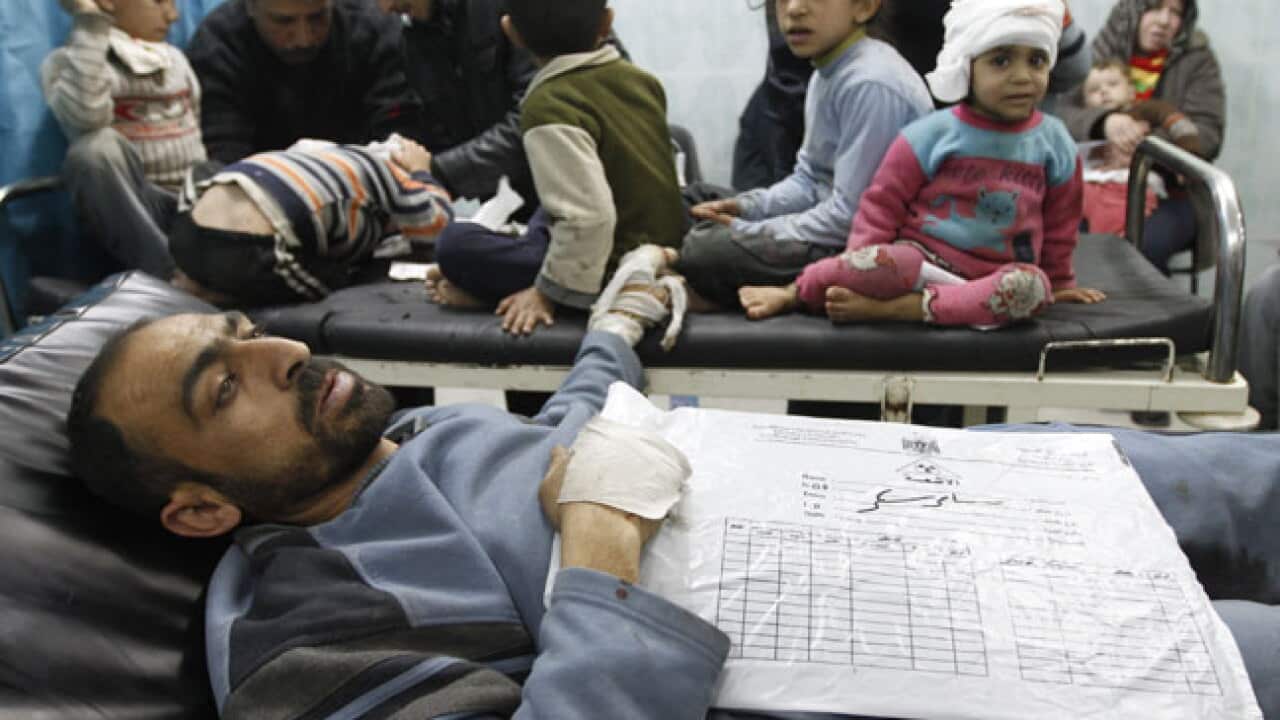
The latest strike killed two Palestinians east of Gaza City, spokesman for the Hamas-run emergency services, Adham Abu Selmiya, told AFP.
Islamic Jihad identified the pair as its members, Bassam al-Ajla and Mohammed Dahir.
News that makes sense
Your trusted source for staying up-to-date with the world around you. Get free daily news updates and analysis, straight to your inbox.
The Israel military said it had hit a "terrorist cell that was preparing to fire rockets."
An earlier raid killed a man in his 60s and his daughter in the Jabaliya refugee camp in the northern Gaza Strip, medics said.
Several hours before that, a teenager was killed nearby, in what the Palestinians claimed was a drone strike.
But the Israeli military said it had not been operating in the area at the time.
As militants kept up a steady stream of rocket fire on towns and cities in southern Israel, Prime Minister Benjamin Netanyahu warned that the army could expand its operations if rocket fire continued.
"The Israeli army is prepared to expand its activities, and will continue its activities as long as necessary," he told MPs from his rightwing Likud party, hailing the Jewish state's "crushing offensive abilities."
During the day, Israeli warplanes carried out at least 10 strikes across the territory, targeting a weapons storage facility and rocket-launching sites, and killing two militants and two civilians.
Both militants, who belonged to Islamic Jihad's armed wing, the Al-Quds Brigade, were killed in strikes around the southern city of Khan Yunis.
And shortly afterwards, a blast killed a 15-year-old boy and wounded six others in what Abu Selmiya said was an Israeli drone strike.
But a military spokesman denied the air force had carried out any attacks in the area at the time, and an AFP correspondent at the scene confirmed there was no sign of an air strike.
The latest attack in Jabaliya killed two civilians, Mohammed Mustafa al-Hasumi, 65, and his 35-year-old daughter Faiza.
In a statement, the Israeli military said the strike targeted "a terrorist squad" who had just launched a rocket towards Israel.
While it acknowledged the strike may have caused "the apparent injury of uninvolved persons," it said the incident was "a blatant example of how terror organisations use human shields to carry out terror attacks."
Monday's bloodshed raised to 25 the number of Palestinians killed in a weekend of tit-for-tat violence that began on Friday afternoon. Another 83 people have been wounded, medics said.
Of that number, 19 were militants -- 12 from Islamic Jihad, and five from the Popular Resistance Committees -- and six were civilians, among them two minors.
Meanwhile in southern Israel, a rocket hit a residential area of Ashdod, lightly injuring an elderly woman, medics and police said.
Between midnight and 9 pm (2200 GMT Sunday and 1900 GMT Monday), Gaza militants fired 66 rockets and mortar rounds, the army said, of which 42 hit Israeli territory, and 24 were intercepted by the Iron Dome missile system.
Monday's firing raised to more than 200 the number of rockets fired at the Jewish state over the past 72 hours, although the casualties have been minimal with just four people hurt over the weekend.
Speaking at the United Nations in New York, US Secretary of State Hillary Clinton condemned the "rocket fire from Gaza by terrorists into southern Israel."
"We call on those responsible to take immediate action to stop these attacks. And we call on both sides, all sides, to make every effort to restore calm," Clinton told the UN Security Council.
She later joined her counterparts from the European Union, Russia and the United Nations for a meeting of the so-called Quartet of Middle East players, which "expressed serious concern for the recent escalation."
"The Quartet reiterates its call on the parties to remain engaged and to refrain from provocative actions," a statement said.
Most of the rocket fire has been claimed by the Quds Brigades, which lost 14 of its militants over the past four days.
On Monday, the Brigades took a sideswipe at Gaza's Hamas rulers, who are seeking Egypt's help to restore calm, and whose armed wing has not been firing rockets at Israel.
"We call on those panting after any calm, whatever its conditions, to direct their messages at the enemy and not the resistance, for there is no calm after today, except based on the conditions of the resistance," a statement said.
But there was no sign a truce was on the horizon.
"No-one now is speaking about a ceasefire," Hamas spokesman Taher al-Nunu told AFP.
"It was the Israeli side who broke the ceasefire and we need to see them end the escalation before we talk about (a new) ceasefire," he told AFP.
The violence kicked off on Friday after Israel killed Zuhair al-Qaisi, head of the Popular Resistance Committees, prompting militant groups to begin lobbing rockets over the border.
The army said Qaisi had planned a deadly attack in August 2011 and accused him of planning a repeat attack "in the coming days."







