

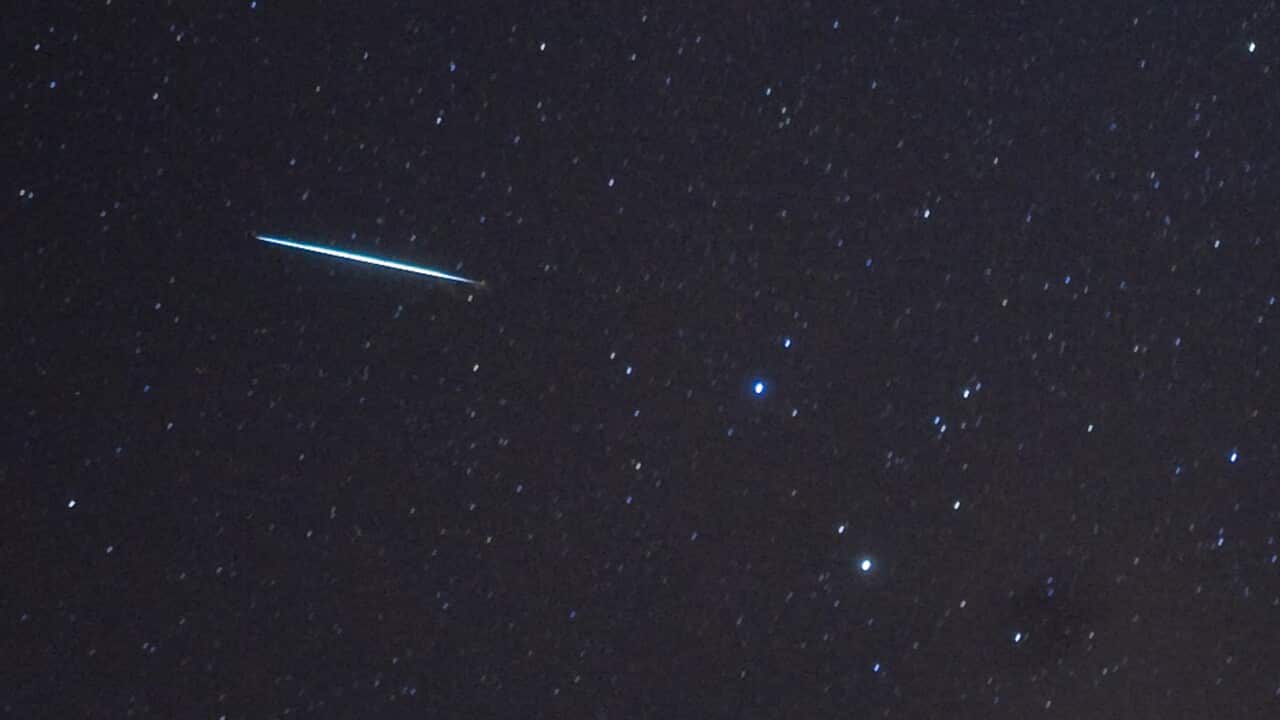
Sky-watchers will be burning the midnight oil as one of the year's most spectacular meteor showers reaches its fiery peak.
At their height, the Geminids could produce between 50 and 100 shooting stars every hour on Sunday night.
They might be glowing in multiple colours and include occasional rapid bursts of two or three.
Sydney Observatory's astronomy curator Andrew Jacob says the meteors will be most visible between 11pm and 1am in eastern Australian skies, but should be visible throughout the night.
Robin Scagell, vice-president of the British Society for Popular Astronomy, says it should be a good display around the world, weather permitting.
News that makes sense
Your trusted source for staying up-to-date with the world around you. Get free daily news updates and analysis, straight to your inbox.
"The constellation is very high in the sky and most of the Moon will have gone away. An average of one comet a minute would be a good rate, and that's possible. You might also get little bursts of activity with two or three together."
Meteor showers occur when the Earth ploughs through clouds of cometary dust. The tiny particles, some no bigger than a grain of sand, burn up brightly as they enter the atmosphere.
The Geminids are unusual in that they are not shed by a classic icy comet but a body that shares characteristics of both comets and asteroids.
Known as 3200 Phaethon, the almost five-kilometre-wide object was discovered in 1983 by two British scientists examining Nasa satellite images and initially classified as an asteroid.
But it has an eccentric orbit that looks more like that of a comet than an asteroid and brings it well inside the orbit of Mercury, the closest planet to the Sun, every 1.4 years.
Nasa describes it as a "rock comet".
Traditionally asteroids are made of rock and comets mostly of ice.
The Geminid meteor shower itself was first noted in the 1860s.
Over time, it has become more intense, with up to 20 comets per hour reported in the 1920s, rising to 50 in the 1930s, 60 in the 1940s and 80 in the 1970s.