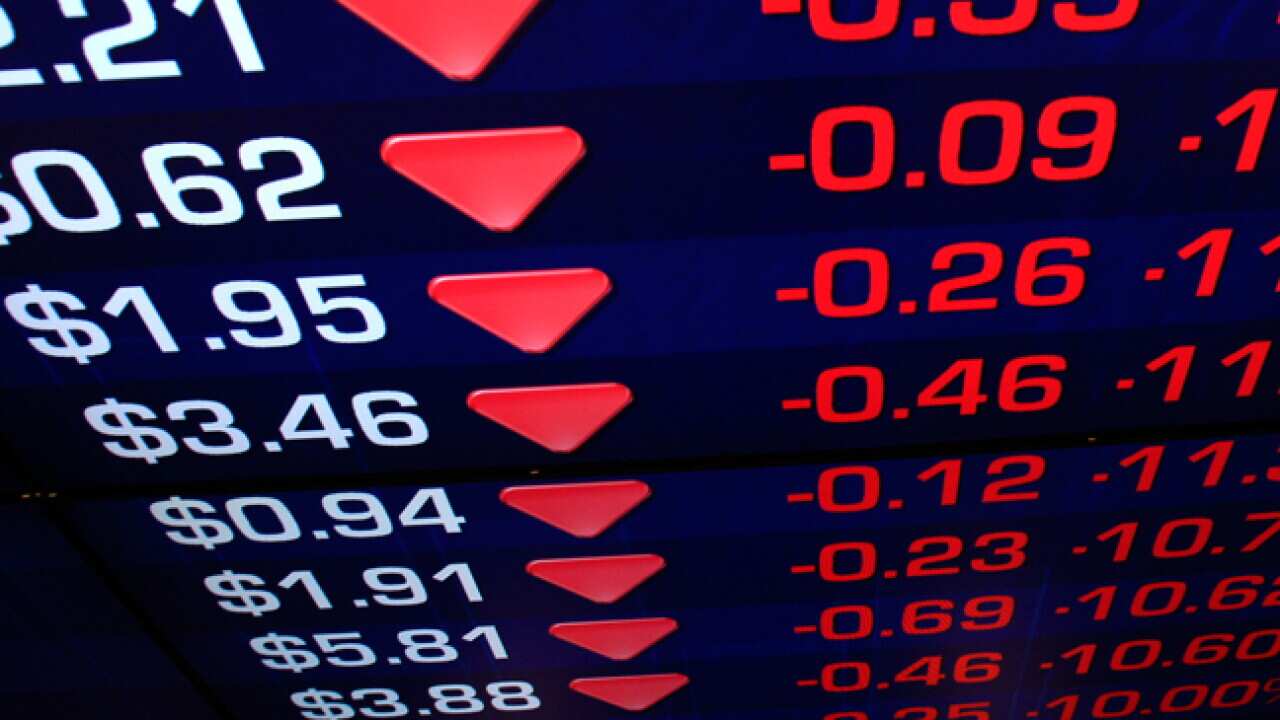
French President Nicolas Sarkozy and German Chancellor Angela Merkel have failed to boost markets in a discussion of eurozone troubles, leaving investors at the mercy of poor economic data on both sides of the Atlantic.
US markets closed lower, despite positive company earnings reports, after Sarkozy and Merkel pledged to give the eurozone bloc a "true economic government" but offered no new initiatives for struggling periphery countries like Greece and Portugal.
European markets closed prior to the end of the two leaders' mini-summit, but took their cues from figures that showed the eurozone economy stalling in the second quarter, as well as more weak US housing data.
News that makes sense
Your trusted source for staying up-to-date with the world around you. Get free daily news updates and analysis, straight to your inbox.
The Dow Jones Industrial Average finished down 0.67 percent, ending a three-day winning streak; the broader S&P 500 lost 0.97 percent.
In Europe, London's FTSE 100 index closed up 0.13 percent; Frankfurt's main DAX index fell 0.45 percent; and the Paris CAC 40 shed 0.25 percent.
Asian markets had opened the day mixed, the Hang Seng Index down 0.24 percent and Japan's Nikkei rising 0.23 percent.
Dealers there said investors took quick profits on gains made in the past few days as the markets bounced back from some of the worst losses seen since the onset of the global financial crisis in 2008.
News that Fitch Ratings confirmed its top US credit rating was welcome after peer Standard and Poor's cut its assessment, but it had little immediate impact.
While London and Zurich were the only majors to close in positive territory, the European markets all came back from sharp early losses after disastrous eurozone figures showing the economy stalled in the second quarter.
The eurozone economy slumped to just 0.2 percent growth in the second quarter from 0.8 percent in the first and short of forecasts for 0.3 percent.
Even more shocking was the slump in Germany, Europe's powerhouse economy, to just 0.1 percent from 1.3 percent in the first three months.
Analysts said governments were now in the worst of both worlds, trying to cut debt by slashing spending and raising taxes, a double squeeze that kills growth and further complicates efforts to stabilize public finances.
"The news is not good and the markets will look at German weakness as a sign that the necessary financial ammunition is not there to keep" the eurozone afloat, said Stephen Gallo, head of market analysis at Schneider Foreign Exchange in London.
"Perhaps... this recent sign of weakness in Germany will lead to a more urgent feeling on the part of the German government that something needs to be done, and very soon at that," Gallo said.
German and French officials made it clear before the Sarkozy-Merkel meeting in Paris that issuing eurobonds -- to ease the pressure on weaker member states -- was definitely not on the agenda.
Germany opposes eurobonds as it believes it would increase its own borrowing costs and allow countries to duck badly needed fiscal reforms.
The poor European growth data pressed the euro down against the dollar but only slightly, with traders citing some tightness in the markets.
At 2100 GMT, the euro had eased to $1.4406, compared to $1.4440 late Monday.
"The euro has been surprisingly resilient given the perfect storm of bad news including the ongoing European debt crisis, a shift in ECB expectations, slowing eurozone growth and more subdued global risk appetites," said Nick Bennenbroek of Wells Fargo Bank.
The Swiss franc meanwhile continued its drop back after the Swiss central bank hinted the currency could be tied to the euro to stem its rise.
The franc moved to 1.1434 per euro (from 1.1327 francs) and 0.7935 francs per dollar (0.7844).
Gold was at around $1,784 an ounce, up sharply from $1,739 late Monday as investors bought back into the traditional safe-haven asset.







