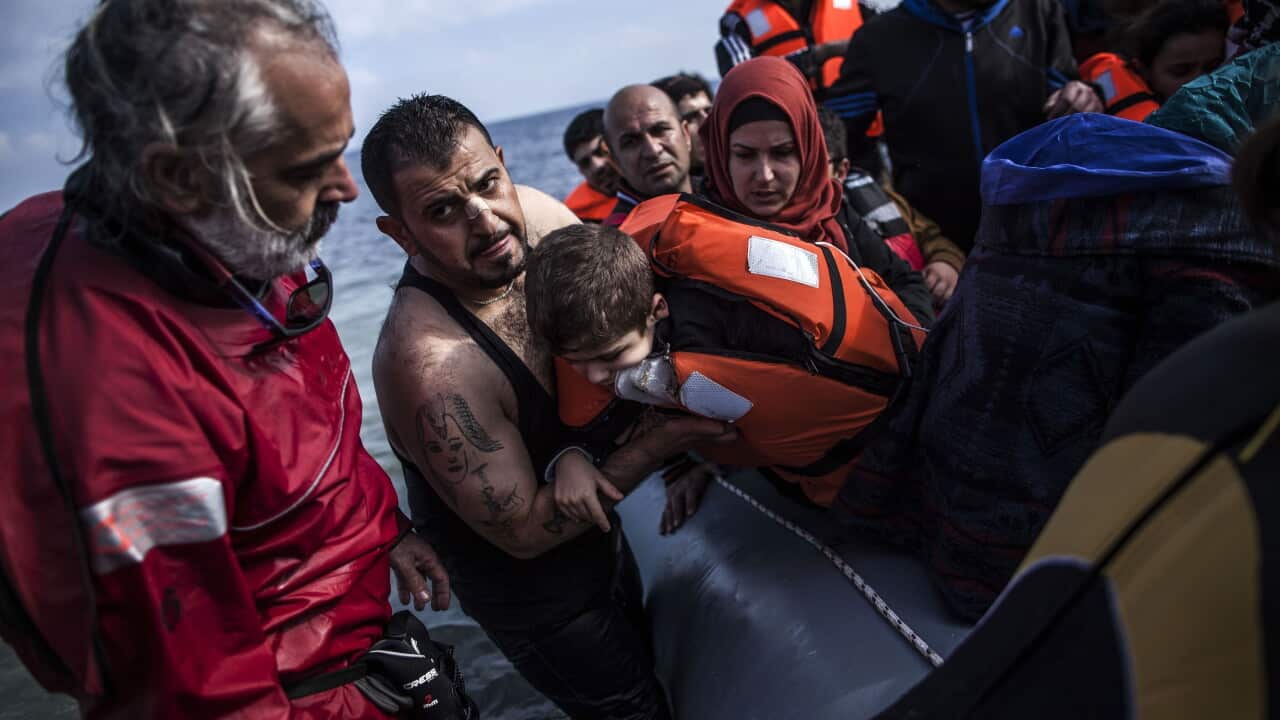
Struggling with a growing logjam of refugees, Greece has recalled its ambassador to Vienna in protest at moves by Austria and Balkan states to make it harder for migrants to head north across Europe.
The unusual step reflected Greek fury at being excluded from a meeting of Balkan states in Vienna on Wednesday to coordinate border restrictions across the region to limit the flow.
"Greece will not become a Lebanon or a warehouse of souls," said migration minister Yannis Mouzalas on Thursday.
Lebanon, a country of 4 million people, is hosting more than 1 million refugees from the civil war in neighbouring Syria.
Greek officials estimated there were 20,000 refugees and migrants trapped in the country as a result of the new restrictions, which began when Austria announced on February 18 it would let in no more than 3200 people a day and cap daily asylum claims at 80.
News that makes sense
Your trusted source for staying up-to-date with the world around you. Get free daily news updates and analysis, straight to your inbox.
European countries are trading bitter recriminations as they wrestle with the continent's worst migration crisis since World War Two.
More than a million people arrived in 2015, most fleeing conflict in countries like Syria, Iraq and Afghanistan, and over 100,000 have reached Greece and Italy already this year.
Greece is likely to face a cost of more than half a billion euros this year, equivalent to about 0.4 per cent of economic output, even as it struggles to cope with its worst financial crisis in generations.
"It's a conservative estimate. Costs could go up if there is increased inflow and refugees become logjammed in Greece due to border closures," said a central bank source.
With reception facilities full, Greek authorities were using stadiums as temporary accommodation. They planned to boost reception capacity by 20,000 by March 6, Defence Minister Panos Kammenos said.
On Thursday, it emerged that the United Nations refugee agency had sought information from tourism authorities on leasing hotels with a minimum capacity of 100 beds for an initial period of nine months, and with immediate availability.
Ignoring warnings from Greek authorities that the border was shut, hundreds of migrants set off on the country's main north-south motorway to Idomeni, a small community on the frontier with Macedonia.
"We have been here for six days. We cannot take it any more," said Hasan, an Iraqi in a group of hundreds walking some 10km from the Macedonian border.
Europe's free travel zone 'could end'
Europe's cherished free-travel zone will shut down unless Turkey acts to cut the number of migrants heading north through Greece by March 7, European Union officials say.
Their declaration came as confrontations grow increasingly rancorous among European countries trying to cope with the influx of refugees. Those recriminations culminated in Greece recalling its ambassador to Austria on Thursday.
"In the next ten days, we need tangible and clear results on the ground," the top EU migration official, Dimitris Avramopoulos, said after EU justice and home affairs ministers met in Brussels on Thursday.
"Otherwise there is a danger, there is a risk that the whole system will completely break down."
EU leaders are now pinning their hopes on talks with Turkey on March 7 and their own migration summit on March 18-19 before warmer weather encourages more arrivals across the Mediterranean.
Seven European states have already restored border controls within the creaking Schengen passport-free zone.
More said they would unilaterally tighten border controls unless a deal with Turkey shows results before the two March summits.
That deal promises Turkey 3 billion euros ($A4.59 billion) in aid to help it shelter refugees from the Syrian war, in return for preventing their travelling on to Europe.
"By March 7, we want a significant reduction in the number of refugees at the border between Turkey and Greece," German Interior Minister Thomas de Maiziere said.
"Otherwise ,there will have to be other joint, coordinated European measures."
Germany has been pushing the Turkey plan hard. Many other EU states are increasingly frustrated and sceptical, though.
Another 110,000 people have arrived on the continent so far this year, mostly from Turkey via Greece, after more than a million arrived last year.
NATO has agreed to send ships to the Aegean to help fight people-trafficking, and one military official said the aim was to have the mission running before March 7.
The crisis was exacerbated when German Chancellor Angela Merkel last year waived EU procedures to take in hundreds of thousands of Syrians. Mutual recriminations have sabotaged efforts to share the burden systematically ever since.
"We have no policy any more. We are heading into anarchy," said Jean Asselborn, Luxembourg's foreign minister.
Belgium, France, Germany, Norway, Sweden and Denmark have all introduced emergency border checks, allowed under the Schengen rules.
But Austria, the last stop for most migrants before Germany, infuriated Brussels and Berlin last week by setting daily caps on the number of people it processes.
The decision set off a cascade of similar moves back through the western Balkans, the main migration route, leaving ever more migrants stuck in Greece.
"If Greece is not able or willing to secure the EU's external border, others have to act," Austrian Interior Minister Johanna Mikl-Leitner said.
"If Greece insists that it cannot protect the Greek border, one has to ask themselves whether the Schengen border should be there."







