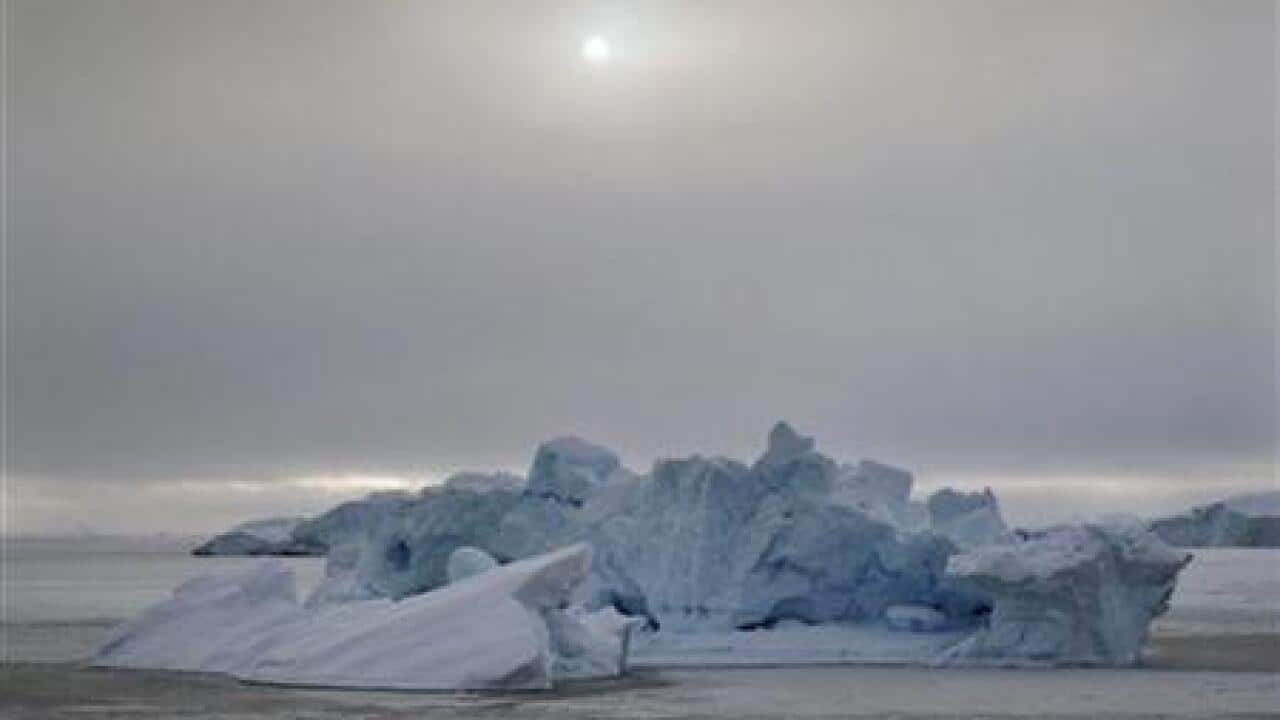
The report, reconstructing temperatures by examining lake sediment cores in west Greenland dating back 5,600 years, also indicated that earlier, pre-historic settlers also had to contend with vicious swings in climate on icy Greenland.
"Climate played (a) big role in Vikings' disappearance from Greenland," Brown University in the United States said in a statement of a finding that average temperatures plunged 4 degrees Celsius (7F) in 80 years from about 1100.
Such a shift is roughly the equivalent of the current average temperatures in Edinburgh, Scotland, tumbling to match those in Reykjavik, Iceland. It would be a huge setback to crop and livestock production.
"There is a definite cooling trend in the region right before the Norse disappear," said William D'Andrea of Brown University, the lead author of the study in the U.S. journal Proceedings of the National Academy of Sciences.
Researchers have scant written or archaeological records to figure out why Viking settlers abandoned colonies on the western side of the island in the mid-1300s and the eastern side in the early 1400s.
Conflicts with indigenous Inuit, a search for better hunting grounds, economic stresses and natural swings in climate, perhaps caused by shifts in the sun's output or volcanic eruptions, could all be factors.
LITTLE ICE AGE
Scientists have previously suspected that a cooling toward a "Little Ice Age" from the 1400s gradually shortened growing seasons and added to sea ice that hampered sailing links with Iceland or the Nordic nations.
The study, by scientists in the United States and Britain, added the previously unknown 12th century temperature plunge as a possible trigger for the colonies' demise. Vikings arrived in Greenland in the 980s, during a warm period like the present.
"You have an interval when the summers are long and balmy and you build up the size of your farm, and then suddenly year after year, you go into this cooling trend, and the summers are getting shorter and colder and you can't make as much hay," D'Andrea said.
The study also traced even earlier swings in the climate to the rise and fall of pre-historic peoples on Greenland starting with the Saqqaq culture, which thrived from about 4,500 years ago to 2,800 years ago.
Scientists fear that the 21st century warming is caused by climate change, stoked by a build-up of greenhouse gases from human activities. An acceleration of warming could cause a meltdown of the Greenland ice sheet, raising world sea levels.
Share


