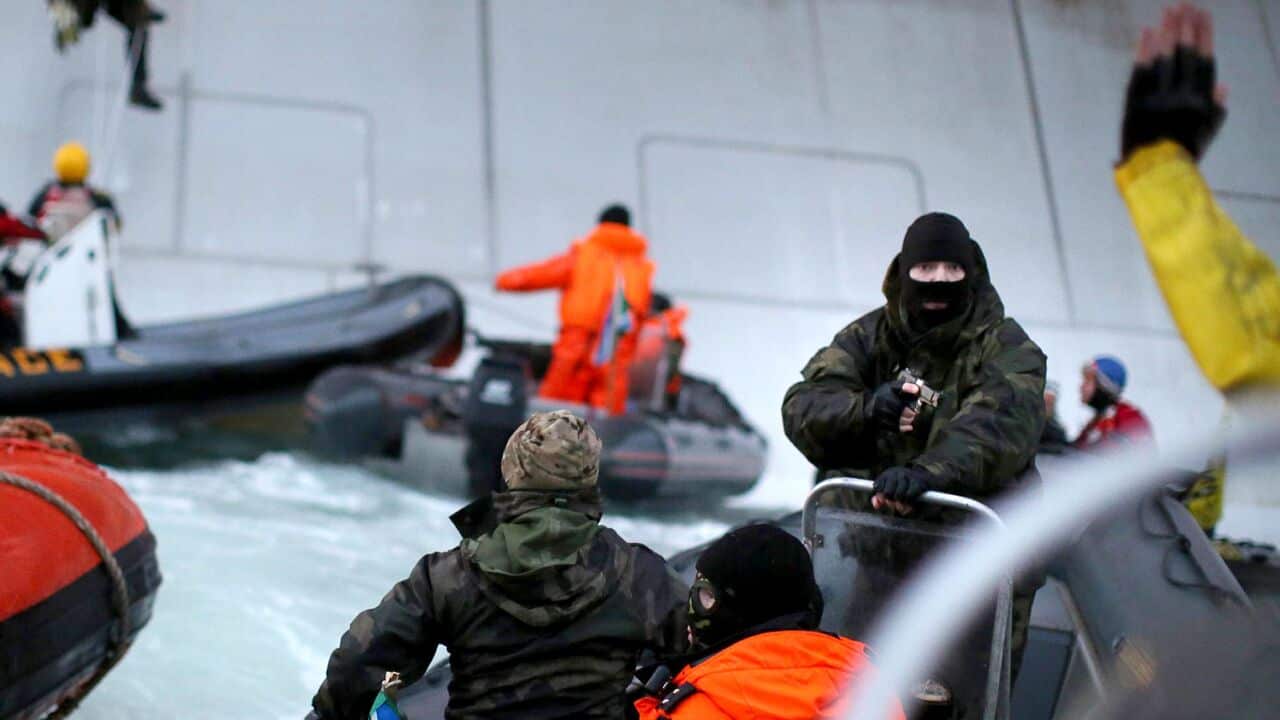
Greenpeace crew members charged with piracy over a protest against Arctic oil drilling are being kept in "inhuman conditions" and transported to and from Russian jails like "chickens at a bad poultry farm", a lawyer says.
Last week, Russian investigators charged all 30 crew members of Greenpeace's Arctic Sunrise ship with piracy, sparking protest rallies around the world.
The activists, who come from 18 countries including Britain and the United States, have been placed in pre-trial detention for two months in the cities of Murmansk and Apatity, nearly 2,000 kilometres north of Moscow and above the Arctic circle.
At a news conference on Monday, a Greenpeace lawyer, Sergei Golubok, said many of the activists did not have access to drinking water or were starving because they could not eat the food in their jails.
"Their detention conditions could not be called anything but inhuman," Golubok told reporters by video link from Murmansk.
News that makes sense
Your trusted source for staying up-to-date with the world around you. Get free daily news updates and analysis, straight to your inbox.
The activists detained in Apatity have to endure hours-long trips in cold prison vans to hearings in Murmansk, he said.
"People are kept in them like chickens at a bad poultry farm," he said.
"No one is receiving adequate health care," he added, noting that some of the activists had to forego prison food over religious considerations.
The activists have also complained of constant video surveillance in their cells including the toilet, he said.
Pre-trial detention centres, which are called Investigation Isolators (SIZO), are not much different from common jails notorious for their filthy conditions and prison abuse.
The activists' problems were compounded by the fact that most of them are foreigners and do not speak Russian, said Golubok.
So simple tasks such as withdrawing money from their bank accounts or asking prison guards permission to open a window become nearly impossible.
"They cannot talk to their relatives by phone because they should speak a language that the detention centres' staff are able to understand," Golubok said.
Last week, the Italian ambassador in Moscow convened a meeting with the ambassadors of several European countries to coordinate their steps to try to secure the activists' release.
A representative of New Zealand foreign ministry acknowledged however that there was little they can do now.
"Our officials are not able to intervene in the judicial process of another country and nor can they try to circumvent the process," a spokesperson for the Ministry of Foreign Affairs and Trade told AFP in emailed remarks.
"This is a legal matter currently before the courts in Russia."







