In brief
- Pauline Hanson has delivered her first ever National Press Club speech on Wednesday.
- Hanson took aim at multiculturalism, immigration and the media.
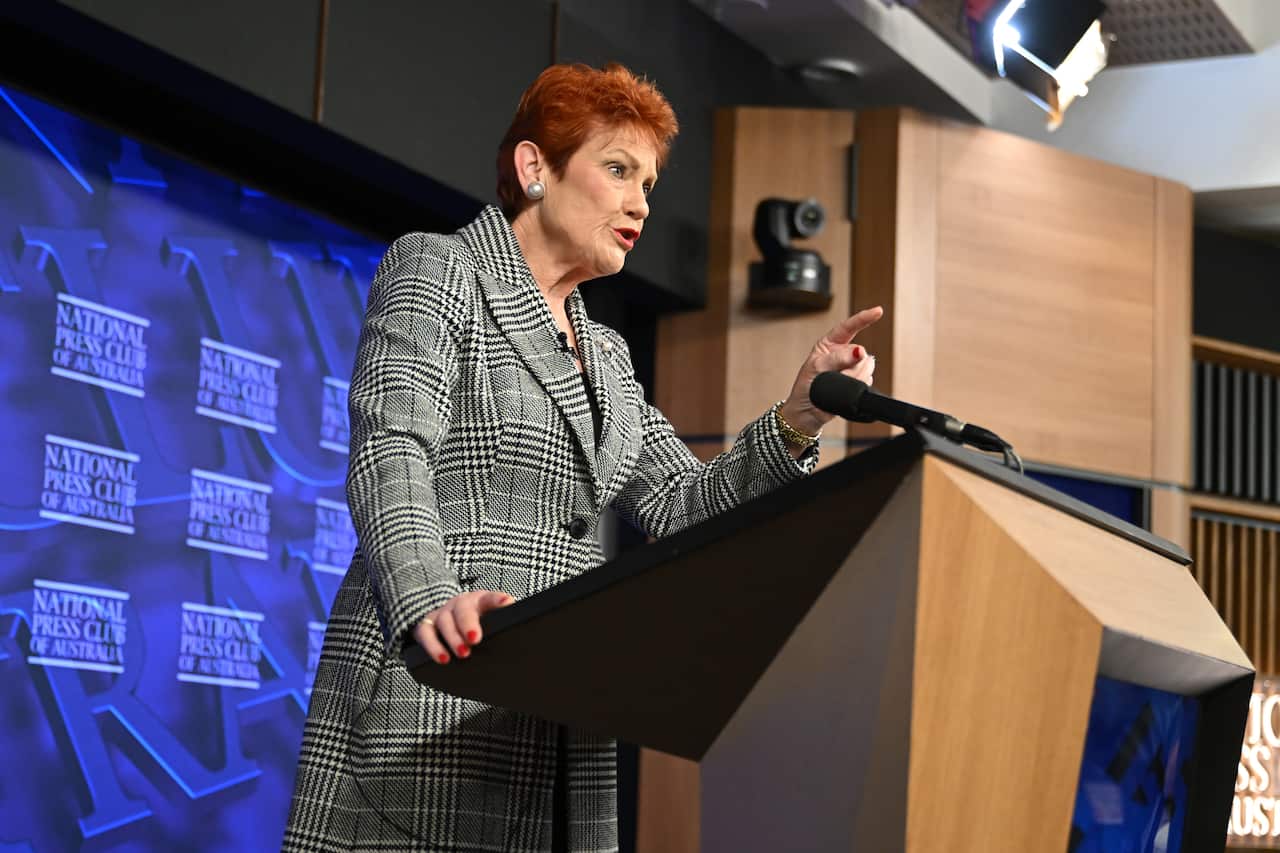
Immigration, multiculturalism and the media were all in the firing line as One Nation leader Pauline Hanson gave her debut National Press Club speech on Wednesday.
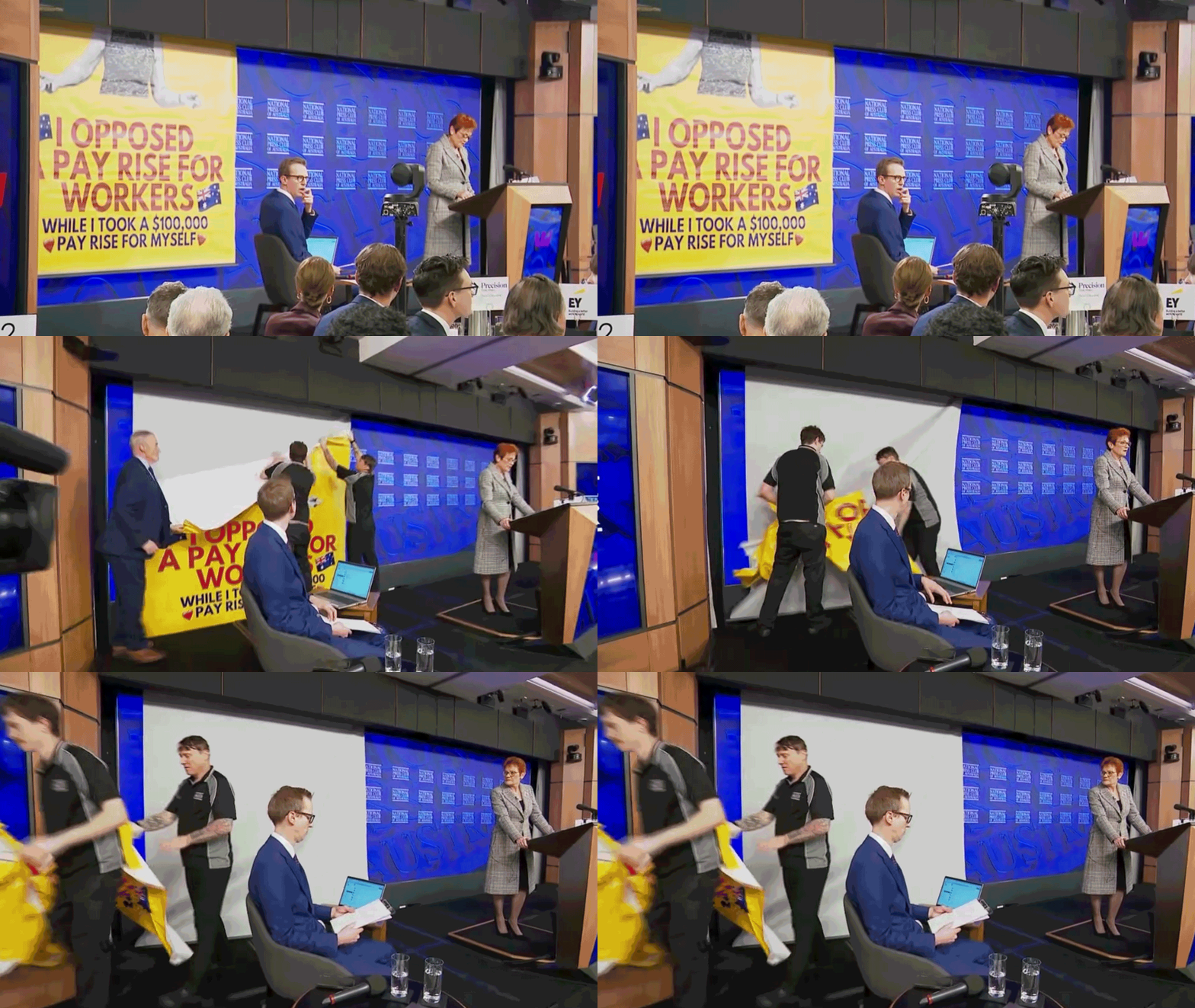
Known for her anti-establishment rhetoric, Hanson appeared in the heartland of Canberra's media to face questions from the press, briefly interrupted as a yellow banner unfurled, accusing Hanson of opposing pay rises for workers.
"Is this another first?" Hanson asked as host, Sky News' Tom Connell apologised for the protest.
The progressive political activist group GetUp! said it was responsible for the protest.
The National Press club said no club personnel or contractors were responsible, and that it had referred evidence to the Australian Federal Police.
News that makes sense
Your trusted source for staying up-to-date with the world around you. Get free daily news updates and analysis, straight to your inbox.
The Press Club said it "sincerely apologises" to Hanson for the incident.
"When the investigation has concluded, the Club will consider its legal options against the perpetrators including recovering costs for the significant damage to the media wall/ light box," the Press Club said in a statement.
In her searing speech pitched to the "bloke in the corner store", Hanson assured the nation: "I haven't changed, and neither has One Nation.
"Australians aren't buying this crap from the political establishment and its media supporters anymore," she said.
Hanson presented a wide-ranging critique of immigration, housing and climate policy, while putting forward One Nation's platform to bring all of Australia under one "cultural umbrella".
Here are the key moments of Hanson's speech.
Taking aim at multiculturalism
When asked if Hanson thought Australia was in danger of being "swamped by Muslims", she replied: "Not if I've got anything to say about it."
The audience applauded.
Hanson outlined a plan to restrict immigration from countries that fostered "radical Islam", echoing US President Donald Trump's "Muslim ban", but did not specify which countries would be included.
She further vowed to deport "hate preachers" who had immigrated to Australia. In response to the Bondi Beach terrorist attack, the government moved this year to tighten powers to crack down on so-called "hate preachers."
Hanson claimed that European nations such as France and Germany were now "s---holes" due to immigration.
"I don't want Australia to become like that," she said.
In Europe and the United Kingdom, anti-immigration sentiment has been linked to the rise of far-right populism. Reform UK's leader Nigel Farage has praised Hanson in the past, telling Sky News in January he admired her "consistency" in politics.
'Common sense' Australians
Hanson outlined a number of policies she argued were "common sense".
"But common sense is not common," she said.
Among them was linking immigration to the housing crisis, having previously proposed an annual cap of 130,000 migrants as a solution.
Net overseas migration has decreased over the past year, with 306,000 arrivals in the 2024/25 financial year. This was down from 429,000 the previous year.
Experts are divided on whether immigration is the main driver of housing stress in Australia.
Hanson also took aim at renewable energy, promising to introduce nuclear power and cut renewables subsidies if elected.
"Don't get me wrong. I'm not opposed to renewable energy," she said.
"But if it's the saviour of the energy crisis and if it's profitable, why would the government have to prop it up?"
She also singled out the trans and gender diverse community and late-term abortions as two areas she would consider for further policy, along with sacking Sex Discrimination Commissioner Anna Cody, and the head of the Human Rights Commission, Hugh de Kretser.
"To abort a baby the day before birth is abhorrent and disgusting, and that’s what I oppose," she said.
"And that's what many common-sense Australians believe."
Late-term abortions are highly restricted in Australia, requiring medical approval in most parts of the country. A pregnancy being terminated immediately before birth is extremely rare and typically only happens under exceptional circumstances.
However, Hanson stopped short of committing to abortion bans similar to those introduced in the United States after the overturning of Roe v Wade.
'The SBS will be gone'
Hanson accused the media of scrutinising One Nation more than other political parties.
"I want truthful, honest reporting from the media," she said.
Among the policy promises, Hanson vowed to scrap SBS, arguing that the "internet has overtaken the need for it".
"Sky News is great to look for news."
An SBS spokesperson said the broadcaster "does not provide commentary on the policies of political parties, consistent with our obligations as an impartial public broadcaster".
SBS provides Australian news in more than 60 languages as part of its charter of providing essential information to post-war migrant communities in languages other than English.
Meanwhile, Hanson said the ABC would move to a subscription-only service, only receiving public funds to operate in regional and remote areas.
She proposed the savings would be used to benefit Australians, but did not specify where the money would be directed.
The ABC and SBS both have legislative frameworks that govern their charter and existence and parliamentary approval would be required to change those acts.
Hanson also singled out a Guardian Australia journalist, who asked a question about the appointment of Hanson's daughter as a political adviser for One Nation.
"I've never seen a person that's such a trashy journalist," she said.
For the latest from SBS News, download our app and subscribe to our newsletter.







