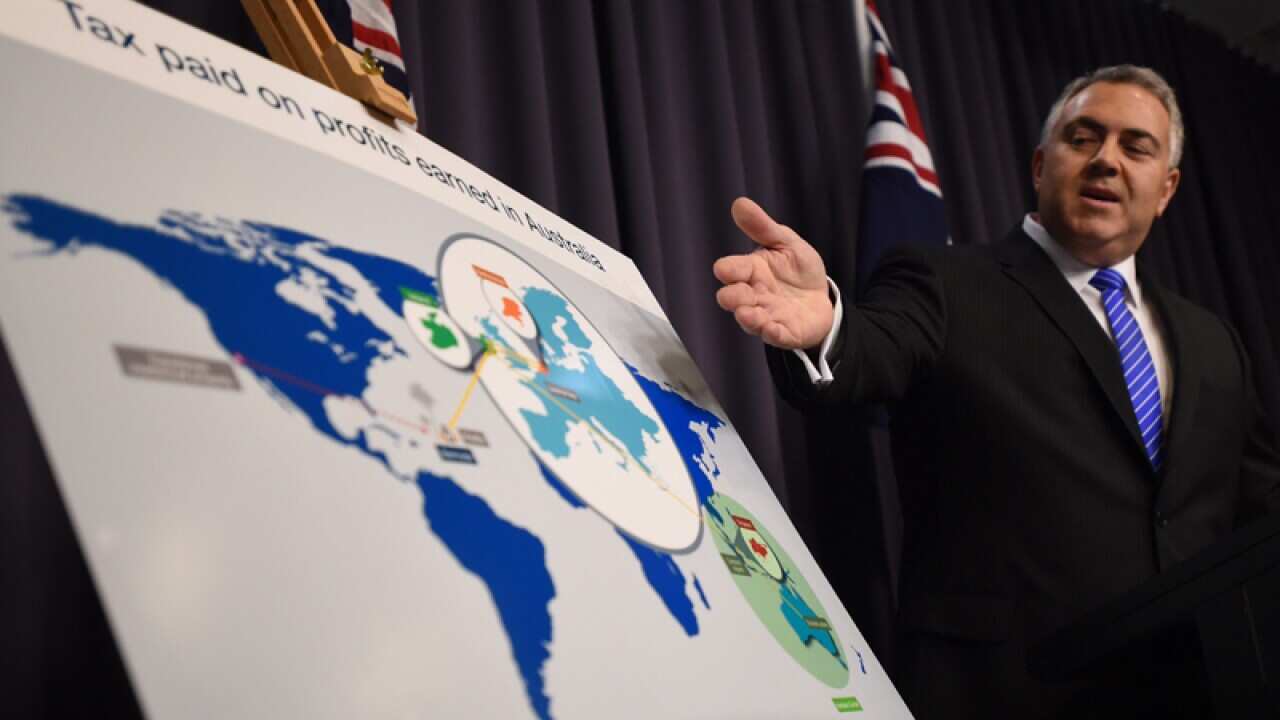
He's been labelled the "phantom" treasurer but on the eve of his second budget Joe Hockey has swooped in with measures that could potentially bring in billions in much-needed revenue.
Opposition parties have lampooned Mr Hockey in recent days for being overshadowed by other ministers, particularly Social Services Minister Scott Morrison, in the run-up to what is a crucial budget for the government and more so the treasurer.
But as parental groups continue to digest the ramifications of Mr Morrison's childcare changes announced on Sunday, Mr Hockey has put big international companies on notice over their tax affairs.
With Tuesday's budget expected to show huge deficits over the next few years at least, every dollar that can be clawed back is crucial.
Mr Hockey will tighten the tax net on about 30 multinational companies who have been diverting profits earned in Australia to low tax jurisdictions through complex arrangements like the much publicised "Double Irish Dutch Sandwich".
The treasurer declined to name which companies the Australian Taxation Office has been embedded in to get a better understanding of how they operate.
Neither would he put a figure on what revenue could be eventually gleaned from these business other than it is expected to run into billions.
"I am not going to make the same mistake that Labor made and bank money that is not identifiable," Mr Hockey told reporters in Canberra on Monday.
Shadow assistant treasurer Andrew Leigh said it was "bizarre" the treasurer could not give a figure.
"He wants to be seen rather than he's got something to say," Dr Leigh told reporters.
But tax experts were pleased Mr Hockey has not followed the path of the UK and introduced a so-called Google tax.
"We already have 125 taxes and charges across Australia and we didn't need another tax adding complexity and confusion," CPA Australia chief Alex Malley said.
He believes existing anti-avoidance provisions provide the tax office with plenty of scope to pursue "artificial and contrived" arrangements.
Mr Hockey also aims to raise $350 million over the next four years by charging GST on overseas digital suppliers of movie downloads, games and e-books who pay nothing at present.
Australian National Retail Association boss Anna McPhee said this finally recognises how the digital economy has changed Australia since the introduction of the GST in 2000.
Finance Minister Mathias Cormann also announced a range of measures with the aim of smaller government, closing about 35 agencies while seeking further efficiencies for other departments, as well as detailing a series of potential asset sales.
Share


