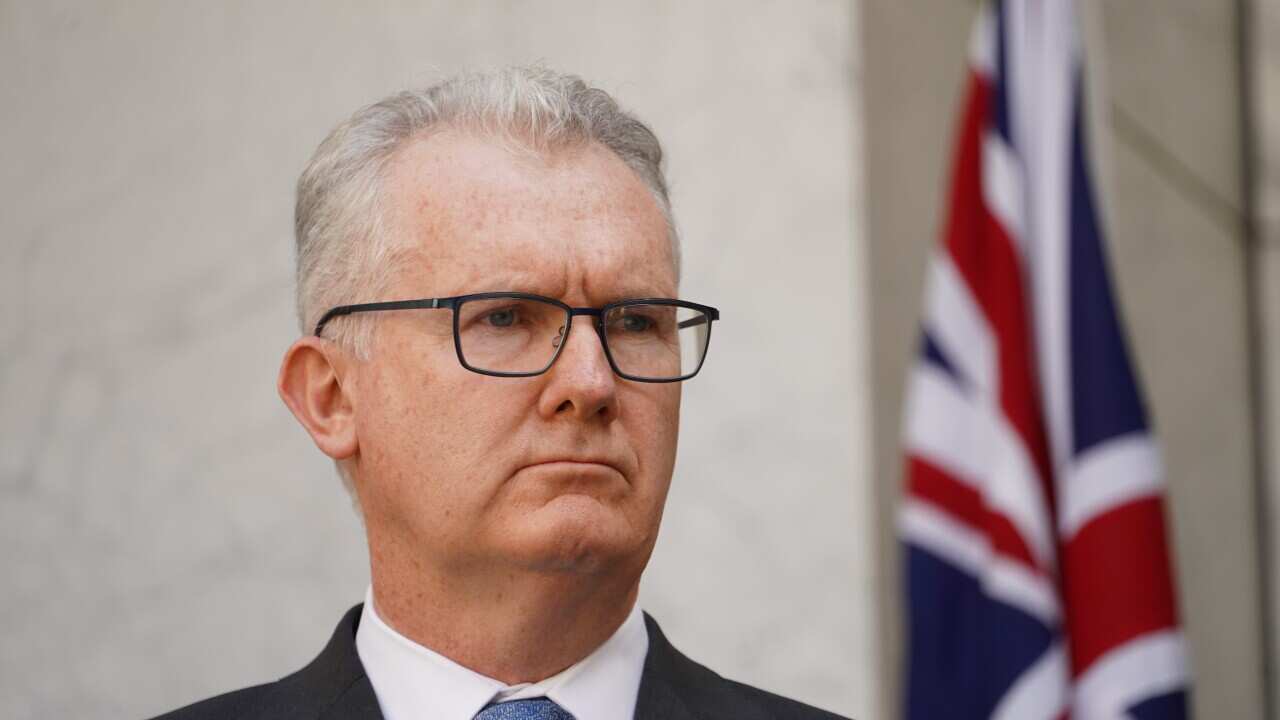
Home Affairs Minister Tony Burke has confirmed a United Kingdom national is facing deportation for allegedly displaying banned Nazi symbols.
The Australian Federal Police (AFP) arrested the 43-year-old earlier this month after an investigation was launched in October into the UK citizen, who allegedly shared the Nazi Hakenkreuz symbol on X and spread pro-Nazi ideology, advocating violence towards the Jewish community.
Weapons, including swords bearing Nazi symbols, axes and knives, were seized from his home in November.
Speaking to ABC News on Wednesday, Burke said when it comes to cancelling visas, he has "no time for hatred".
"If you come to Australia on a visa, you are here as a guest. Almost everyone on a visa is a good guest and a welcome guest in Australia, but if someone comes here for the purposes of hate, they can leave," he said.
News that makes sense
Your trusted source for staying up-to-date with the world around you. Get free daily news updates and analysis, straight to your inbox.
Speaking on proposed changes that would increase the minister's power to cancel visas, Burke said the department currently has to prove someone has engaged in hate speech or vilification, as well as its impact on the Australian community.
"My view is that the incitement of hate should be enough," Burke said.
"That, of itself, says you are not a welcome guest in this country and we should be able to cancel visas on that basis alone."
Earlier this month, South African neo-Nazi Matthew Gruter left Australia after his visa was cancelled for taking part in a rally outside NSW parliament organised by the neo-Nazi group the National Socialist Network.
Gruter was one of 60 black-clad demonstrators who assembled outside NSW parliament, yelling Hitler Youth chants and holding a banner calling to "abolish the Jewish lobby" on 8 November.
Burke said at the time the department was "setting a standard for Australia".
Standing alongside Prime Minister Anthony Albanese on Monday, Burke announced the proposed changes to the minister's power to cancel visas, as well as proposed changes to customs laws to make it easier for hate symbols to be intercepted at the border and establishing a new form of listing for organisations that have not been listed as terrorist organisations.
Burke said on Tuesday: "We want to make sure that those hate preachers who have managed to keep themselves just on the legal side of Australian law, that the threshold is lowered so that those statements that every reasonable Australian has viewed as horrific and as having no place in Australia will become criminal."
"Similarly, for organisations like Hizb ut-Tahrir and the neo-Nazis that have kept themselves just on the legal side of Australian law but never on the side of the Australian community … the thresholds will be lowered to allow them to be listed organisations under a new regime," Burke said.
Hizb ut-Tahrir is a global Islamic political party established in 1953.
Hate crimes database
On Tuesday, a new national database published by the Australian Institute of Criminology was launched to help law enforcement agencies track and tackle hate crimes.
Burke told ABC News the database, which was fast-tracked after the Bondi terror attack on 14 December that claimed 15 lives, is an "extra tool that we have to measure how effective our hate laws are".
According to the National Hate Crimes Database, there were 18 hate-related charges under Commonwealth legislation between July 2024 and June 2025.
While neither the federal nor the state and territory governments have specific 'hate crime' offences legislated, the institute said the data pertains to offences with characteristics that could be interpreted as hate-related under the legislation.
The charges include one offence of threatening force or violence against groups, four offences of public display of prohibited terrorist organisation symbols and 13 offences of public display of prohibited Nazi symbols or giving Nazi salute.
However, the number of offences does not reflect the number of offenders, as one person can be charged with multiple offences.
The dashboard is in its first phase, and Burke said it will be developed further over time.
"I want to, over time to go deeper into this, be able to start getting better categories than we currently have, also potentially look at not waiting for convictions but getting a sense of charges and reports as well."
SBS News has contacted the Department of Home Affairs for comment.
— With additional reporting by the Australian Associated Press
For the latest from SBS News, download our app and subscribe to our newsletter.







