

(Transcript from SBS World News Radio)
It started as a simple gesture of support - but it's growing into a movement.
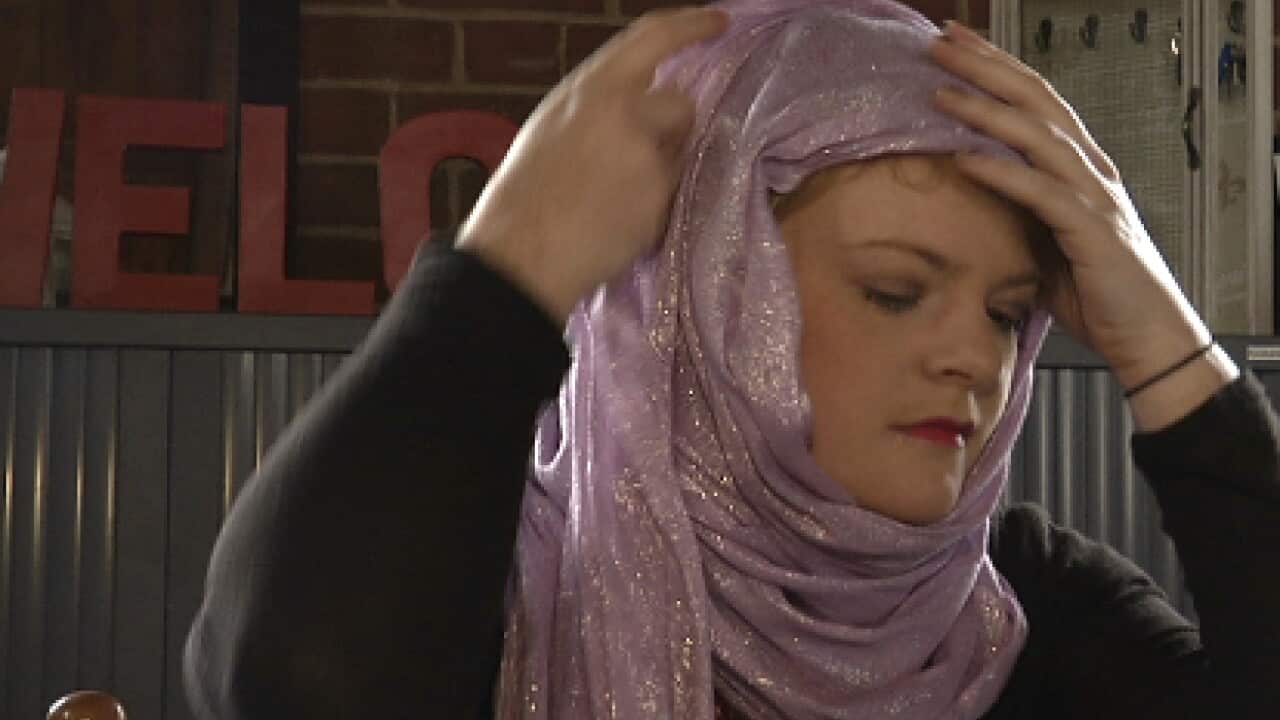
Women across Australia are increasingly wearing scarves draped around their heads as a sign of solidarity with Muslim women.
As Karen Ashford report, it's in response to women who wear Islamic garb reporting rising incidents of abuse and intolerance.
(Click on the audio tab above to hear the full report)
News that makes sense
Your trusted source for staying up-to-date with the world around you. Get free daily news updates and analysis, straight to your inbox.
For a week Kate Leaney, a Christian woman, has donned a scarf on her head in the Islamic tradition before leaving the house.
The refugee advocate is showing support for her many Muslim friends who she fears are increasingly being targeted because of their appearance.
"Friends who've worn hijab for years and years, sometimes decades, and finally feeling scared to do that in public because that was a really visible display of their Muslim faith and they felt targeted for doing that. And these are people so close and so dear to my heart and it broke my heart to see them responding in that way and feeling fear in a country like Australia where no one should feel afraid to show their faith or go out in public, and so I thought about what was something practical and visible I could do to show them that I stand with them and show them that I support their rights to feel safe in Australia."
Out in public the reaction has been largely positive, but there moments of concern.
"I walked into a petrol station, somebody asked me if I was Muslim and I said 'No, obviously I'm not, I'm just wearing this in solidarity with my friends who do identify as Muslim,' and then her response was, 'What are you doing that for? You look like them.' And her change in reaction was so assertive and aggressive straight away."
Far more confronting , Kate Leaney says, has been the reaction to her social media postings.
"The most negative feedback I've had is online, so on Twitter and Facebook and when articles have been published the response I have got from that has been pretty terrifying, being linked to terrorism just because I have chosen to wear a piece of fabric on my head - but then realising that's something I'm exposed to for a week for my own choice, for other people that's their everyday lives."
Ms Leaney's actions have inspired others to follow her lead - often citing personal reasons for participating.
Emma Thompson says she's acting out of concern for women's rights and freedoms.
"I did feel quite nervous before going outside for the first time in my hijab, and that in a way strengthened my convictions as to why I'm doing this. I believe that if you tell someone that they can't wear something, that's just as oppressive as telling someone they must wear something. We're all people, we're all human and it doesn't matter what we wear, what colour our skin is, what we believe in - we're all human and we're all equal. We should be able to live our lives with our differences."
And there are some who identify with no religion who want to show solidarity with family and friends.
Megan Lamb wants to disprove negative media coverage she feels is a slight to her future in laws.
"I've been quite concerned recently with the coverage of Muslim extremists, compared to the Muslim people I know. Also my partner and fiancé's family is Muslim and I don't feel that what's currently being perceived in the community is a reality in regards to the Muslim faith and the people."
Her fiance, Ali Jafari was initially concerned for her safety, but supports her choice.
"I was really worried about her, but after, like, I think the second day, I got a bit less concerned about it. But overall, I'm really, really proud of her."
Before putting on the hijab, the women checked with Muslim friends and leaders to ensure their gesture wouldn't be culturally or religiously offensive.
Young Muslim leader Manal Younus says it's been welcomed at every turn.
"The way that they're wearing it, it's not with that attitude of "Oh I'm going to see what it's like to be a Muslim woman for a day, and I'm going to tell the world about it" or anything like that It was simply "I'm just doing this as an act of solidarity. It's not a campaign, it's just an expression of love. but the fact that they were willing to put themselves out there and show that they supported all Muslims, not just their friends - that was really empowering for me."
In a little over a week, individual gestures of support have morphed into a national movement, perhaps best represented through a social media site called WISH - or Women In Solidarity with Hijabis.
It was set up by Sydney-based campaigner Mariam Veiszadeh on the day that woman in hijab was assaulted and thrown from a moving train in Melbourne.
"These incidents are not rare, we're seeing a lot of reporting coming through with Australian Muslim women in particularly being verbally and physically abused and we need to take a stand. We need to unite together to say no to bigotry and Islamophobia."
If support via the WISH site is any indication, close to 20,000 women agree with her.
Ms Veiszadeh's hope now is for leaders to positively use their power and influence.
"At a federal level however I would love to see some of our politicians who perhaps are a little bit obsessed with discussing Muslim women's dress, for them to perhaps don a hijab and get behind this campaign."