
Key Points
- The federal government has committed $750 million to build 300 new Bushmaster vechicles.
- The Australian-designed and made vehicles are now used by nine defence forces around the world.
It's an armoured troop carrier that's protected Australians in Iraq and Afghanistan, and more recently had a substantial impact in Ukraine's war against Russia.
Now known as the Bushmaster, initial prototypes were affectionately dubbed "battle taxis".
The military vehicle has evolved since its conception in the 1980s and is now used in eight countries outside Australia.
On Monday, Deputy Prime Minister Richard Marles announced a $750-million-spend to build 300 new Bushmasters in Bendigo, north-west of Melbourne, as part of a $1.2 billion defence boost.
"The Bushmaster is the very best protected mobile vehicle for armies anywhere in the world. It saves lives," Marles said.
News that makes sense
Your trusted source for staying up-to-date with the world around you. Get free daily news updates and analysis, straight to your inbox.
Built at a rate of about 50 a year, some of the vehicles will be sent to the Netherlands. While the precise number is unknown, 268 Bushmasters are earmarked for the Australian Defence Force (ADF).
Another $450 million will be used to upgrade Hawkei protected mobility vehicles.
So what makes the Bushmaster unique and drives its demand?
What is a Bushmaster?
The Bushmaster is a protected mobility vehicle designed to rapidly deploy up to 10 army personnel safely, moving them around or closer to the battlefield.
Michael Shoebridge, director of defence and security think tank Strategic Analysis Australia, said that its V-shaped hull, rather than a flat one, "deflects blasts from large improvised explosive devices or landmines".
"So the vehicle can be badly damaged, but the people inside will be safe," he told SBS News.
The inside of the vehicle is lined with spall liner material, which Shoebridge said "prevents shrapnel from damaging or injuring people inside the vehicle".
For over 25 years, the vehicles have been used by the Australian Defence forces, and regarded quite highly.
But Shoebridge said the design needs to evolve to counter newer threats including drone weapons, and suggested perhaps optimising the remote weapon station.
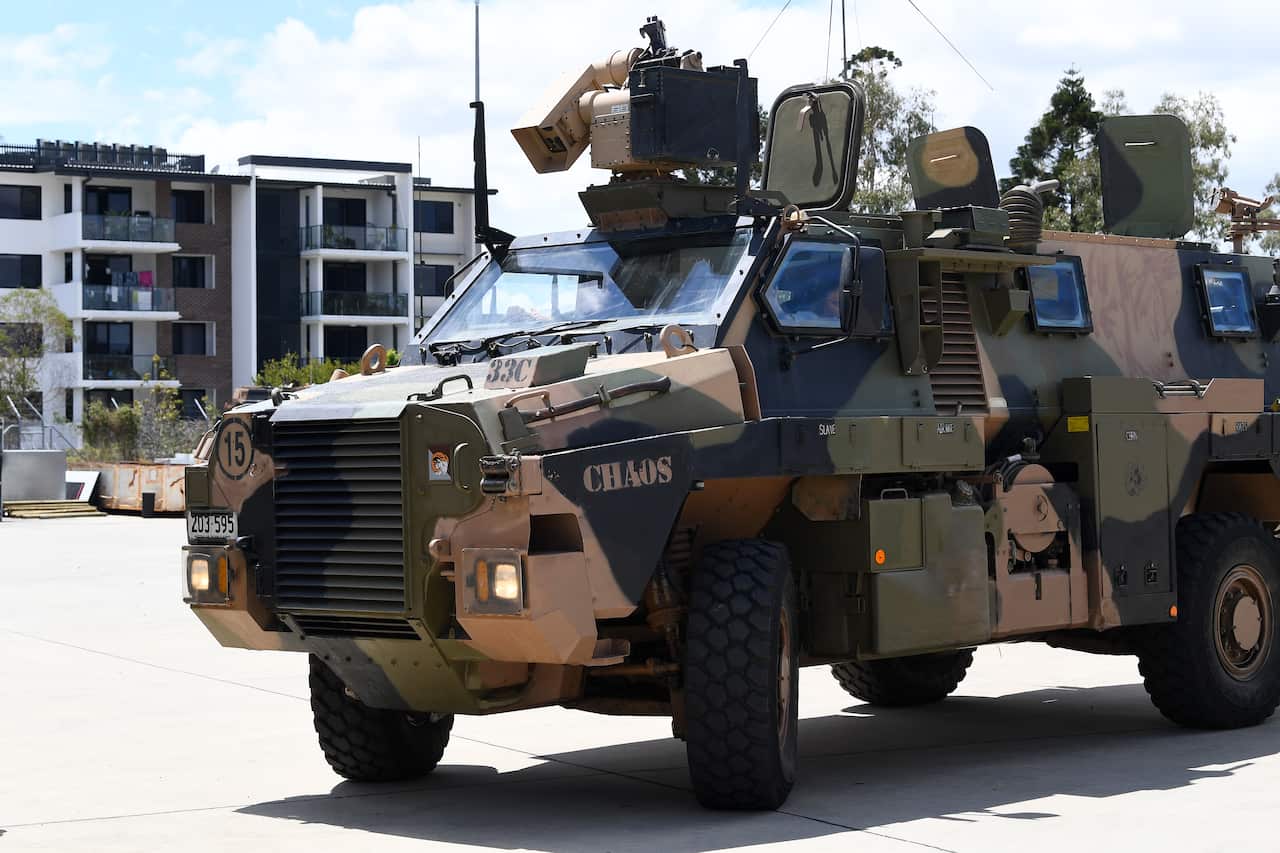
Malcolm Davis, senior analyst in defence strategy at the Australian Strategic Policy Institute, agrees, suggesting new iterations be equipped with counter-drone defence systems.
"I think probably one of the most promising (solutions) are directed energy weapons like high-energy lasers or high-power microwave systems that can essentially take down a drone at reasonably short range," he said.
Davis said the lightness of the vehicle is its main disadvantage.
"It's not a tank, it's not an infantry fighting vehicle like the Redback, so it's not as survivable against direct fire from heavy weapons," he said.
From 'battle taxi' to Bushmaster
Brendan Nicholson is the author of The Bushmaster: From concept to combat. The former journalist, with a career spanning five decades, specialised in defence and foreign affairs.
He told SBS News that part of the unique design was discovered in South Africa in the 1980s.
A need for the Bushmasters had emerged amid growing fears that Australia may be involved in a confrontation with another country, requiring small teams of special forces to be deployed in northern Australia.
"Seems bizarre now, but the idea was that troops would need to be sent to track down these infiltrators," he said.
"And it was likely that if they were enemies special forces, they'd be creating improvised bombs by stealing diesel and fertiliser from cattle stations and small villages."
Nicholson said the fear was so real that specialist forces were sent around the world to examine various technologies to withstand that kind of threat.
It was Australian troops on United Nations peacekeeping missions in Namibia that saw how vehicles with a V-shaped hull, now synonymous with the Bushmaster, withstood damage against devastating landmines.
The first two prototypes were deployed to Timor-Leste in 1999 as part of Operation Stabilise.
They assisted in providing secure transport to VIPs, including Xanana Gusmão, who was to become the new nation's first president.
This protection eventually earned them the nickname "battle taxis".
Why is it gaining prominence now?
Fighting by allied forces in Afghanistan and Iraq demonstrated the value of the Bushmaster, according to Shoebridge and Nicholson.
Shoebridge said Canadians and British forces, fighting alongside Australians, suffered much higher casualty numbers in Afghanistan.
"A lot of that is attributed to the Bushmaster, because there were multiple IED attacks on the vehicles, but it saved lives every time. So I think it's seen very affectionately by the Australian military," he said.
The Dutch also witnessed the effectiveness first-hand in Afghanistan, perhaps spurring their recent acquisition.
"I think there's changed thinking in Europe now about the more real security threat, particularly given the less reliable American alliance," Shoebridge said.
"That means that European militaries are investing more now, and the Bushmaster would make a lot of sense for protecting their own troops."
Bushmasters are used by New Zealand, the United Kingdom, Japan, the Netherlands, Indonesia, Fiji, and Jamaica.
In 2023, the federal government gifted 120 Bushmasters to Ukraine in its efforts against Russia, which have been particularly effective for things like evacuating wounded soldiers.
Shoebridge said providing further Bushmasters to Ukraine would give the ADF "valuable operational experience" as it improves its systems.
"And if there's a military that understands counter-drone warfare and could help optimise the Bushmasters systems for that, it's the Ukrainians," he said.
"So there'd be a direct advantage to Australia by giving Ukraine more of these vehicles."
For the latest from SBS News, download our app and subscribe to our newsletter.







