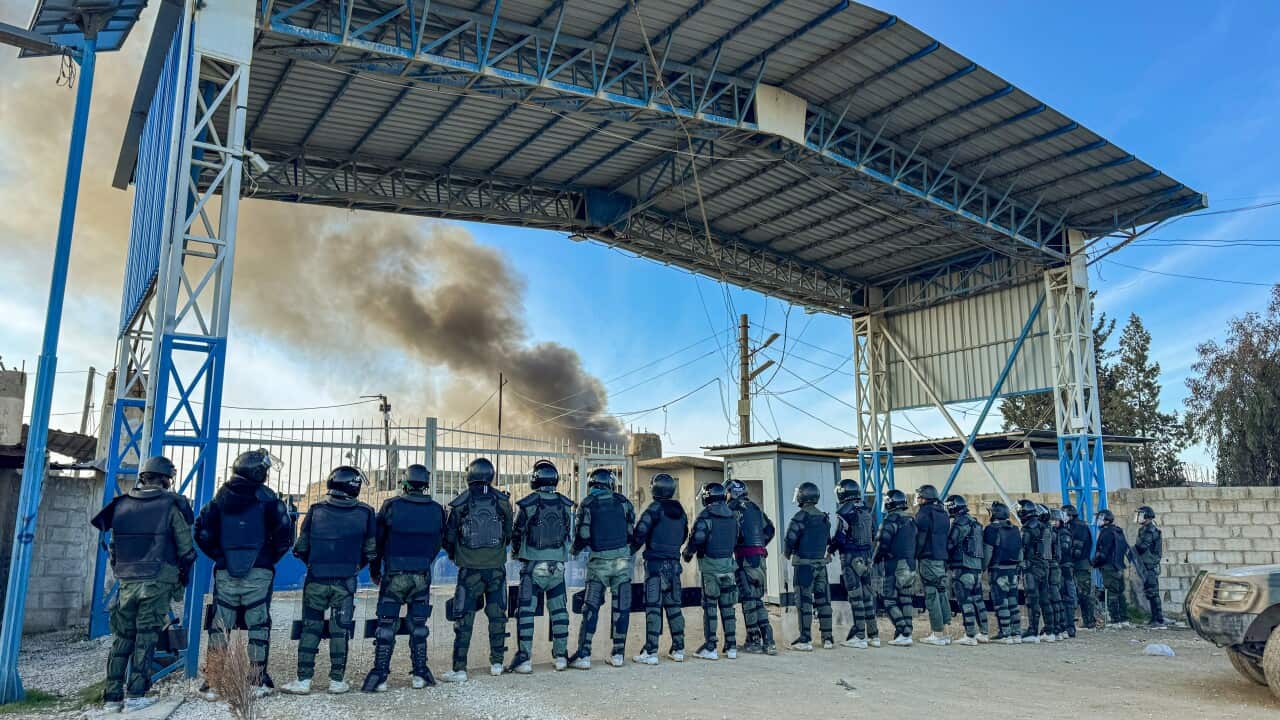
IN BRIEF
- The al-Roj and al-Hol camps are home to thousands of individuals suspected of having links to the IS group.
- The shift in control has already come with consequences, as many have already fled the camp.
Years of scaled-back US presence and shifting political dynamics inside Syria led to a shot at returning home last week for a group of Australians held in Syrian camps, before their window closed again.
A group of 34 Australian women and children with alleged links to the self-proclaimed Islamic State (IS) group attempted to travel to Damascus from al-Roj camp in north-east Syria, in mid-February. Their goal was to return to Australia from there.
Their trip was halted when Syrian officials denied exit permission, and the Australian government has been adamant it will not assist their return and may charge the women if they do return.
The group of 23 children and 11 women, who are the family of IS group fighters, were taken to internally displaced person camps after the fall of the IS group caliphate in 2019.
After seven years of harsh conditions in the camp and an uncertain future, they found an opportunity to leave amid a shifting political climate in Syria.
News that makes sense
Your trusted source for staying up-to-date with the world around you. Get free daily news updates and analysis, straight to your inbox.
Reportedly, they followed a decision by officials at al-Roj camp to allow detainees with valid travel documents to leave — a significant shift in how camps are managed.
Previously, the camps had been run by Kurdish forces, with support from the US. But, as the US announced it would pull back support for the Kurds earlier this year, power is transitioning to Syrian government forces.
Experts say the power transfer in the region leaves thousands of people in the camps with more uncertainty, and could mean a risk of rising support for the IS group.
'If not managed correctly'
The al-Roj and al-Hol camps are home to thousands of individuals suspected of having links to the IS group, after the group's caliphate was defeated in Syria in 2019 by the Kurdish-led Syrian Democratic Forces (SDF), with backing from a coalition led by the US.
"These camps are really significant, firstly, because of the large numbers of people that are housed in them," Dara Conduit, a political science lecturer at Melbourne University, said.
"Human rights organisations have raised concerns over the last few years about the conditions in these camps, but they're also really significant because of the risk that they represent if they're not managed correctly."
But since the fall of the Assad regime in Syria in 2024, US support for the SDF has weakened, with the president building new ties with the new Syrian government and its president, Ahmed al-Sharaa.
On 13 February, the acting US ambassador to the United Nations, Dorothy Shea, told the UN Security Council that the country's assistance on the camps "cannot last forever" and urged "countries to expeditiously repatriate their displaced and detained nationals".
This has led to changes in how the camps are managed.
Conduit said the US' personnel withdrawal from Syria "reflects the changing political environment in Syria [and] the maturing of the relationship between the US".
"Previously, the Kurdish forces in north-eastern Syria were the only party that the US could work with in Syria against the Islamic State Group. The US is now working successfully with the Syrian government in anti-Islamic State campaigns," she told SBS News.
But, Conduit also said if the camps are not "guarded properly", it will provide an opportunity to IS to "regroup".
"The Islamic State Group today is very different to what it was back during its peak in 2015," she said, adding that it is more likely to carry out urban operations.
"The Islamic State Group is not going to be able to come back immediately like it was previously. But certainly, some of these people are highly radicalised individuals who do believe in the Islamic state's social projects, and that is a destabilised force."
Uncertain future for internally displaced people
In January, the Syrian government announced that both camps would close soon. While al-Roj is still under SDF control, al-Hol's control has been transferred to Syrian authorities.
Mehmet Özalp, head of the School of the Centre for Islamic Studies and Civilisation at Charles Sturt University, said it is part of the Syrian government's policy "to take full control of the country as the single government and single authority, whether that's sovereignty or military authority".
"The Kurdish region is a problem in that respect for them, for the government. So they would like to take full control of any legal, military, or government authority in that part of the country," he told SBS News.
"We [are] just seeing the repercussions of that greater struggle within Syria and the greater struggle on the camps."
The shift in control has already come with consequences, as many have already fled the camp.
Syrian authorities have blamed the SDF for a "mass escape" earlier in the year, saying the group withdrew from al-Hol without coordination with the government, while the SDF responded they were to leave to "avoid turning the camp into an open battlefield".
At the same time, the US Central Command said in a statement that it had launched an operation to move IS-linked prisoners from Syria to Iraq to "ensure the terrorists remain in secure detention facilities."
Özalp said that "there could be negotiations happening behind the scenes between the current Syrian government and the United States, [on] what to do with" those held in the camps.
Conduit warned that the impact of the closure of the camps "is that there are large numbers of former supporters of the Islamic State Group and victims of the Islamic State Group that are being released".
"In some cases, that creates security issues. And in many cases, that creates serious human rights issues.
"These children in particular are victims of the Islamic State Group as much as anybody else. A lot of these children were basically trafficked across the world by their parents and have been forced to grow up in these inhumane conditions.
"Their fate is actually a human rights and rights of the child issue."
On Monday, Human Rights Watch (HRW) warned that the "wellbeing of about 8,500 people held in camps ... remains uncertain".
Prime Minister Anthony Albanese has insisted the government will not assist the 34 women and children — who are Australian citizens — in returning to Australia, and said they will face the full force of the law if they return.
He said he has "nothing but contempt" for the women who travelled to Syria amid the rise of the IS group.
Khalid Ibrahim, a Syrian Kurd serving as a senior official with the Foreign Relations Department of the Autonomous Administration of North and East Syria, told SBS Kurdish that responsibility for their futures rests with Australia.
Ibrahim said the women and children's futures were uncertain in the camp, and shared fears they could become a threat if they were not repatriated or moved to another state.
"Children are innocent. If a country does not take care of them, we are afraid that they will become radicals and become members of a new terror, continue their war in another way and unfortunately, people don't know what will happen," he said.
An 'intergenerational plan'
The camps house approximately 28,000 people, with about 12,500 being foreigners from more than 60 countries, according to HRW.
Those in the al-Roj camp, including the 34 Australians — which is still under SDF control — are also facing brutal conditions, with HRW reporting the women in the camp experiencing near nightly raids by the Asayish, Kurdish internal security forces.
Conduit said that any extension of the women and children's time in Syria may work to serve the agenda of the IS group.
"A central part of [the IS group] ideology, and one of its key mobilising principles, was the idea of building a caliphate and the idea of building this alternative life to what a lot of these people were experiencing in the West," Conduit said.
"And part of this caliphate was this building of this intergenerational model ... Women and children in this camp are part of that intergenerational plan.
"Their ongoing presence there, the fact that they are being mistreated, and they are potentially being exposed to further drivers of radicalisation means that a lot of this serves the longer-term interest of the Islamic State group."
On the other hand, Özalp said there is "no evidence" that those in the camps are "used for further radicalisation".
"These people were probably radicalised in the first place ... Syria has moved on, the country has moved on, the world has moved on, and people's ideas and ideologies change over time. And they could shift in any direction," he said.
"We just don't know. We don't have information."
For the latest from SBS News, download our app and subscribe to our newsletter.







