

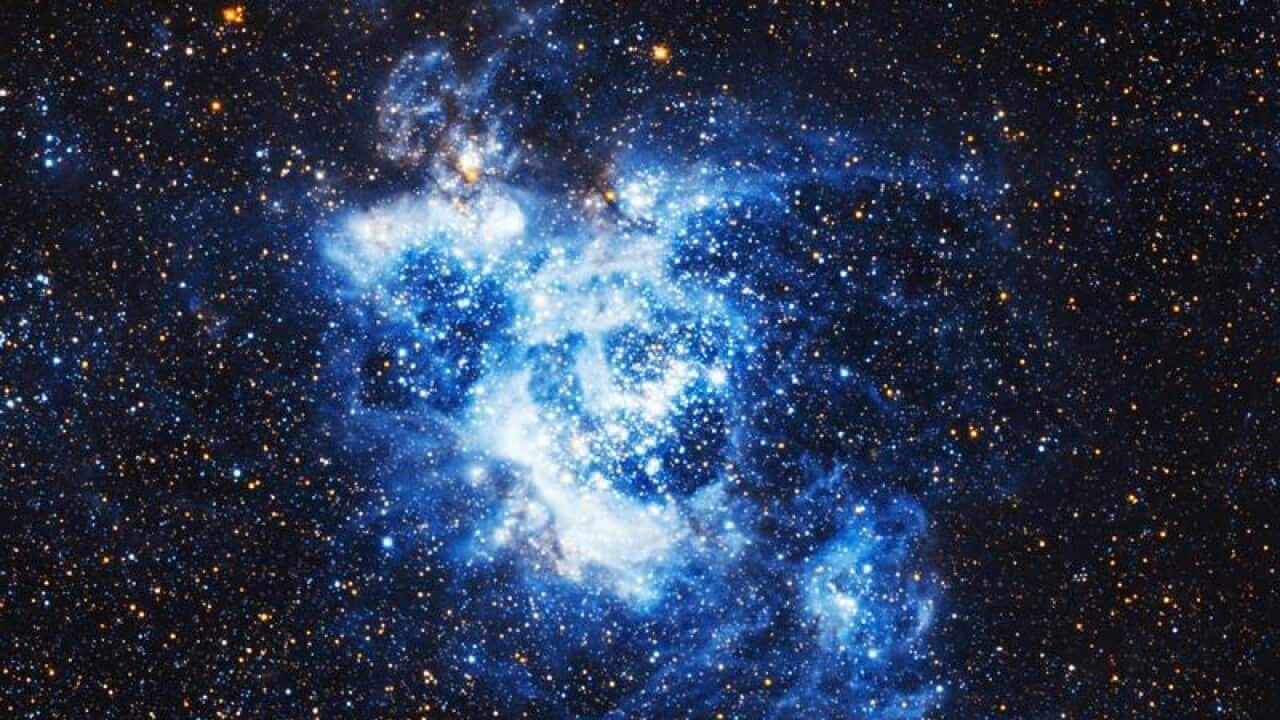
The most detailed image yet of a 40-billion star neighbouring galaxy has been captured by the Hubble Space Telescope.
The Triangulum Galaxy, located three million light years away from the Milky Way, is one of the most distant objects visible to the naked eye.
Under dark-sky conditions, it appears as a faint, blurry object in the constellation of Triangulum (the Triangle) and is a target for amateur astronomers.
But in a new 665-million pixel image taken by the NASA/European Space Agency (ESA) Hubble Space Telescope, the spiral galaxy's billions of stars are brightly showcased.
The spectacular vista is in fact a giant mosaic, formed from 54 separate images created by Hubble's Advanced Camera for Surveys.
As the second-largest image ever released by Hubble, it encompasses the central region of the galaxy and its inner spiral arms.
Millions of stars, hundreds of star clusters and bright nebulae are visible.
Triangulum, also known as Messier 33 or NGC 598, is part of the Local Group - a collection of more than 50 galaxies, including the Milky Way, that are bound together by gravity.
According to the ESA, it is the group's third-largest galaxy, but also its smallest spiral galaxy.
It measures only about 60,000 light years across, compared to the 200,000 light years of the much bigger spiral Andromeda Galaxy.
By comparison, the spiral Milky Way is about 100,000 light years in diameter.
In contrast to the two larger spiral galaxies, Triangulum does not have a bright bulge at its centre - and it also lacks a bar connecting its spiral arms to the centre.
The ESA said that the galaxy contains a huge amount of gas and dust, giving rise to rapid star formation.
The Andromeda Galaxy was mapped by Hubble in 2015, creating the sharpest and largest image of this galaxy and the largest Hubble image ever.