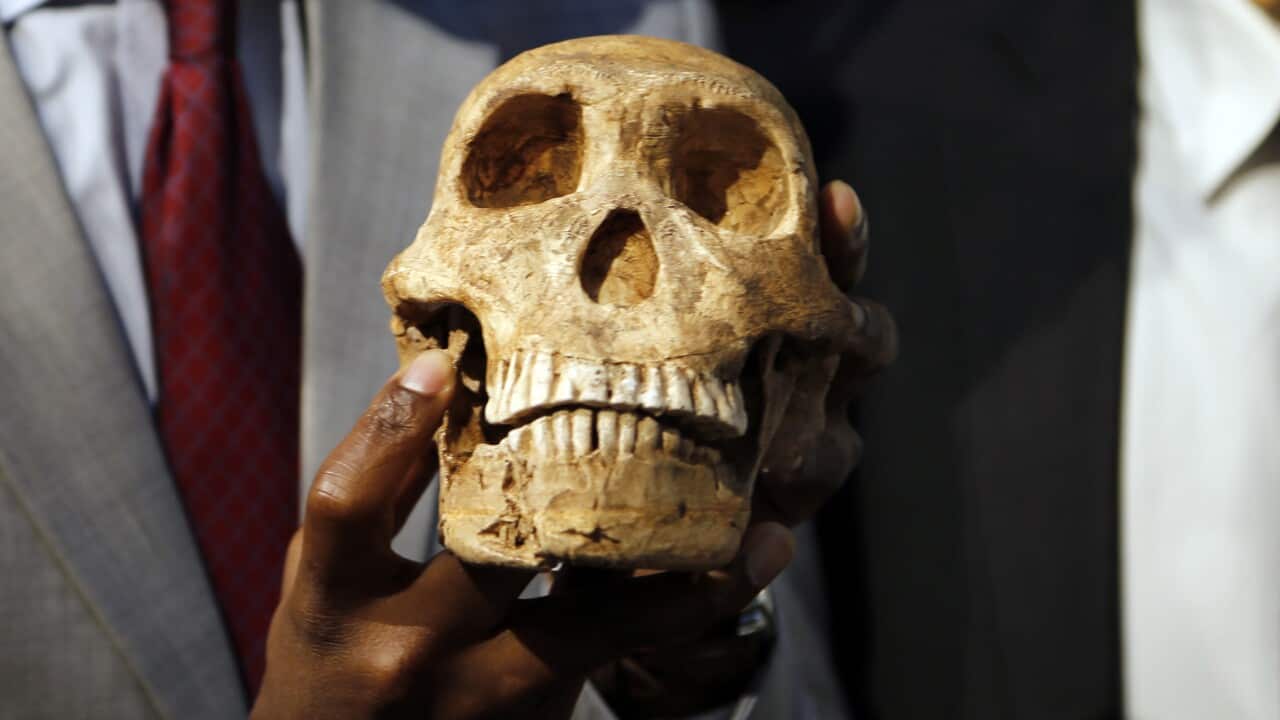
Just where the last common ancestor between chimps - our closest relatives - and humans existed is a matter of hot debate in the scientific community.
The new hypothesis, released on Monday, says the origin of mankind is based on 7.2 million-year-old pre-human remains found in caves in Greece and Bulgaria.
Researchers from France, Germany, Bulgaria, Greece, Canada and Australia analyzed the dental roots of two known specimens of the fossil hominid Graecopithecus freybergi.
Using a specialized X-ray known as computer tomography to scan a lower jaw from Greece and an upper premolar from Bulgaria, they found characteristics suggesting these ape like creatures - nicknamed "El Graeco" - were likely pre-humans, or hominids.
News that makes sense
Your trusted source for staying up-to-date with the world around you. Get free daily news updates and analysis, straight to your inbox.
"We were surprised by our results, as pre-humans were previously known only from sub-Saharan Africa," said co-author Jochen Fuss, a researcher at the University of Tubingen.
The findings also showed Graecopithecus is far older than the oldest known potential pre-human from Africa -- Sahelanthropus from Chad, which is six or seven million years old.
The fossil in Greece was dated to 7.24 million years, while the Bulgarian one was 7.175 million years old, said the report in the journal PLOS ONE.
"This dating allows us to move the human-chimpanzee split into the Mediterranean area," said co-author David Begun, a University of Toronto paleoanthropologist.
Environmental changes may have helped drive the evolution of pre-human species, separate from apes, said co-author Madelaine Bohme, a professor of human evolution at the University of Tubingen.
"The incipient formation of a desert in North Africa more than seven million years ago and the spread of savannahs in Southern Europe may have played a central role in the splitting of the human and chimpanzee lineages," said Bohme.
The two fossils were found in sediment that contained red-colored silts "and could be classified as desert dust," said the report.
"These data document for the first time a spreading Sahara 7.2 million years ago, whose desert storms transported red, salty dusts to the north coast of the Mediterranean Sea in its then form," it said.
Severe droughts and wildfires may have forced apes to seek out new food sources, and begin walking upright more often.







