The bill passed on Tuesday bans face-covering veils everywhere that can be considered public space and is seen as part of a determined effort to define and protect French values.
It has disconcerted many in the country which has Europe's largest Muslim population, about 5 (m) million of the country's 64 (m) million people are believed
News that makes sense
Your trusted source for staying up-to-date with the world around you. Get free daily news updates and analysis, straight to your inbox.
to be Muslim.
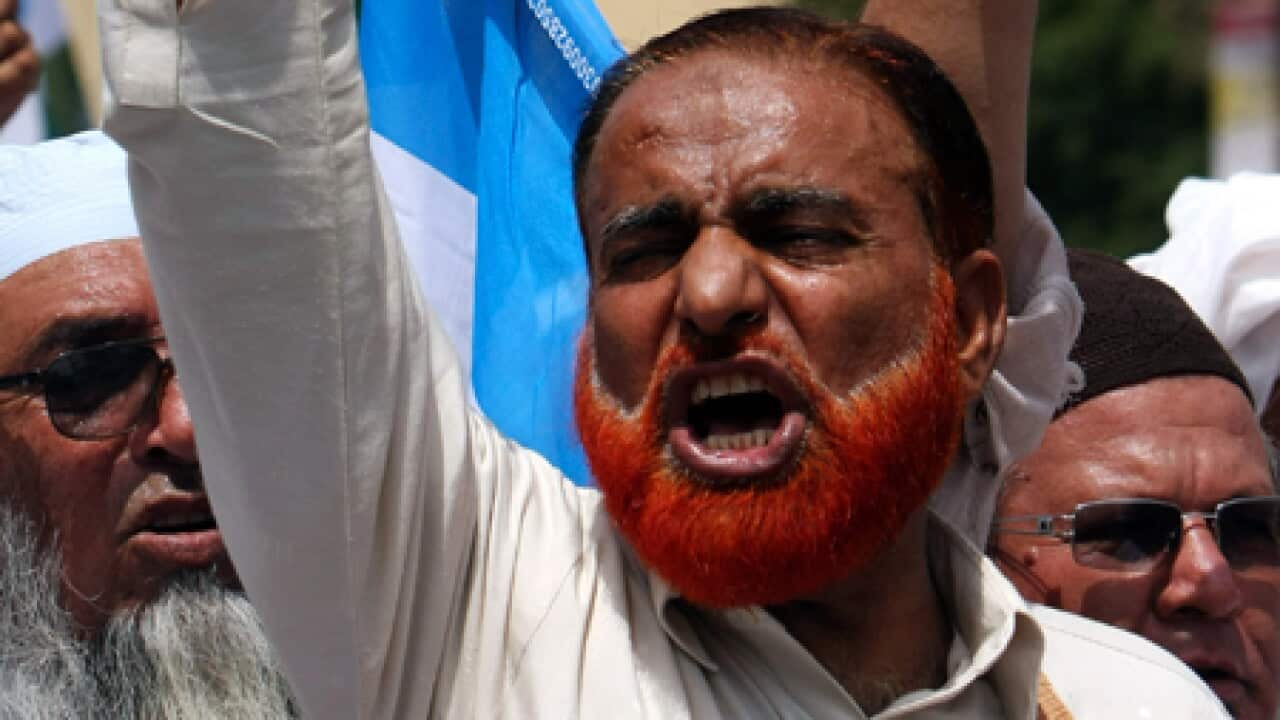
Speaking at the rally on Sunday, Mohammad Hussain Mehnati, Chief of religious Jamaat-e-Islami (JI) party in Karachi, demanded that the United Nations take immediate and appropriate action on France.
"Before passing a bill in the parliament, the government of France has to realise that Muslims are living all over the world including France and other EU countries and they don't have to make a law against Muslims," he said.
"The veil is a part of our religion and the UN charter also permits the religious freedom and no government is allowed to create a problem for any religious group because they practise their own religion," he added.
Protesters at the rally held a banner reading, "Down with the West, We Condemn ban on Hijab", even though the law would cover the niqab, a robe which covers the whole body and face, leaving just the eyes exposed, and the burqa, which is similar but in which a mesh covers the eyes too.
It is not targeting the hijab, the headscarf worn by many Muslim women which covers the hair, leaving the face exposed.
While ordinary headscarves are common in France, only about 1,900 women are believed to wear face-covering veils.
Proponents of the law say face-covering veils don't square with the French ideal of women's equality or its secular tradition.
The bill is controversial abroad but popular in France, where its relatively few outspoken critics say conservative President Nicolas Sarkozy has resorted to xenophobia to attract far-right voters.
The ban on burqas and niqabs will go in September to the Senate, where it also is likely to pass.
The issue has been debated across Europe, and Spain and Belgium have similar bans in the works.







