Hungarian authorities says police have made the first arrests under harsh new laws coming into force punishing "illegal border-crossing" with prison terms of up to three years.
"Today, 60 people have been caught by police cutting or damaging the fence, 45 at the border, the other 15 further inside the country. Police have launched criminal procedures against them," said Gyorgy Bakondi, Prime Minister Viktor Orban's chief adviser.
The new laws which came into force on Monday are part of Orban's strategy to stem the flow of migrants - more than 200,000 so far this year - travelling from Greece through the western Balkans and into the EU country, most of them on their way to Germany and elsewhere in the 28-member bloc.
Hungarian authorities also on Tuesday effectively sealed the border with Serbia, blocking off a gap in a razor-wire barrier where many of the migrants passed through, as well as two official border crossing points.
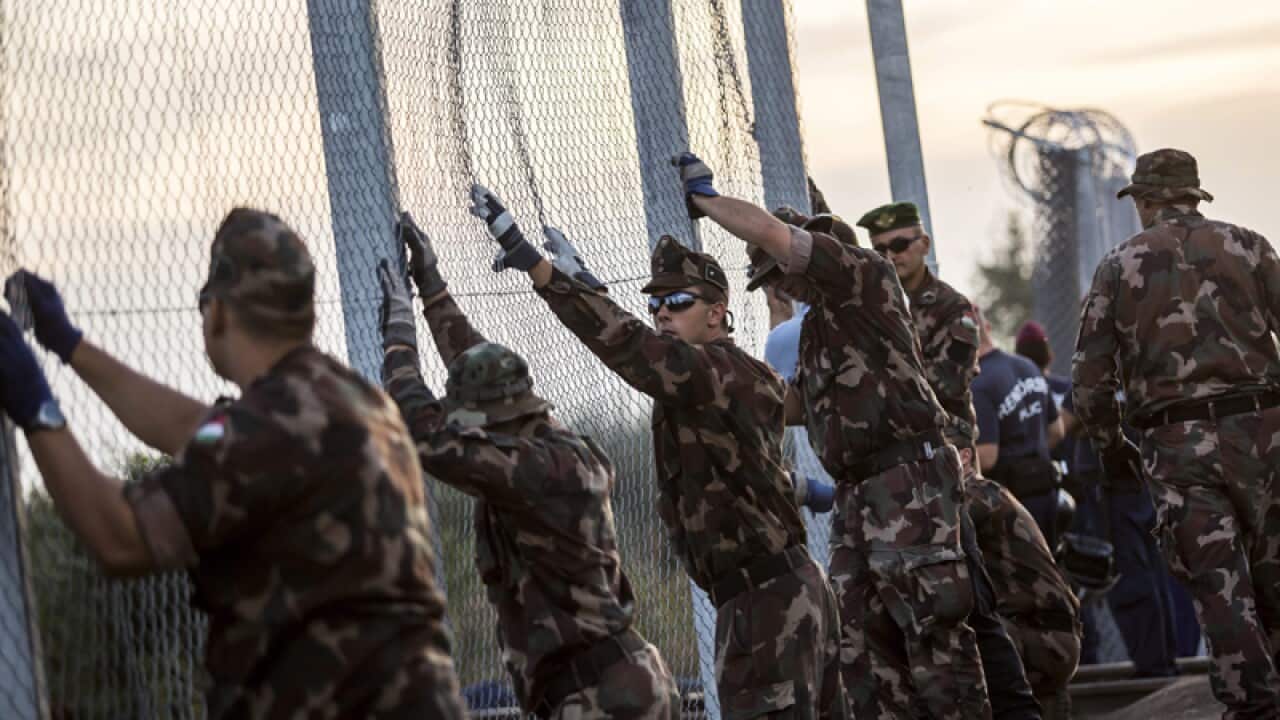
Equally controversially, Hungary is also building a four-metre high fence along its entire 175-kilometre border with non-EU Serbia and plans to deploy the army.
Under the new laws, crossing the border illegally can result in a prison term of up to three years, rising to five years if people damage the razor-wire barrier or the fence.
The government on Tuesday also announced the creation of two "transit zones" at the main crossing point at Roszke and at Tompa to the west to fast-track asylum claims made by migrants entering at official border crossings.
If the asylum claims are rejected - which with Budapest saying that many of the new arrivals are not, strictly speaking refugees, is highly possible - then the migrants can be expelled.
"The people in the transit zones are legally speaking not in Hungarian territory, similar to transit zones in an airport," government spokesman Zoltan Kovacs told a joint news conference with Bakondi.
"The transit zones are in operation, completely conforming with Hungarian and international law. Twenty asylum requests are already being processed, the number of illegal border-crossers has already reduced significantly," Kovacs said.
"The message we want to send is, 'don't come, this route will not take you to your destination'," Bakondi said. "Our information suggests that the migrants and also the traffickers have got the message."
The Hungarian government on Tuesday also declared a "state of crisis" in the two southern counties of Bacs-Kiskun and Csongrad, giving police additional powers, including to confiscate vehicles.
Share


