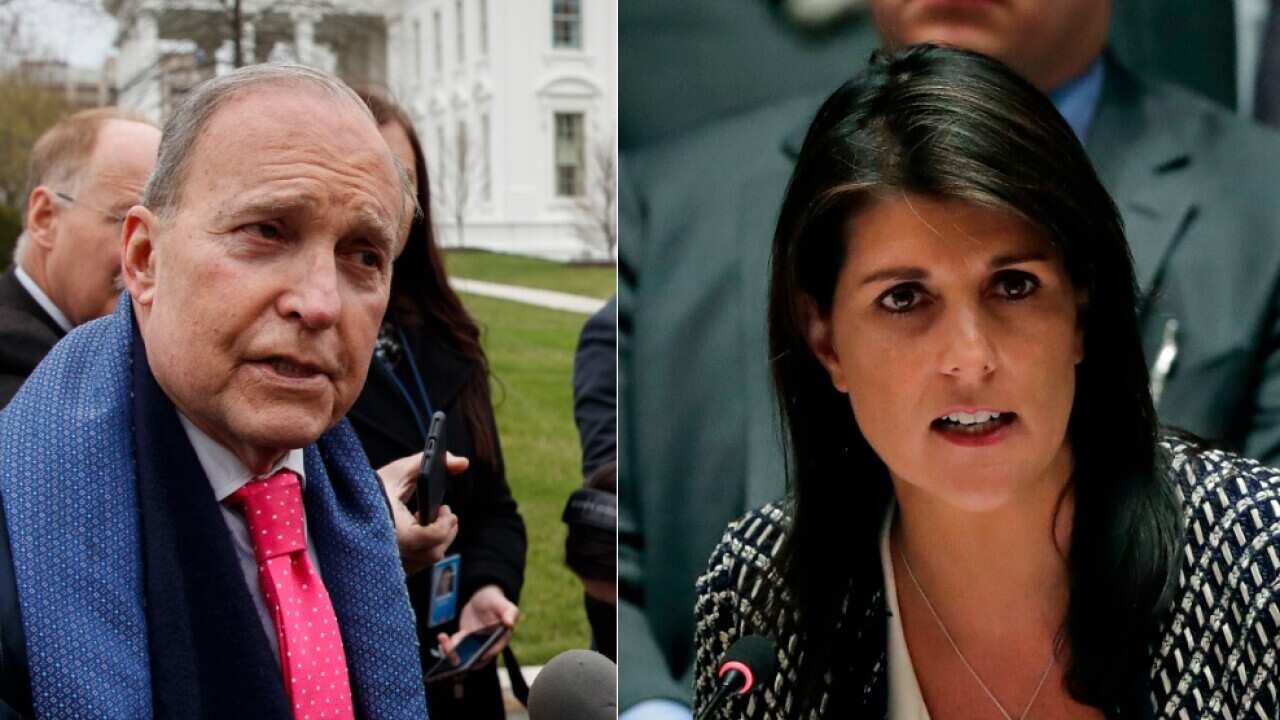
UN Ambassador Nikki Haley has fired back against a Trump administration official who said she was suffering from "momentary confusion" when she announced new sanctions against Russia were imminent.
"With all due respect, I don't get confused," Haley said in a statement to Fox News on Tuesday.
A striking intra-administration quarrel played out in public when National Economic Council Director Larry Kudlow told reporters in Florida that Haley "got ahead of the curve" when she said the US would be slapping new sanctions on Russia on Monday, in retaliation for the country's support for Syria's Assad government after its latest suspected chemical attack.
News that makes sense
Your trusted source for staying up-to-date with the world around you. Get free daily news updates and analysis, straight to your inbox.
Kudlow said additional sanctions are under consideration but have yet to be implemented. Of Haley, he said, "There might have been some momentary confusion about that."
Haley had said on Sunday that Treasury Secretary Steven Mnuchin would be announcing new sanctions directed at companies associated with Syria's chemical weapons program on Monday, "if he hasn't already."
But Monday came and went without an announcement.
The dispute between Haley's team and the White House had been playing out largely behind the scenes since Haley's initial comments.
The White House has been struggling to explain Haley's remarks amid reports that Trump put the brakes on the new sanctions. Several administration officials have disputed that characterisation, saying Haley was out of the loop.
One senior administration official said that, under the plan conceived last week, the sanctions would have been announced Friday night, at the same time US, French, and British forces launched a missile strike on Syrian President Bashar Assad's chemical weapons facilities.
But the sanctions were not ready in time for Trump's Friday night statement, so they were delayed.
The official said a decision was then made to announce the sanctions as an answer to Russia's response to the strikes. But that plan was re-evaluated and then put on hold over the weekend as it became clear that Russia's response was less robust than anticipated.







