
The ABC's managing director has admitted the public broadcaster did not adequately consider the risks of having a convicted criminal in the live audience of its Q&A program, but has defended the ABC's independence.
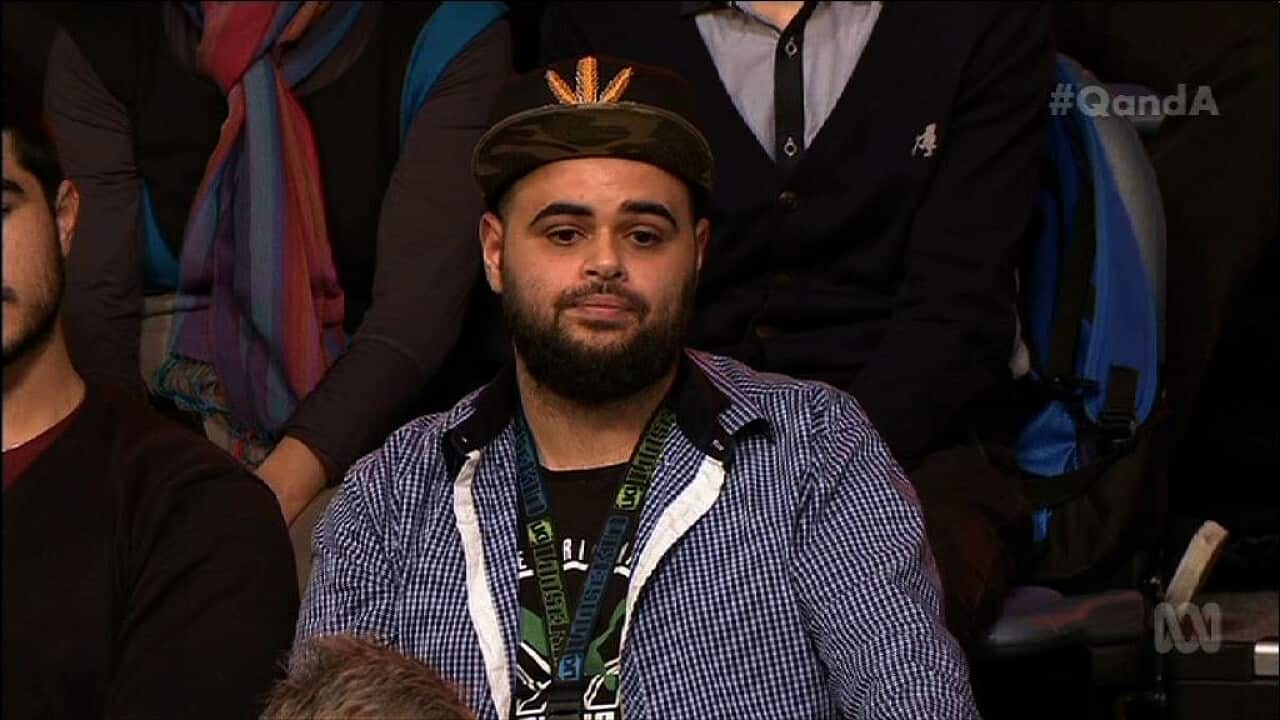
Mark Scott concedes the decision to allow Zaky Mallah, who pleaded guilty to threatening to kill ASIO officers, on the broadcaster's live forum should have been referred higher up the management ladder.
Responding to Prime Minister Tony Abbott's question to the ABC earlier in the week - "whose side are you on" - Mr Scott said it's on the side of Australia.
"The ABC is clearly Australian, it’s on the side of Australia," he said.
"The A in ABC is for Australian. And the part we play, what we do for the side, is a vital one, central to our culture and our democracy – that of being an independent public broadcaster."
Mr Scott said the broadcaster is a public one, not a state one.
"I hope no-one seriously wants the ABC to be a state broadcaster," he told the gathering.
"We know the examples. North Korea and Russia. China and Vietnam. There are many others.
"That has never been the role of a public broadcaster here, a public broadcaster formed in the tradition set out by Lord Reith the first head of the BBC, who spoke of a duty to inform, educate and entertain."
Mr Scott said during his nearly nine years at the helm, there have been stories which have generated the wrath of the government of the day.
"Monday's Q&A is but the most recent example."
Mr Scott said the broadcaster also is talking to federal police about potential security issues.
"The risks and uncertainties of having him in a live programming environment weren't adequately considered before the decision was made to accept his application to be in the studio audience," Mr Scott said during a Centre for Corporate Public Affairs speech in Melbourne on Thursday night.
Mr Mallah wasn't unknown to the media and had appeared in the Q&A audience before.
"Media organisations often give air time to the criminal and the corrupt," he said.
"You have to set the bar very high before you begin to exclude certain views or perspectives."
Mr Scott could see circumstances in which a pre-recorded question could have been broadcast like it had been for other controversial figures like Julian Assange.
"It's not weakness to say you made the wrong call," he admitted.
The ABC is reviewing how it decides who attends the show's audience and is willing to co-operate with the federal government's own "snap" inquiry which will report back on Tuesday.
But despite reflecting on the controversy, the managing director expressed the broadcaster's desire to treat the program with care.
"I feel that Q&A has the potential to be a 20+ year franchise for the ABC," he said.
'The ABC let down its own standards, betrayed, if you like, its own standards'
Malcolm Turnbull has refused to go as far as the prime minister in calling for heads to roll at the ABC, after it allowed a convicted criminal to be on air live and then replayed the show.
The communications minister thinks the public broadcaster betrayed its own standards by allowing Zaky Mallah to appear on Q&A.
But he's refusing to say it let down the country, as Tony Abbott did earlier on Thursday.
"I said today that this was a very, very grave error of judgment and the management has to take responsibility for it and that there should be consequences," he said.
"I don't want to take it any further than that, but this was a very serious error of judgment.
"... A lot of people would say that the ABC let down its own standards, betrayed, if you like, its own standards, it's own very high standards."
Mr Turnbull insists the ABC is a public broadcaster, telling the 7.30 program it was not run by himself or Mr Abbott.
Liberal frontbencher Christopher Pyne on Friday accused the ABC of trying to deflect attention from the fact it allowed a convicted criminal into a live studio audience.
Mr Pyne says ABC boss Mark Scott should admit wrongdoing for allowing Zaky Mallah on the Q&A program instead of trying to "pretend" that the government is attacking free speech.
Share


