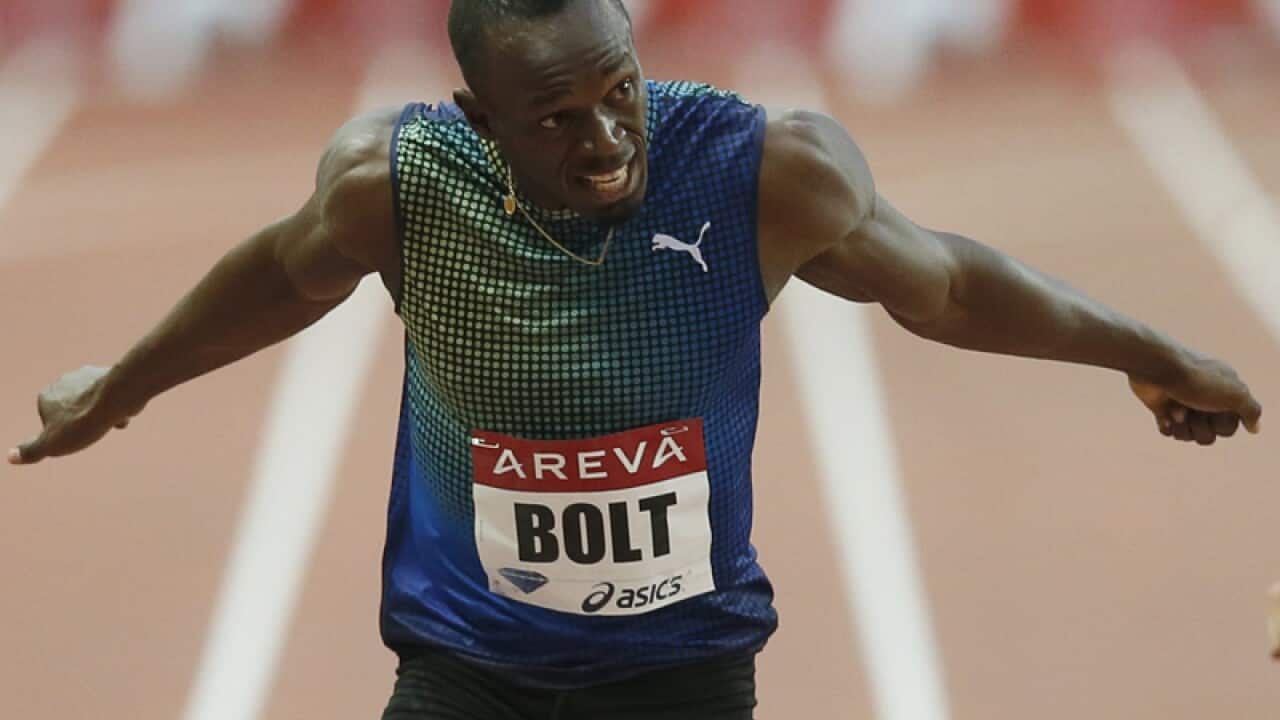
Scientists on Friday said Usain Bolt performed a feat of biomechanics when he ran 100m in a record 9.58sec at the 2009 World Championships in Berlin.
Crossing the line in a time that is still a world record meant Bolt had to muster "truly extraordinary" power and energy to overcome exceptional drag, they said.
Taking into account the altitude of the Berlin track, the temperature at the time of the race and the resistance caused by Bolt's 1.95m (six feet five inch), 94-kilo frame, the researchers calculated he had a drag coefficient of 1.2, which is less aerodynamic than the average human.
Bolt hit peak power after only 0.89 seconds, expending 81.58 kilojoules of energy by the time he finished the race.
But 92.21 per cent of this energy was used to overcome air resistance, according to a paper appearing in the European Journal of Physics. Only 7.79 per cent was used to achieve motion.
News that makes sense
Your trusted source for staying up-to-date with the world around you. Get free daily news updates and analysis, straight to your inbox.
After 41 strides, he crossed the line at 43.92 kilometres per hour.
"The enormous amount of work that Bolt developed in 2009, and the amount that was absorbed by drag, is truly extraordinary," said scientist Jorge Hernandez from the National Autonomous University of Mexico.
"It is so hard to break records nowadays, even by hundredths of a second, as the runners must act very powerfully against a tremendous force which increases massively with each bit of additional speed they are able to develop.
"This is all because of the 'physical barrier' imposed by the conditions on Earth. Of course, if Bolt were to run on a planet with a much less dense atmosphere, he could achieve records of fantastic proportions."
The team compared Bolt's time in Berlin with his previous world-record time, of 9.69sec, set during the 2008 Beijing Olympics.
In Berlin, he benefited from a tiny tailwind of 3.23 kph, the researchers found.
Without this boost, he would have come in at 9.68sec, thus beating the previous mark by 0.01sec.
The analysis was made from data provided by the International Association of Athletics Federations (IAAF), whose laser tracker recorded Bolt's position and speed every 0.1 of a second in Berlin.







