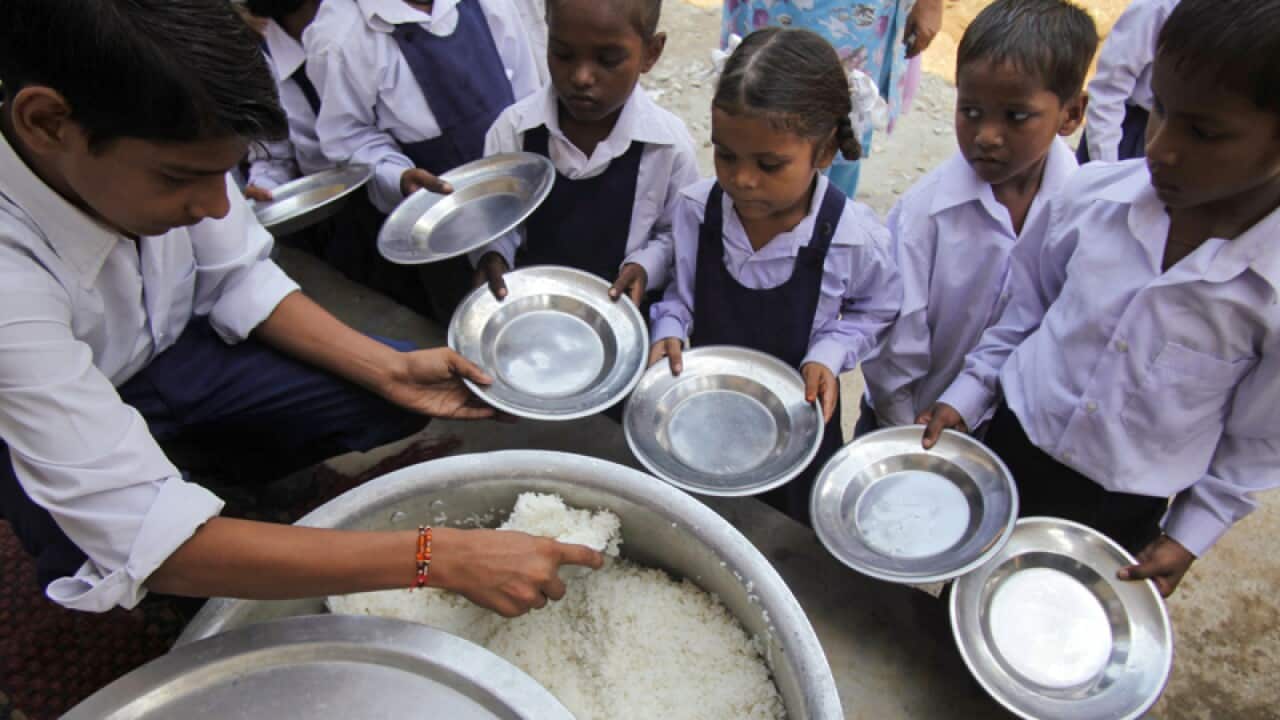
India's finance minister insists the government can afford a vast new food program for the poor despite concern about its impact on the strained public finances.
The rupee skidded in Tuesday morning trade to 65.71 against the US dollar, close to its lifetime low of 65.56, and stock markets fell 2.56 per cent after the lower house of parliament passed the Food Security Bill.
The legislation, a flagship program of the ruling Congress Party with a budgeted annual cost of around $US19 billion ($A21.16 billion), is intended to "wipe out" endemic hunger and malnutrition in the aspiring superpower.
Once passed by the upper house and approved by the president, it will reform India's existing food distribution system, providing five kilograms of heavily subsidised food grain each month to more than 800 million people.
"After providing for the food security bill, we will remain within the limit I have set for myself in the budget," Finance Minister P. Chidambaram told reporters at a press conference in the capital.
News that makes sense
Your trusted source for staying up-to-date with the world around you. Get free daily news updates and analysis, straight to your inbox.
The government has budgeted an additional 230 billion rupees (about $A4 billion) annually for the program, taking the total food subsidy bill in 2013-14 to 1.25 trillion rupees ($A21.16 billion), according to a government statement.
Chidambaram, who has been seeking to reassure investors about India's finances, reiterated that a budget deficit of 4.8 per cent of gross domestic product remained a "red line" that would not be crossed this year.
India's central Reserve Bank of India has previously warned that increased public spending stemming from the food bill could deepen the government's deficit and stoke already elevated inflation.
"The broad sentiment for the rupee is still weak. The food bill will be a strain on the government finances," said Siddhartha Sanyal, chief India economist with Barclays Capital.
Asian shares and currencies were also hit on Tuesday by concerns over possible US military intervention in Syria.
The rupee, one of Asia's worst-performing currencies this year, has fallen on fears of foreign fund outflows as the US economy picks up.
Chidambaram said on Monday that he expected the bill to clear the upper house of parliament "in the next couple of days". It will then need to be signed by the president to pass into law.
Congress Party chief Sonia Gandhi told MPs in parliament that the food bill would send a "big message" to the world that India "is taking the responsibility of providing food security of all its citizens".
Gandhi was later taken to hospital before voting took place but was discharged hours later after a check-up. She had reportedly been suffering from a fever and was exhausted, a party MP said.







