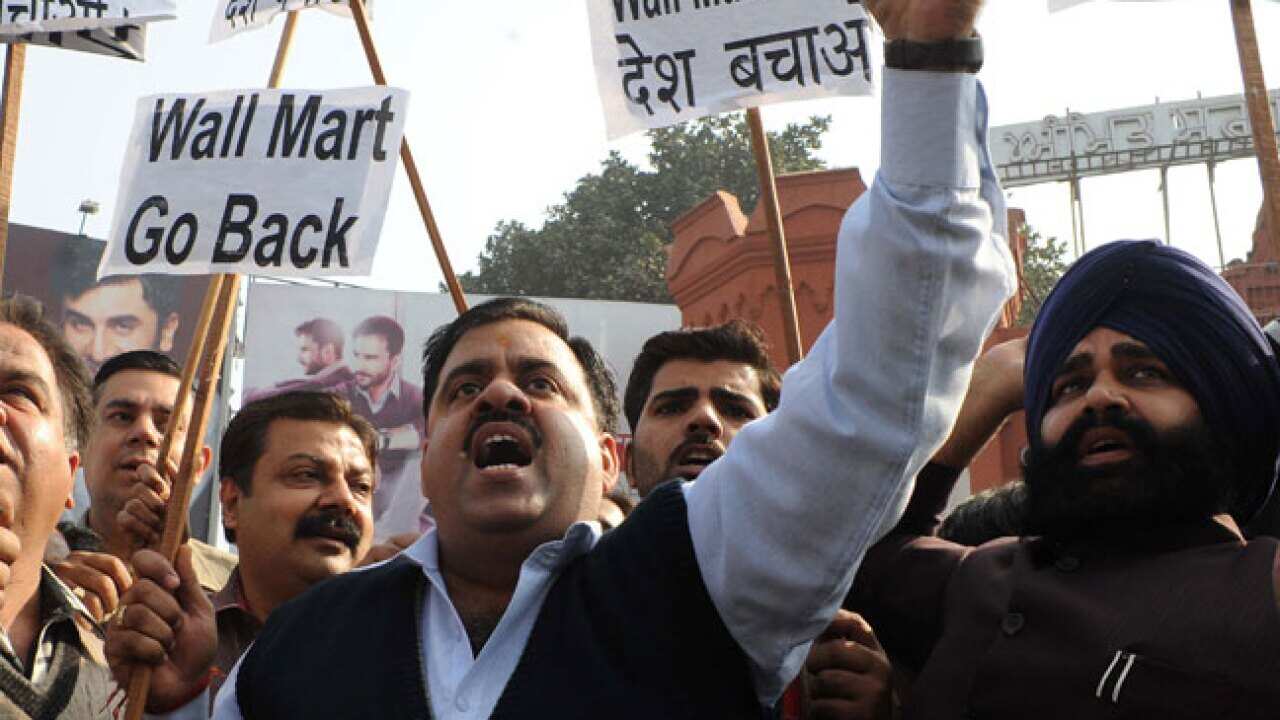
India's decision to suspend plans to open its $470 billion retail sector to foreign supermarket chains such as Wal-Mart, has only served to deepen the impression of a government in permanent drift, analysts say.
In a humiliating climbdown on Wednesday, the government capitulated in the face of pressure from opposition MPs and trade unions and shelved the major retail reform which it had announced with great fanfare only two weeks before.
It was another personal setback for Prime Minister Manmohan Singh, 79, whose credibility has been battered by a series of high-profile corruption scandals and who is increasingly seen as ineffectual and out-of-touch.
"It shows you that this government is not strong and is not capable of implementing a policy... there is a total absence of statesmanship," George Mathew, chairman of the Delhi-based Institute of Social Sciences told AFP.
A thumping re-election victory by Singh's Congress party-led coalition in 2009 was seen as a powerful mandate for economic reform, especially as his government was no longer reliant on communist support to remain in power.
But the promised reform wave was restricted to a ripple, as a re-galvanised opposition used a series of graft scandals and other populist protests to hammer the government, paralyse parliament and stall key legislation.
Political analyst Parsa Venkateshwar Rao said the latest U-turn over opening the retail sector was forced, in part, by poor strategy.
Singh's cabinet failed to consult properly with its own allies before announcing what was always going to be a contentious reform, Rao said, thus alienating key coalition partners and even sections of the Congress Party.
"They wanted to take the political initiative... and catch the opposition by surprise, but they didn't anticipate this reaction from their own allies," he said.
Rao also suggested that Singh was increasingly isolated in his commitment to liberalise the economy, with many Congress MPs wary of pushing through tough reforms ahead of state polls next year and a general election in 2014.
"Some Congress partymen are already afraid of the anti-incumbency vote in 2014 and they see Singh as a lame-duck PM," he said.
A poll released in August by a New Delhi-based research institute showed that Indians' top choice for prime minister was Rahul Gandhi, scion of the Nehru-Gandhi political dynasty.
Some 34 percent of the more than 20,000 people polled said Gandhi, 43, should replace Singh immediately as premier, compared to just 22 percent who wanted Singh to stay on.
The suspended retail reform would have allowed foreign firms to hold a majority stake in "multi-brand" chains, posing the threat of sharp competition to traditional family-run shops which dominate the market and employ millions.
Announcing the rollback in parliament, Finance Minister Pranab Mukherjee insisted that the policy was only being "suspended" until a political consensus was achieved.
But most observers saw that as a disingenuous statement from a government outmanoeuvred by an opposition that had effectively held it to ransom by shutting down the parliamentary process.
"It's worrying to hear the government say they won't go ahead without a full political consensus," Rao said.
"No policy will have a full consensus. It's as though they have submitted to political blackmail by the opposition."
The Federation of Indian Chambers of Commerce and Industry (FICCI), the country's leading business body, described the government's reversal as a "highly regressive move" amid slowing economic growth.
Data released last week showed second-quarter growth skidding to a two-year low of 6.9 percent, hobbled by a string of interest rate hikes that have failed to rein in inflation, still close to 10 percent.
The Indian rupee, the worst performing of Asia's 10 most-traded currencies has slid to record lows against the dollar, as foreign investors abandon Indian and other emerging market currencies in search of safe havens.
Gautam Duggad, retail analyst with Mumbai-based Prabhudas Lilladher, said he feared the current climate meant the retail reform was gone for good.
"We don't expect the government to revive this legislation anytime soon, given the lack of numbers and the impending state government elections.
"We expect the proposal to remain in cold storage and meet the same fate which several other government proposals have met," Duggad said.
Share


