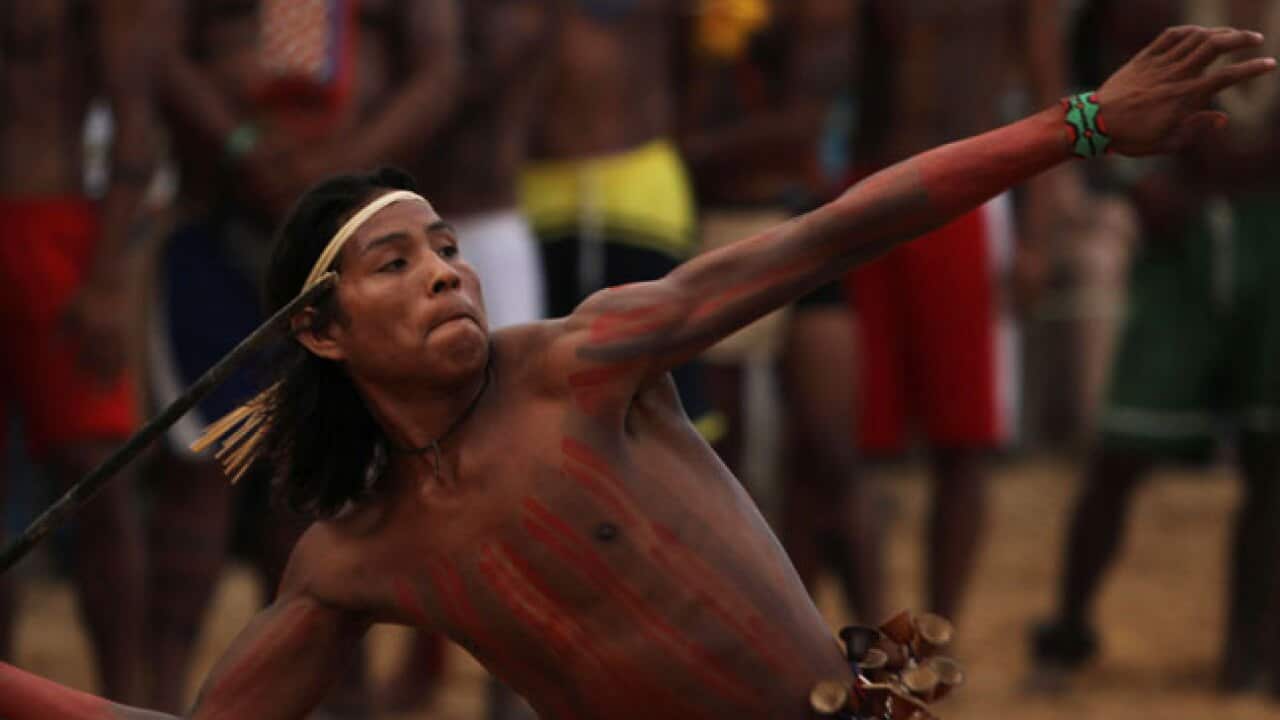
Log-carrying, archery, wrestling and swimming will be featured in the Indigenous Games, Brazil in what organizers hope to turn into an international event with entrants from Latin America, Africa and Asia.
Some 1,400 Brazilian Indian athletes will compete in the Indigenous Nations' Games in Porto Nacional in the state of Tocantins through November 12.
"We believe the Games must be a celebration before being a competition and we want to preserve our sports," Marcos Terena, head of the organizing committee, told AFP.
News that makes sense
Your trusted source for staying up-to-date with the world around you. Get free daily news updates and analysis, straight to your inbox.
Brazil is home to 800,000 Indians, around 0.4 percent of the country's 190 million people.
Billed as one of the world's biggest indigenous sporting events and inaugurated in 1996, the games comprise around 10 traditional and Western events in both male and female categories.
One of the most popular events is the native-style wrestling in which there is no referee, with the fight ending when one competitor knocks down his opponent or lifts him from the floor.
Another is the tree-trunk foot race, where runners have to carry 90-kilogram tree trunks on their shoulders.
"Strength and speed have always been viewed as the hallmark of a good Amazon native and this is evident in these games," noted Terena.
Also on the program is archery, swimming involving a river crossing and "huka-huka," a type of soccer in which teams of eight players must use only their heads and ensure that the latex ball does not touch the ground.
"In these games, there is no champion because all celebrate. There are no rankings. The winners receive a medal carved by a native artist with material from the forest," said Terena.
President Dilma Rousseff's government earmarked $740,000 dollars for the games, which draw representatives from 39 ethnic groups.
That sum is a mere pittance compared with the billions of dollars which Brazil plans to spend to host the 2014 World Cup and the 2016 Summer Olympic Games.
"Our challenge is to promote these (indigenous) games not only as sports but also as cultural and social events," said Brazil's new sports minister Aldo Rebelo, who signaled official support for staging World Indigenous Games soon.
Rebelo took over the sports portfolio last month, with the key task of organizing both the World Cup and the 2016 Summer Olympics.







