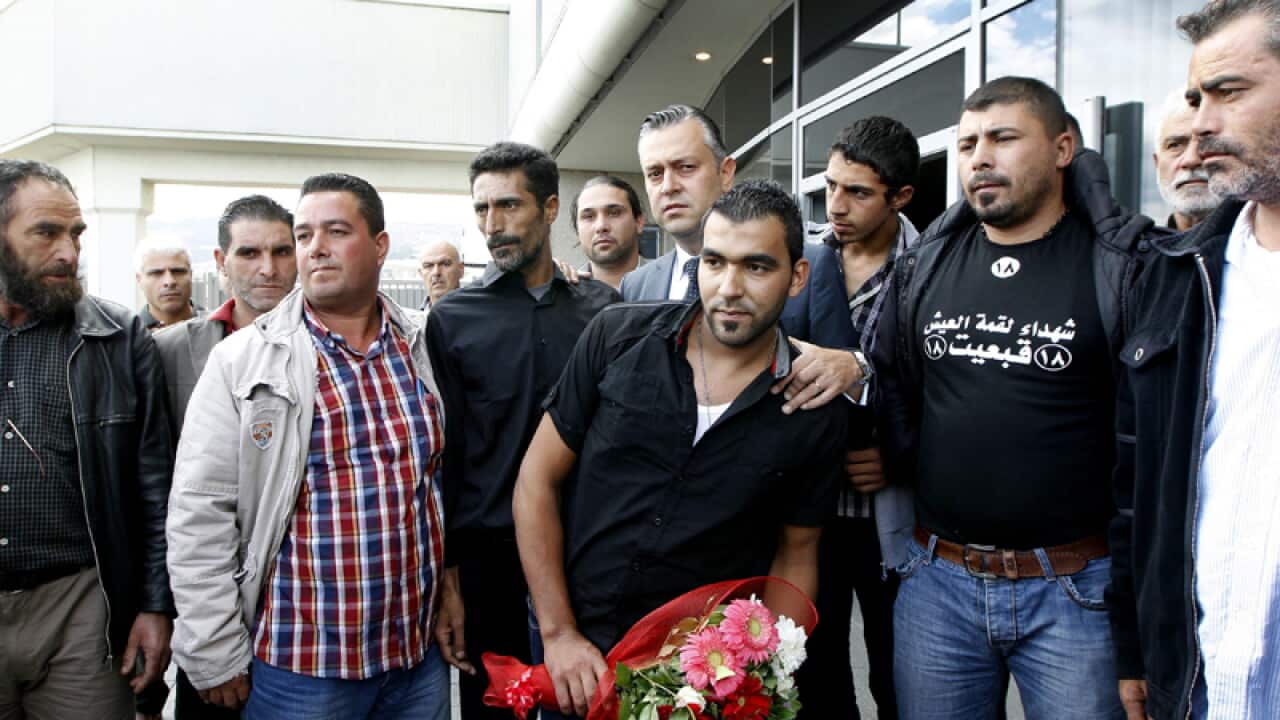
Assaad Assaad sold everything to escape poverty in Lebanon, but now he is back, after watching his wife and three children, and his dreams of a better life, perish at sea.
The 36-year-old, who could now pass for 50, was among 18 shell-shocked Lebanese who returned on Sunday after surviving a shipwreck off Indonesia that killed dozens of impoverished migrants from the Middle East.
The Lebanese aboard the Australia-bound boat mainly hailed from the northern Akkar region, where an influx of refugees from neighbouring Syria has compounded the endemic poverty of one of Lebanon's poorest areas.
"We were desperate to leave, and we had hope for a better life, because there is nothing for us here," Assaad said as he stared ahead blankly, still reliving the tragedy.
"I lost everything - my wife, my children, my home," he says, sitting in his parents' modest house where the crushing silence is only occasionally broken by neighbours calling in to quietly offer their condolences.
News that makes sense
Your trusted source for staying up-to-date with the world around you. Get free daily news updates and analysis, straight to your inbox.
In Kabiit, a village nestled beneath verdant mountains, Assaad supported his family on $13 a day before deciding to sell everything - his house, his car, his land and his cow - to pay for passage to Australia, the "Eden" to which many of his fellow villagers had gone.
"I don't want to be rich. I just want to live decently. Here we live in humiliation," he said.
Criminal networks have descended on the region to take advantage of Syrians fleeing the civil war, offering cut-rate passage to Australia via Indonesia that has encouraged poor Lebanese to try their luck as well.
"Many of those who left lead good lives now. We were not so lucky," said Assaad, who paid $US70,000 ($A74,432) to people-smugglers.
He describes the moment when he lost everything.
"It was like an explosion. The boat just disintegrated. It was indescribable," he said. "I would have preferred to die with my family."
Between 80 and 120 people, most of them from the Middle East, were on board the boat. Twenty-eight bodies, many of them women and children, were recovered, but 22 others are still missing.
Assaad wants the Lebanese state to "open its eyes" to the situation in Akkar, where residents are forced to work the land or, in his case, fell trees for charcoal.
In Kabiit - three hours north of Beirut - pot-holed streets run past shuttered shops and children fill plastic bottles with water from a public tap before hauling them back to homes without plumbing.
The closest hospital is 20km away.
Even after the tragedy off Indonesia, many locals say they are still willing to try their luck on the ocean passage, fearing that if they remain they could lose even their limited livelihoods to Syrian refugees.
Fahed Kassem, 36, says he struggles to make ends meet with the $US800 a month he earns at a metallurgical plant in Beirut.
"Now my boss tells me he could have four Syrians in my place," he said. "If the opportunity presents itself, I would emigrate too."
Hussein Khodr gave similar reasons for leaving before he set off on the "ship of death" with his eight children and pregnant wife, all of whom died.
"He was overwhelmed, he wanted to leave everything. He said 'I want to live well or I want to die'," his father Ahmad said.
Lebanon, with a population of just four million, is home to 770,000 refugees, and has been without a government for six months after a political crisis caused in part by its ever-feuding political factions' support for rival sides in Syria.
Afrah Hassan, a 22-year-old who survived the shipwreck, was studying law at a university in the northern city of Tripoli, where fighting has repeatedly broken out between supporters and opponents of Syria's President Bashar al-Assad.
"There was shooting all the time, and sometimes we had to hide under our chairs in the classroom," she said. "It was too much. I wanted to leave everything."
She remembers the cockroaches in the boat, five days in which she saw only sky and sea, and then the 10-metre-high waves that crashed into the ship, the small children floating lifeless in the churning waters.
"There is no horizon in Lebanon, it's true," she said. "But now I tell myself I never should have left."







