As the tension between Ukraine and Russia continues to play out on the world stage, the emotions of the Ukrainian and Russian people have played out before the world, too.
But in the shadows, in their shadows, the lives of a third group of people have been turned upside down -- again.
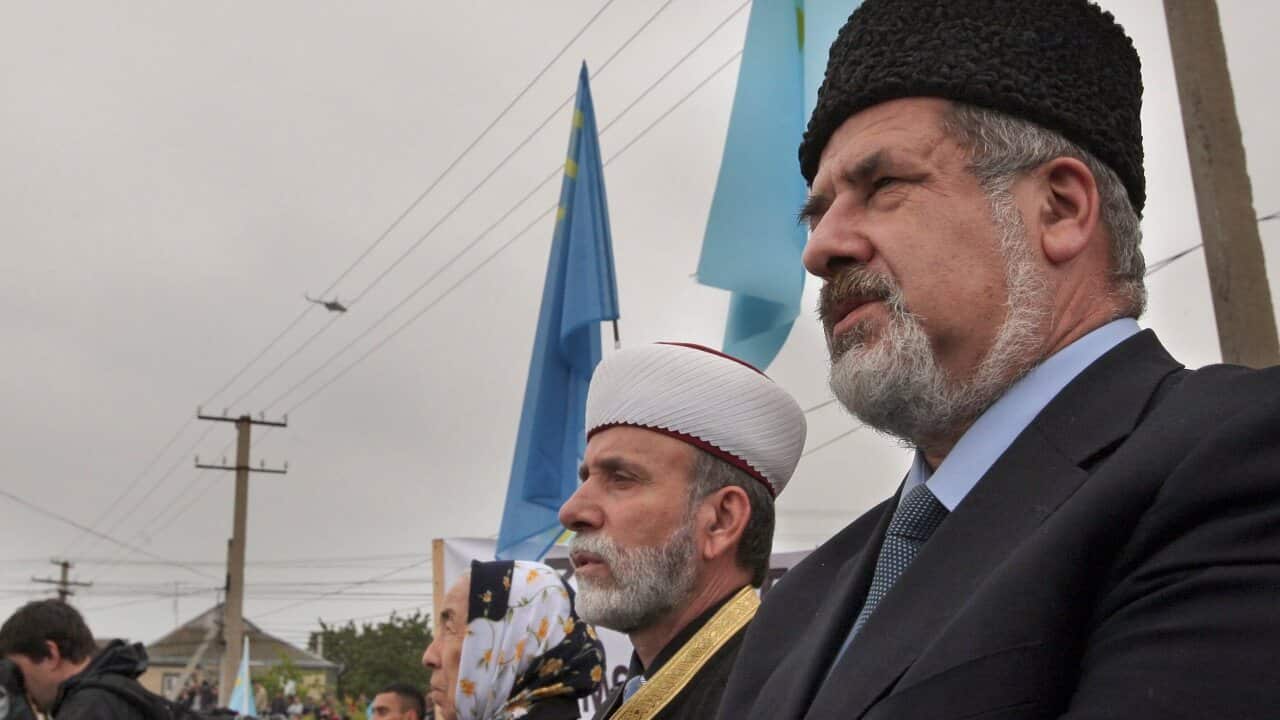
A quarter-of-a-million Tatars live in Crimea, a land Russia once drove them from, a land pro-Russian forces have taken again from Ukraine after they returned.
Many in the small Tatar community of Australia watch ... and worry.
(Click on audio tab to listen to this item)
It was back in 2000 that the president of Tatarstan asked Roostam Sadri to represent the Russian republic at a conference in Poland.
And it was there the human-rights member of Russia's delegation raised the issue of Russian soldiers' alleged mistreatment of Chechans in the war in Chechnya.
The Russian MP's English was lacking, though, and he asked Mr Sadri, a leader of the Tatar community in Adelaide, to make a presentation on his behalf.
Mr Sadri did, comparing how then-Prime Minister Vladimir Putin had used the Chechans to consolidate his power to how Adolf Hitler had used Germany's Jews to consolidate his.
"That didn't go well with some other members of the Russian delegation, who whispered to me 'Don't come to Russia. We'll bump you off.'* And I was banned from going to Russia for four years after that conference."
Roostam Sadri, like many in Australia's small Tatar community, retains strong ties to Tatarstan as a spiritual home but admits Tatars have long had a love/hate relationship with Russia.
And these days, the emotions can be particularly raw, with Tatars caught in the middle as Russia and Ukraine fight over Crimea -- the more historic home of the Tatars as a kingdom.
Mr Sadri and most of Australia's community trace their roots to Tatarstan, but there is no mistaking the feeling when he says the Tatar nation, the Tatars of Crimea and Tatarstan, are one.
"We ruled the Russians for almost 300 years, taught them how to wear trousers, how to fight wars in an effective way. And because, numerically, Russians are much bigger than us, eventually it backfired on us, because, when they got up, they were not as generous with us as we used to be with them. Historically, it was a love/hate relationship between the Russians and the Tatars."
Russians could argue the Crimean Tatars' roaring slave trade of centuries past in the region is part of the story, too.
Regardless, the Tatars' distrust that Roostam Sadri alludes to is something the world is likely to hear little about from within Crimea, and particularly from within Tatarstan, at the moment.
Tatars in Australia suggest those in Tatarstan, about 15-hundred kilometres north-east of Crimea, are under pressure from now-President Putin to encourage Crimea's Tatars to back Russia.
But feelings in Crimea did rise to the surface recently when thousands of Tatars defied a ban by the new pro-Russian rulers to mark the 70th anniversary of their mass deportation.
Over three days in May 1944, Josef Stalin and the Soviet Union exiled more than 200-thousand Crimean Tatars to Uzbekistan, Siberia and other distant places.
After the anniversary tribute, the United Nations refugee agency revealed at least 10-thousand people, mostly Tatars, have been displaced in Crimea since the current crisis erupted.
Shohret Valiff is president of the Tatar Association of South Australia -- where most of Australia's estimated 600 Tatars live.
He's hoping Australia will step up to help.
"The Crimean Tatars in Crimea have been discriminated (against) so badly that, most of them, they want to leave -- leave Crimea again, to Ukraine. The situation's really bad. The Russian nationalists in Crimea are quite strong. They really don't want the Tatars to stay there at all. They want them to leave. I was just hoping that the Australian government can accept some of those Crimean Tatars. I think they are, like, refugees now."
Shohret Valiff says community representatives hope to meet soon to act on it.
"We are thinking about (meeting and) talking about it, because we just heard that news that 10,000 Crimean Tatars left Crimea for Ukraine. So we were thinking about ... we think we're going to write a letter to the MPs and the ministers and the Immigration Minister to ask about the possibility of Crimean Tatar refugees coming to Australia."
The Crimean Tatars are a Turkic, mostly Muslim, people.
Josef Stalin deported them as a form of collective punishment, for some collaborating with the Nazis during the Second World War.
In those years just before the state of Israel was born, Russian and Jewish representatives were also discussing Crimea, with its rich Jewish history, as a possible Jewish homeland.
Roostam Sadri, author of a book on Soviet expansion into Turkic regions in those years, insists the potential sale of the land for that purpose was strongly linked to the deportation.
"Basically, he wanted to sell Crimea to the West at a high price, and, to do that, he wanted to vacate the Crimean Peninsula of its core population. That's why the desire to evict. And he was brutal and very efficient in doing so."
But as Mr Sadri says, the relationship between the Tatars and Russia has long been a love/hate one, and that love of Russia has left many in the Australian community torn in their feelings.
Feruza Lawson was born and raised as Feruza Gafurova, daughter of Tatar parents in Uzbekistan, before arriving in Australia just five years ago.
She describes a kind of emotional roller-coaster these days, her emotions going out in all directions.
"I'm Tatar by origin, but I went to Russian schools and I was born in Uzbekistan, so I'm worried about everything that's happening, that's happening in that area. So I'm concerned about everything -- Ukraine, Russia and, of course, Uzbekistan. So it's not like only Crimea. And I have relatives everywhere ... so in Russia, in Uzbekistan. Not in Ukraine, but, I mean, we are Tatars, so, of course, we worry about everything that's happening there."
On her father's side, Feruza Lawson comes from family that escaped to Uzbekistan during the Russian revolution, a familiar tale within the Australian Tatar community.
But, now, she spends a lot of her time reading Russian web sites and trying to follow the upheaval in the region from that end.
And almost a century after the revolution, almost a quarter of a century after Tatars returned to Crimea during perestroika, she is concerned fighting could break out in the region again.
"It actually worries me. If someone will start a war, my brother lives in Russia with his little kids, so I really don't want any wars."
Shohret Valiff's wife Dilara likewise was born in Uzbekistan, while he and Roostam Sadri were born in Tatar communities in China's heavily Turkic, western Xinjiang province.
But Shohret Valiff talks, too, of good relations between Adelaide's Tatar and Russian communities, how he does not want to hurt anyone in the Russian community with his remarks.
And, indeed, others in the community hesitate to talk about the unfolding scene in the region, speaking of what they call a very complex political issue.
That complexity can range from the conflict between Tatar descent and a Russian upbringing to even differences in language and looks between Tatars of Tatarstan and Crimea.
Crimean Tatars, for example, speak an indigenous language and typically bear the darker appearance of many Turkic people.
The Bulgar Tatars of Tatarstan tend towards the fairer look of the Russian steppes and, by one woman's estimate, might understand as little as 60 per cent of Crimean Tatar language.
Still, Shohret Valiff makes it clear there is that tie that binds, that overrides any differences.
"We are Tatars, we are like brothers. Whatever happens there, it really affects us as well, because we know how they've been suffering. They're trying to come back to their homeland, Crimea. The Russians were not happy -- they didn't want them back. Crimea is part of Russia now, the Crimean Tatars are not very happy. They wanted to stay with Ukraine. So what's happening now is that there is lots of discrimination going on in Crimea against Tatars, so the Bulgarian Tatars, (we) Tatars here, are really concerned about the future and what's going to happen to them."





