
“I want to go home to my daughter. I want to see her now,” Hawa Idrissa tells me, her voice loud and eyes bright, staring directly at me across the orange plastic fence separating us.
“I feel strong,” she bounces, a huge smile breaking across her beautiful face. “I could even run from here to Kailahun if I could get out.”
Young mother Hawa has Ebola. Mercifully, her baby daughter was not infected but they have not seen each other for three weeks.
"Being one of relatively few journalists to visit Sierra Leone’s Ebola-ridden east, I was granted extraordinary access to many aspects of the desperate, ongoing operation to bring the disease under control there."
Hawa is being treated in the largest-ever Ebola case management centre, built by Médecins Sans Frontières (MSF), in June this year in the virus-ravaged remote east of Sierra Leone. .jpg?imwidth=1280) The centre in the district of Kailahun is an expertly run facility, a bone-crunching 12-hour drive from the capital Freetown. It has been developed by medics who have known previous Ebola outbreaks in the Democratic Republic of the Congo and Uganda.
The centre in the district of Kailahun is an expertly run facility, a bone-crunching 12-hour drive from the capital Freetown. It has been developed by medics who have known previous Ebola outbreaks in the Democratic Republic of the Congo and Uganda.
But these medics are breaking new ground because the scale and complexity of the epidemic raging across West Africa is unprecedented.
MSF predicts the outbreak will continue into next year, but nobody actually knows. It is evolving before their eyes and spreading faster than efforts to contain it.
To date, the MSF Kailahun centre – the only fully functioning treatment facility in Sierra Leone – has admitted 328 patients.
Of these, 214 were confirmed Ebola cases. Fifty-two people treated there have survived the disease and 118 have died so far. It is a fast, cruel sickness with no proven cure. Ebola will kill most of those infected.
Being one of relatively few journalists to visit Sierra Leone’s Ebola-ridden East, I was granted extraordinary access to many aspects of the desperate, ongoing operation to bring the disease under control there, for a report to be broadcast on tonight’s Dateline on SBS ONE.
The country’s authorities have finally scaled up efforts to tackle the virus after what many say was a sluggish, uncertain start. .jpg?imwidth=1280) Security forces are deployed across affected zones and military checkpoints dot the arterial highway linking west to east. Heavily armed soldiers and riot police man these checkpoints on a scale not seen since the end of the civil war in 2002.
Security forces are deployed across affected zones and military checkpoints dot the arterial highway linking west to east. Heavily armed soldiers and riot police man these checkpoints on a scale not seen since the end of the civil war in 2002.
They have orders to restrict movement and effectively quarantine the worst-hit areas… a necessary but debilitating measure for local populations constantly in flux. Soldiers are also ordering travellers to wash with chlorine water and take body temperatures – if you’re over 38.5 degrees, you could be referred for an Ebola swab test.
En route to Kailahun, I stopped in Kenema, another hotspot, to visit the town’s government hospital, where I was told Ebola patients were being treated alongside other routine conditions like malaria and typhoid. The maternity ward was apparently still operating.
Two foreign journalists who’d also been there warned me the place was deadly and completely contaminated. I was told not to even touch the walls. 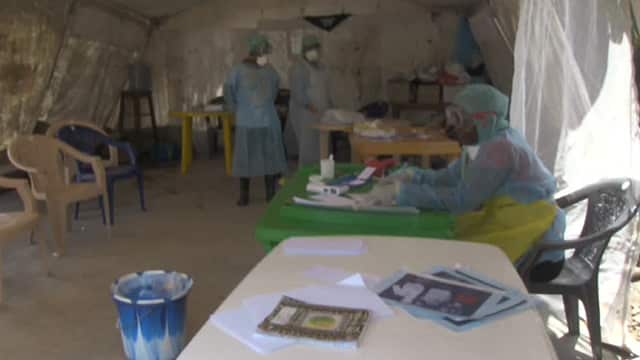 Inside it was a free-for-all, with potential patients, staff, visitors, goods peddlers and random hangers-on wandering in and out unchecked. Nurses semi-clad in protective gear interviewed sick people in a grubby ‘screening’ tent beside one entrance.
At least 20 nurses working at Kenema Hospital have been infected and died from Ebola since the outbreak began.
Renowned local doctor Sheik Umar Khan also contracted Ebola there and died in early August.
Posters of dead nurses plaster the hospital walls. One reads: "Sarah Mansaray, 3rd July 2014, Gone but not forgotten." Another: "Elizabeth we all love U but God loves U most, may her soul rest in perfect peace."
It is horrifying to think that some of the sick people being interviewed in the screening tent could have Ebola, mingling as they were with everyone else. You simply could not know who and what might be infected.
Jacob Mufunda, World Health Organisation (WHO) representative for Sierra Leone said it was out of the question that Kenema Hospital be shut down. “Where else would the patients go?” he asked.
Given the complexity of this strain of Ebola, it is impossible to treat sufferers safely in the same environment as other ailments. The risk of cross-contamination is too high.
The International Federation of the Red Cross is working to build another treatment facility outside Kenema, to eventually transfer patients there. The WHO says this, along with numerous other planned facilities could be fully operational within two weeks.
But the Red Cross site is an empty field and ambulances are carrying Ebola patients 12 hours from Freetown to Kailahun because the capital city is ill-equipped to deal with them.
Bureaucracy and local political squabbling are delaying construction of facilities. 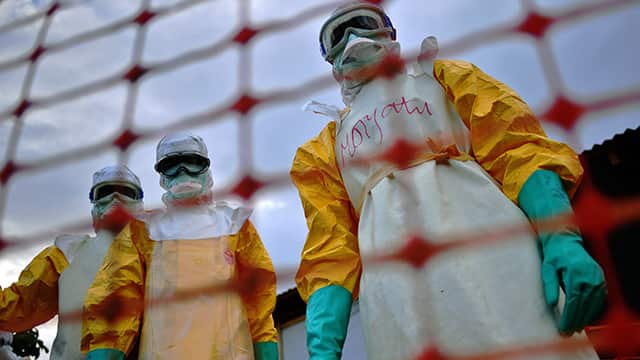 After Kenema Hospital, the sense of order, understanding and control at MSF’s Kailahun centre was deeply reassuring.
As a visitor to the low-risk zone, I was only required to douse my hands and shoes in concentrated chlorine water at the entrance and exit and keep hold of my kit.
I could walk about the zone safely, chat with doctors, observe the exhaustive process of putting on and removing Personal Protective Equipment (PPE) whenever staff needed to enter the high-risk zone, and watch the dead body management personnel wrap corpses in white body bags to be removed for safe burial.
I met the hygienists who are locally recruited and constantly on call. They are responsible for disinfecting Ebola-contaminated space inside the high-risk zone. This includes vomit, diarrhoea and blood. They witness Ebola deaths every day and must clean up the bodies.
“It is an important job but it is not a good job,” one hygienist tells me, “because we are working to see people out of this situation but we too are at the same risk… the stigmatisation is very high.“
They go home to families who shun them for their work with Ebola.  After much reported suspicion at the start of the outbreak, do people in Sierra Leone believe Ebola is real now?
Every person I met had heard of it and were afraid. People were frightened to touch, to gather, to travel and to trust.
People did not know where it may have come from or how to hide from it, which is why they told me that “it is a war you cannot see.”
Social mobilisation and community education are crucial to ending Ebola here.
While it may have started with consumption of infected animals, it continues to spread because of traditional cultural practices, particularly those involving close contact with infected individuals such as caring for the sick and burying the dead.
Information about Ebola needs to be delivered across a vast jungle area in culturally appropriate ways by local health promoters, so that it is understood in its local context and communities can take ownership of that information and then themselves pass it on. It may do little good if imposed by outsiders whose motives are abstract and methods disruptive and often mistrusted. .jpg?imwidth=1280) When I said goodbye to Hawa at the centre in Kailahun, I gave her my mobile phone number and asked MSF to tell me of her outcome. She was so feisty, bursting to get out of that closed, sick place.
When I said goodbye to Hawa at the centre in Kailahun, I gave her my mobile phone number and asked MSF to tell me of her outcome. She was so feisty, bursting to get out of that closed, sick place.
Playing on my mind however, was the knowledge that most Ebola sufferers do not survive. I left Kailahun and travelled back to Freetown thinking about her baby girl.
Three days later, the night before my flight out of Sierra Leone, I got a phone call…
“Aicha? Aicha is that you? It’s me Hawa,” she was still shouting as she had the day I met her.
“I am at home, I am back in Segwima. When are you coming to see me?”
When I go back to Sierra Leone, I will look her up.
Share


