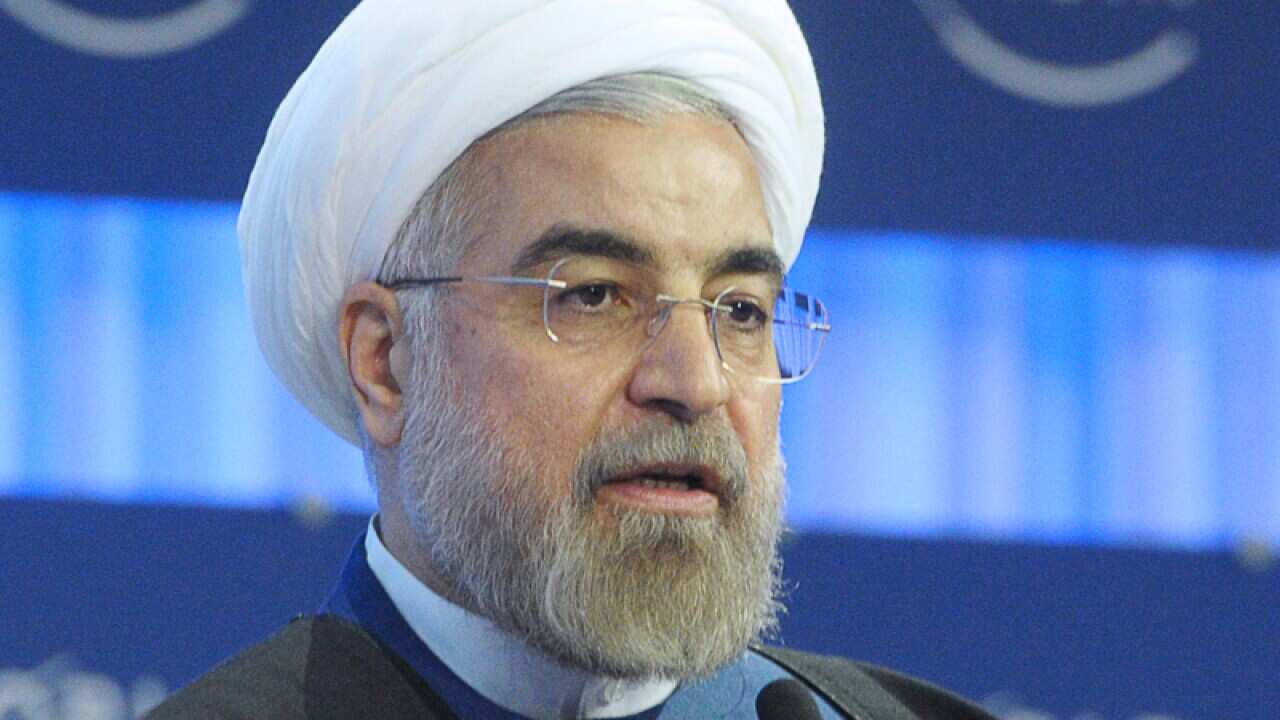
Iran has stepped up attempts to normalise its relations with the West with a Davos charm offensive that was immediately attacked by Israel as a confidence trick.
On a visit to the Swiss resort aimed at enticing international investors back to Iran, President Hassan Rouhani told the World Economic Forum his government was sincere in its desire for a new relationship based on mutual trust and a rebuilding of economic ties that have been shattered by international sanctions.
Israeli Prime Minister Benjamin Netanyahu warned the West not to take the media-friendly Iranian's offer at face value, insisting there was no concrete evidence of any fundamental change in the nature of the Islamic regime.
"Hassan Rouhani can say something but it doesn't make it real," Netanyahu said on Thursday. "It's false."
He said the Iranian president's claim that Tehran wanted to promote stability and security in the Middle East had "no connection with what is going on on the ground", notably in Syria, where he said Iranian Revolutionary Guards and its Hezbollah allies were fighting and killing alongside government forces.
Rouhani was making his first international outing since he created a stir at the UN in New York in September by outlining his new government's desire for a fresh start in relations with the US and other Western powers.
In his speech, described as a message of friendship and hope by the Forum organisers, he unveiled a proposal to create a new multilateral body tasked with stabilising global energy supplies.
Rouhani said Tehran was ready to put some of its extensive oil and gas reserves at the disposal of the proposed new body.
"We are prepared to engage in a serious process to establish a reliable institution for this long-term partnership," he said.
Iran's oil exports are currently running at around half the level of a decade ago as a result of EU and US sanctions applied over Tehran's suspected attempts to develop nuclear weapons.
An agreement on a modest easing of the sanctions took effect this week in line with an interim accord on Iran's nuclear capacity agreed between Tehran and major world powers in November.
The interim agreement is intended to pave the way for a fuller accord and a further lifting of sanctions.
Iran is already seeking to persuade oil majors to start planning for a resumption of investment in the country.
Rouhani has had a string of private meetings with senior oil executives here and also met with Mark Rutte, the prime minister of the Netherlands, which is home to Anglo-Dutch oil giant Shell.
In his speech, Rouhani described the nuclear accord, which limits his country's ability to enrich uranium and provides for inspections of its facilities, as marking the start of a new phase in relations with the US.
Share


