(Transcript from SBS World News Radio)
Ten Arab countries are putting their support behind the United States in its fight against the Islamic State militants in Iraq and Syria.
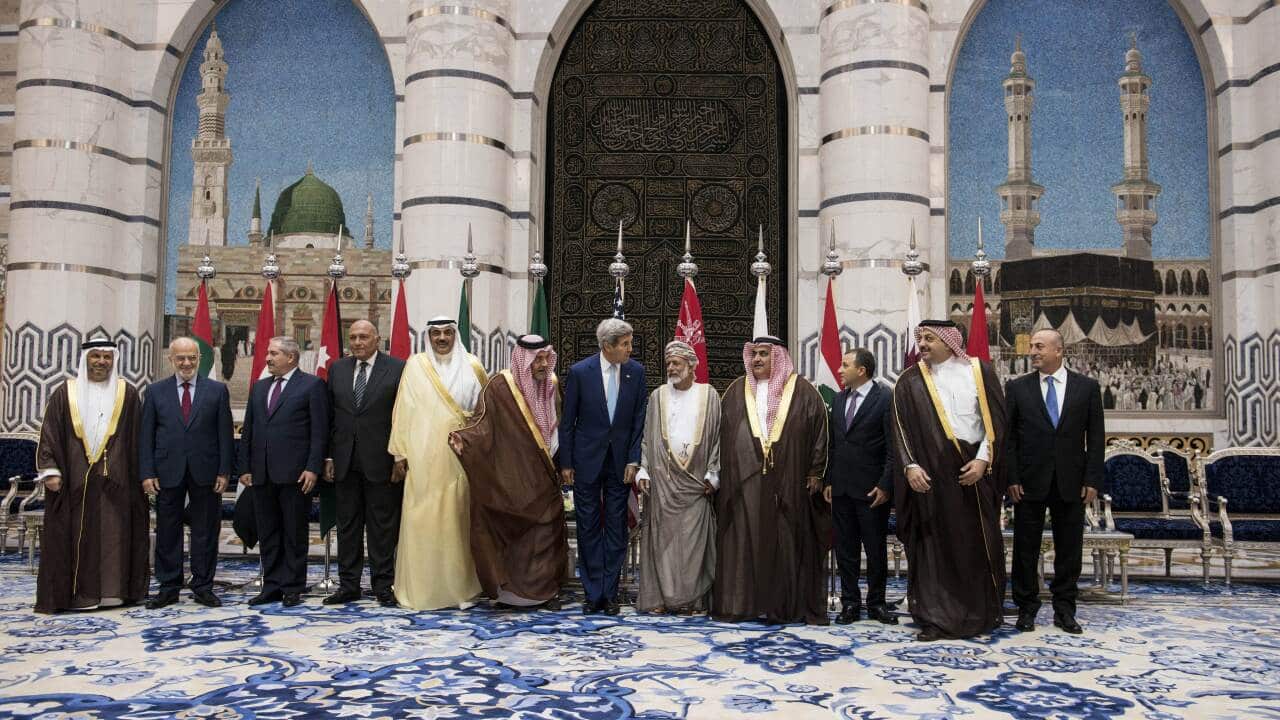
US Secretary of State John Kerry has held talks in Saudi Arabia, and the result is a pledge from the Arab nations to provide military and humanitarian support.
Michael Kenny reports.
(Click on the audio tab above to hear the full report)
News that makes sense
Your trusted source for staying up-to-date with the world around you. Get free daily news updates and analysis, straight to your inbox.
The support from Arab nations comes after US president Barack Obama set out his plans to destroy and degrade the Islamic State, including strikes in both Iraq and Syria.
Ministers representing Saudi Arabia, Qatar, Oman, Kuwait, Lebanon, Jordan, Iraq, Egypt , Bahrain and the United Arab Emirates offered their support in a joint communique.
US Secretary of State John Kerry says it is vital for halting the Islamic State, also known as ISIL or ISIS.
"Arab nations play a critical role in that coalition, the leading role really, across all lines of effort: military support, humanitarian aid, our work to stop the flow of illegal funds and foreign fighters, which ISIL requires in order to survive, and, certainly, the effort to repudiate, once and for all, the dangerous, the offensive, the insulting distortion of Islam that ISIL propaganda attempts to spread throughout the region and the world."
Turkey was also at the meeting in Jeddah, but did not sign the communique.
John Kerry dismissed that as Turkey's sensitivities over the plight of 49 Turkish hostages held by the militants.
At the Australian National University, Middle East specialist Adel Abdel Ghafar says the support from the Arab nations will have some effect.
"We're likely to see some results, in the sense that the Arab League states will give some political cover for the air strikes that were announced, but the devil is in the detail.* The US would want, of course, more involvement from the Arab states, in terms of logistics, even in terms of manpower, and this is something, likely, that many of the Arab states would push back on."
The Arab support comes as questions continue to be raised about whether the US strategy to counter the Islamic State will succeed.
In Washington, the Center for Strategic and International Studies' Tom Sanderson says President Obama's plan to use only air power is an extremely tough way to succeed.
"I think what we have here and what we've presented is a system of moving parts that is prone to break down, because of the various interests on the part of the partners that we have there, and just the difficulty on so many levels of bringing this together. It is really going to be remarkable. And I think it's going to demand a greater commitment by the American side, possibly by the NATO partners' side, which could include, eventually, troops on the ground in certain circumstances. Small numbers, but I just find it very difficult that ... To actually get to ISIS, to decapitate the leadership, even to degrade it, you need more than air power."
The northern Syria spokesman for the Free Syrian Army rebels, Hussam Al Marie, agreed in comments to the BBC.
"Air strikes will never be enough to tackle ISIS in Syria. There has to be kind of coordination with the Free Syrian Army on the ground -- the Free Syrian Army, the Syrian fighters, who know when and how and where to hit ISIS."
Adel Abdel Ghafar, from the Australian National University, says the US support for what it calls moderate Syrian rebels is opaque.
"The support is quite vague, you know? How are we going to fill it for the rebel groups that the West supports versus the ones that it does not support, you know? So it's quite difficult to make these distinctions on the ground."
Russia has warned the United States against taking its air strikes to Syria.
But John Kerry has dismissed the warning, pointing to Russia's alleged actions in Ukraine.
So far, the United States has carried out more than 150 air strikes against the Islamic State in Iraq.







