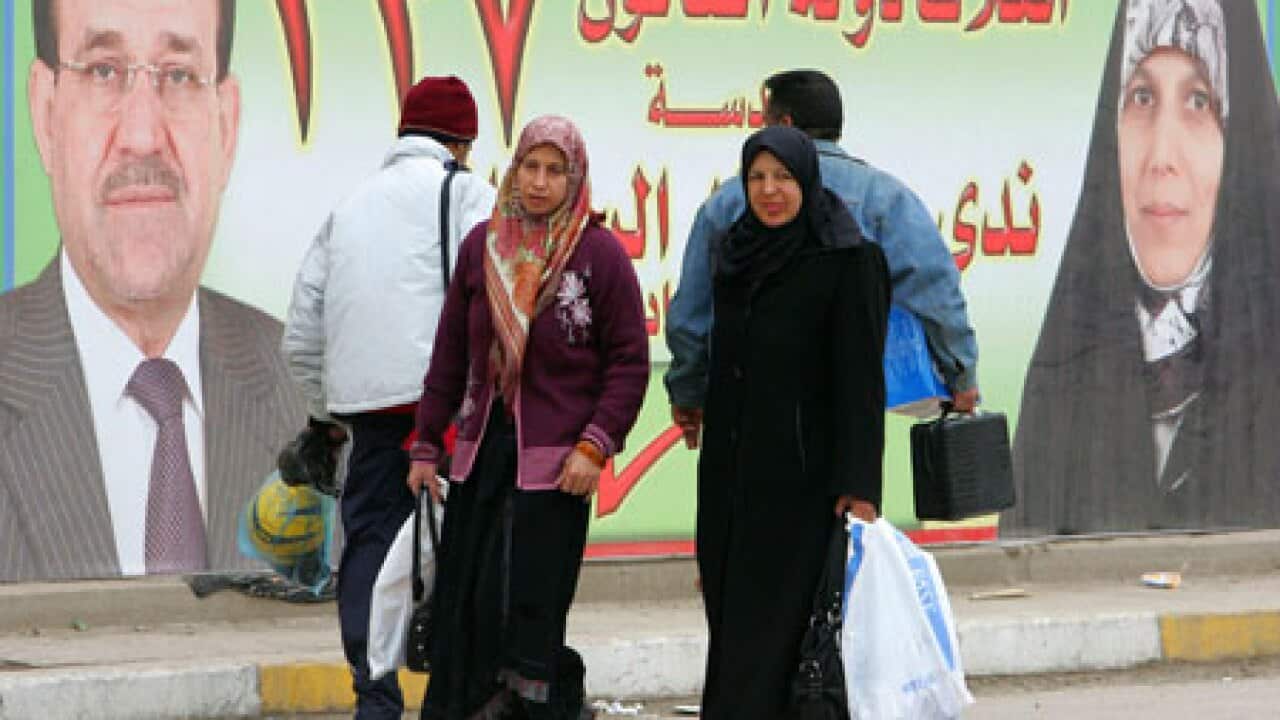
The man who has led Iraq for the past four years is battling for his political survival just as US troops are getting ready to pack up and go home.
With about 83 per cent of the votes counted from parliamentary elections, it's not at all clear that Prime Minister Nouri al-Maliki will emerge the winner because a secular challenger is showing surprising strength. And a drawn-out battle of negotiations with rival coalitions is inevitable.
"Al-Maliki is fighting for his political life," said Joost Hiltermann, an analyst at the International Crisis Group.
News that makes sense
Your trusted source for staying up-to-date with the world around you. Get free daily news updates and analysis, straight to your inbox.
"He may well come out of this no longer prime minister. He may lose the elections, that is how close it is."
Reaching out to Sunnis
The prime minister, known as a hardline Shi'ite during his first couple of years in power, has more recently transformed himself into a law-and-order nationalist who has occasionally reached out to minority Sunnis.
While trying to re-establish a strong central government - most notably by routing a Shi'ite militia that ruled parts of Baghdad and Iraq's second-largest city, Basra - al-Maliki has also alienated many key constituencies by governing with a heavy hand.
Al-Maliki campaigned with all the benefits of incumbency: easy air time on national TV, the ability to dole out favours to local officials in exchange for their support, and a record of helping stop some of the country's violence.
But the political bloc loyal to al-Maliki has only a slim lead over the secular coalition led by Ayad Allawi, a Shi'ite who himself was prime minister from 2004 to 2005.
Allawi 'anti-Iran'
Allawi's anti-Iran rhetoric - and the many Sunnis in his Iraqiya coalition - earned him Sunni support in Baghdad and in Sunni-dominated provinces such as Anbar and Salahuddin.
Al-Maliki has been doing well in the Shi'ite south as well as in Baghdad, a city of 6 million people accounting for almost a fifth of the 325 parliament seats.
With about 12 million votes cast in the March 7 election, the prime minister's coalition has about a 40,000-vote lead over Allawi and is ahead in more provinces - an important factor considering that parliament seats are divided by province and not by the overall vote count.
The process of choosing the next prime minister could take months - a situation which could invite violence at a time when the United States has vowed to stick to President Barack Obama's timetable that calls for the withdrawal of combat forces by late summer and all American troops by the end of next year.
MPs choose President
Once election results are final and the parliament is seated, the lawmakers will elect a new president. The president then tasks the bloc with the largest number of seats to form a majority government.
But even if the president gives al-Maliki the nod, it's not clear he could form a governing coalition and retake the prime minister's office. Almost four years in office have left a long roster of important people and constituencies angry with him.
Followers of anti-American cleric Muqtada al-Sadr are still miffed at al-Maliki for ousting Sadrist militiamen from the oil city of Basra.
Another Shi'ite religious party, the Supreme Islamic Iraqi Council, blames al-Maliki for splitting the Shi'ite vote.
And the Kurds, who like the Sunnis make up about 15-20 per cent of Iraq's population, have their own grievances.
Those include disputes over who controls oil drilled in Kurdish lands, and the future of Kirkuk - a northern city claimed by both Arabs and Kurds.
Kurdish support crucial
The Kurds are widely considered crucial to putting together any government in Iraq. Allawi and other leaders practically sprinted up to the Kurdish city of Sulamaniyah in the days after the election.
The Kurds appear ready to drive a hard bargain for their support.
"The Kurdish coalition won't make any alliance with any bloc without a signed agreement in order to guarantee that our demands will be implemented," said Fadhil Mirany, a senior official with the Kurdistan Democratic Party.
"We will form an alliance ... on the basis of what we get."







