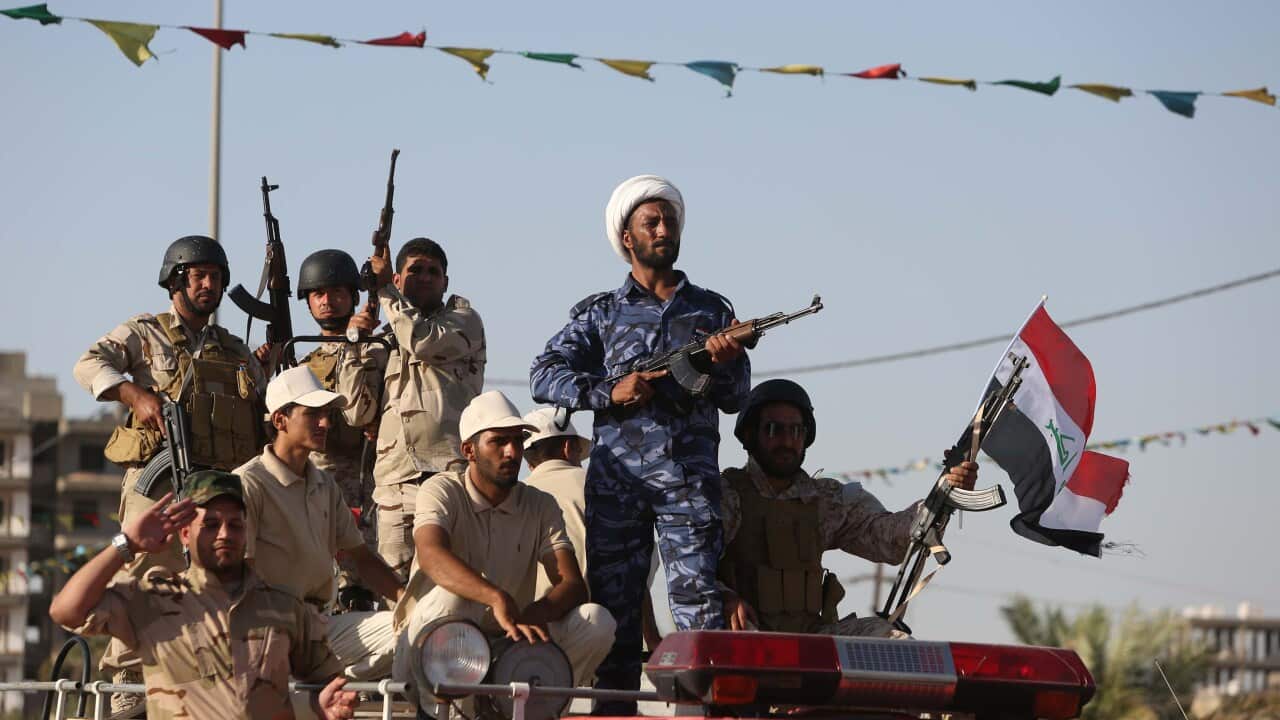
Prime Minister Nuri al-Maliki has conceded that political measures are needed alongside military action to repel a Sunni insurgent offensive that is threatening to tear Iraq apart.
He spoke as British Foreign Secretary William Hague urged Iraqi leaders to unite in the face of the onslaught, led by the Islamic State of Iraq and the Levant (ISIL), that has killed nearly 1100 people and displaced more than half a million more.
Iraqi forces launched a helicopter-borne assault aimed at opening the way to retaking militant-held Tikrit, while the autonomous Kurdish region further staked its claim to the disputed city of Kirkuk.
News that makes sense
Your trusted source for staying up-to-date with the world around you. Get free daily news updates and analysis, straight to your inbox.
Powerful Shiite cleric Moqtada al-Sadr meanwhile risked ratcheting up already-high sectarian tensions by vowing to "shake the ground" under the feet of the advancing militants.
Later on Thursday, a suicide bomb in a predominantly Shiite area of Baghdad killed 19 people.
"We should proceed in two parallel tracks," Maliki's office said he told Hague, on a surprise visit to Iraq.
Along with military operations, the authorities must continue "following up on the political process and holding a meeting of the parliament (on time) and electing a head of parliament and a president and forming the government".
Thus far, Maliki had publicly focused on a military response to the two-week crisis, and his latest comments were his clearest yet regarding finding a political solution.
In an interview with the BBC, he said the Syrian air force had carried out strikes against militants on the Syrian side of the Al-Qaim border crossing, controlled by ISIL.
The premier said Baghdad had not requested the Syrian strikes, but he "welcomed" any such move against the ISIL-led militants.
The New York Times reported that predominantly Shiite Iran is flying surveillance drones over Iraq and sending military equipment to help Baghdad fight the insurgents.
Iraq appealed for US air strikes against the militants, but Washington has so far offered only up to 300 military advisers, the first of whom have begun work in Baghdad.
On Thursday, Iraqi forces swooped into Tikrit by helicopter, taking control of a strategically located university after clashes with militants, officials said.
A senior army officer said the assault on Tikrit, the hometown of now-executed dictator Saddam Hussein, which has been held by militants since June 11, would open the way for the city and surrounding areas to be retaken.







