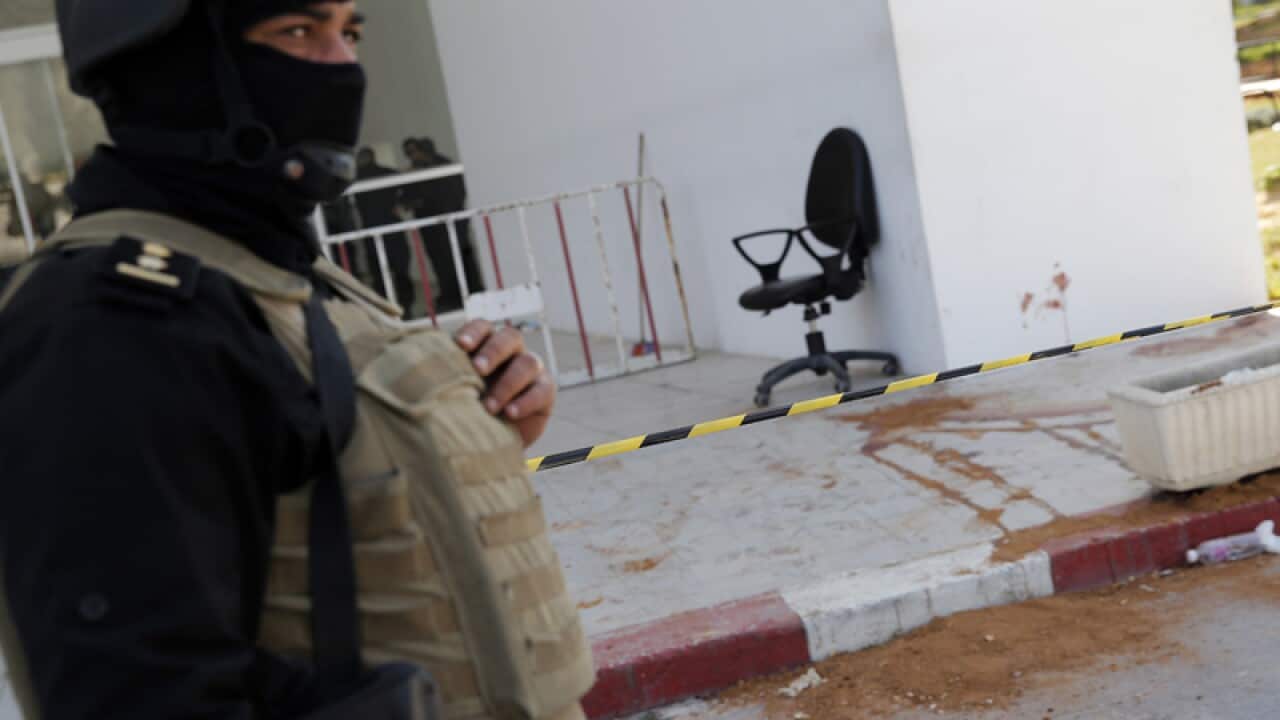
Islamic State has claimed responsibility for an attack on foreign tourists at Tunisia's national museum that killed 21 people including an Australian.
Authorities say they have identified the two gunmen killed after the Wednesday assault, prompting calls for a show of national unity against extremism in the birthplace of the Arab Spring.
In an audio message posted online on Thursday, IS said "two knights from the Islamic State ... heavily armed with automatic weapons and grenades, targeted the Bardo Museum".
The group, which has hundreds of Tunisians among its ranks, threatened more attacks, saying: "What you have seen is only the start."
Authorities say as many as 3000 Tunisians have gone to Iraq, Syria and Libya to fight in jihadist ranks, raising fears of battle-hardened militants returning home to plot attacks.
News that makes sense
Your trusted source for staying up-to-date with the world around you. Get free daily news updates and analysis, straight to your inbox.
The president's office said security forces arrested "four people directly linked to the terrorist operation and five suspected of having ties to the cell".
And a presidential source said soldiers were to be deployed in major cities following the assault, while insisting "we are not under siege".
As international outrage grew over Tunisia's worst post-revolution attack, President Beji Caid Essebsi said his country would not be cowed by extremism.
"The process of implementing a democratic system is underway, well anchored," he told France's TF1 television.
"We will never move backwards."
Panic broke out during the deadly assault as gunmen in military uniforms opened fire at visitors as they got off a bus then chased them inside the museum.
The dead included three Japanese, two Spaniards, a Colombian, an Australian, a British woman, a Belgian woman, two French, a Pole and an Italian, Health Minister Said Aidi said.
A retired Colombian general whose wife and son, a dual Colombian-Australian national, were killed, lamented the "irony" of losing them on holiday after spending his life "fighting terrorism" at home.
"Look at the irony of life, all my life I spent in the military fighting terrorism, combating terrorism, and now in a place totally remote from Colombia it takes my wife and son," Jose Arturo Camelo said, according to the Colombian president who called him.
Dozens more people were wounded, in a massive blow to Tunisia's heavily tourism-dependent economy.
After cowering in fear in the museum during the night, two Spanish tourists were discovered on Thursday alive and well.
At least two major cruise ship operators suspended stopovers in Tunis following the attack.
Nine of the slain tourists were from the MSC Splendida cruise ship, whose owners said a special psychology unit had been set up for passengers.
The government, in a show of defiance, said the National Bardo Museum would reopen early next week.







