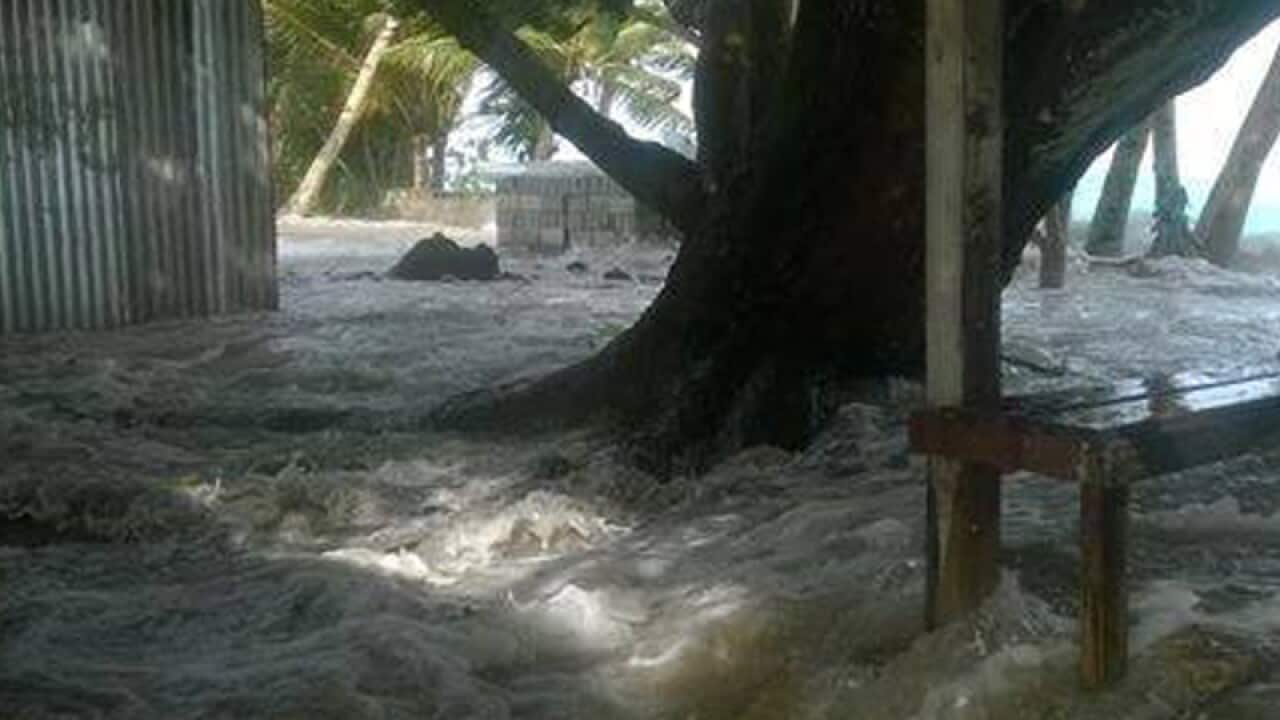
Tens of thousands of cyclone victims face at least a week without help and in all likelihood without food after Cyclone Pam devastated Vanuatu, Oxfam says.
Oxfam's Vanuatu director Colin Collett van Rooyen has been attending disaster response meetings in the capital of Port Vila, and says that while help is slowly arriving there, the same can't be said for Vanuatu's islands.
He fears it will be at least a week until authorities can reach all of the nation's islands, where access is challenging in fine conditions.
Initial reports of aerial surveillance at Erromango and Tanna - two of the main islands south of Efate, where Port Vila is located - are cause for deep concern.
Tanna, whose active volcano Mount Yasur has long been a tourist drawcard, appears to have suffered terribly.
"There are reports that entire communities seem to have faced massive destruction," Mr van Rooyen told AAP on Monday.
"Tanna has 29,000 people on an island that's about 40km by 20km so it's quite densely populated."
Beyond that, Oxfam and Vanuatu's Humanitarian Team are not aware of any other contact with, or intelligence from, the other 60 or so islands that are inhabited in Vanuatu.
"Some of these islands are really small and have very small communities of under 100 people. They are incredibly remote and even in perfect conditions, they might only have access to the outside world once or twice a month when a boat comes," Mr van Rooyen said.
"Under the conditions we have it's almost impossible. Most of them would not have operational landing strips and are accessible by boat. At an incredibly intense pace I'd say it would take at least a week to get to them all."
He said Pam's fury had wiped out the gardens remote communities relied upon for food.
"Vanuatu people use their gardens as their main food source. Even in Port Vila, people have been saying our food has gone. Food, and clean water, is going to be a huge problem."
Mr van Rooyen said he did not have an estimate of how many people were crowded into relief shelters, but he said there was no doubt many of those shelters would become long-term homes for families who'd lost everything.
But he said even in these early hours after the disaster, people were getting on with their lives.
"As soon as the all clear was lifted people were in the streets not just cleaning up their own spaces, but cleaning up the streets, helping other people.
"The world could take more than a couple of lessons on resilience from the people of this country."
Share


