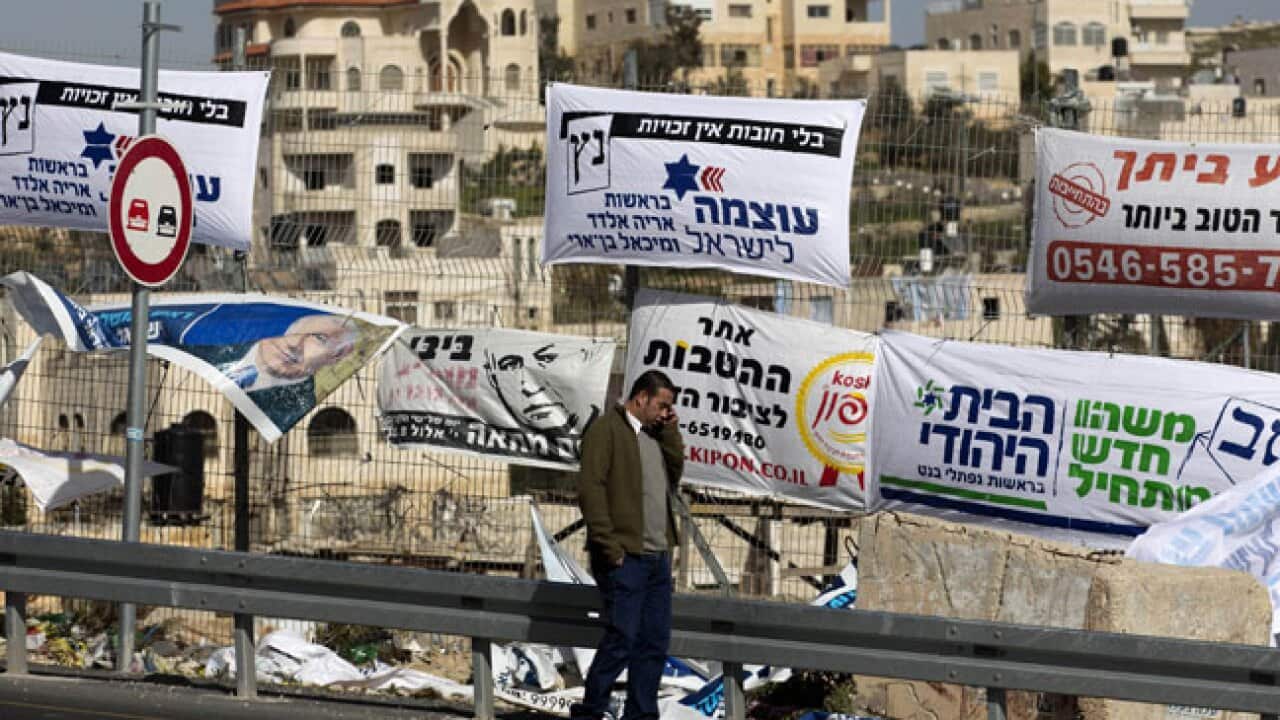
Israelis go to the polls on January the 22nd for an election that, for the first time in a long time, is dominated by domestic issues.
Some commentators are calling it "the boring election" because of a sense of inevitability about the re-election of Prime Minister Binyamin Netenyahu.
He is way ahead in the polls and is the only candidate with extensive experience in the job.
News that makes sense
Your trusted source for staying up-to-date with the world around you. Get free daily news updates and analysis, straight to your inbox.
Unleash the rhetoric and cue emotive tinkling pianos.
Election ad: "3,000 years ago, King David reigned over the Jewish state in our eternal capital Jerusalem. The Jewish people have come home. We will never be uprooted again."
Playing on Israeli television in the run-up to the January 22nd vote are the campaign ads of the ruling coalition.
They are accompanied by slogans on blue and white banners in Hebrew reading "strong Prime Minister, strong Israel".
Prime Minister Binyamin Netanyahu's party, Likud, is running on a joint ticket with a nationalist party, led by former Foreign Minister Avigdor Lieberman.
Political reporter at the Jerusalem Post, Lahav Harkov says it looks like a powerful alliance.
"You could say the main candidate is current Prime Minister Binyamin Netenyahu, his party the Likud, which merged with another rightwing party called Yisrael Beiteinu are polling by far as the biggest party - by at least 15 seats in most polls, so it's hard to say there is another main candidate. But the second biggest party would be Labour which is lead by Shelly Yachimovich, who is a relative newcomer. She has only been in politics for a few years, before that she was a popular television anchor and reporter."
Other parties include the centrist Hatnuah party, headed by former Foreign Minister Tzipi Livni and the the far right Bayit Yehudi party, which translates to Jewish Home.
In Israel, no single party has ever won a parliamentary majority.
That means the party with the most votes usually gets the first opportunity to try to form a coalition.
But Israelis, on the rainy streets of Jerusalem, appear mostly indifferent about the election.
"Anyhow I don't think that it will influence someone. it's a big, big waste of money, very boring. And not funny." // "It's all very mixed. And nobody, there's not one candidate that fits my viewpoint exactly so I'm going to have to compromise here and there and I'm still deciding."
Entrenched in what they view as their Biblical heartland, the hard-line Jewish settlers of Hebron are looking forward with delight to the election.
They cite opinion polls forecasting a right wing victory.
Prime Minister Netanyahu, already at odds with the world over Jewish settlements in the occupied West Bank, could end up with coalition partners that push him further to the right in a third term in office.
Hebron is home to 200-thousand Palestinians and about 800 Israelis.
Hebron settlers are among the most ideologically driven among the half-a-million Israelis who live on land Palestinians want for a state.
David Wilder speaks for the Jewish Community of Hebron.
"This time it seems that the right is getting stronger, the country is moving right, I mean we see that all the time, there's no doubt about that. However that does not necessarily mean the prime minister, following his re-election, will decide to form a right-wing coalition. He can go to the left. It is very difficult to know where Netanyahu will go. We hope and expect, because there are many people in the Likud who are very strongly right-wing, that he will form a right-wing coalition, but I won't believe it until I see it."
Binyamin Netanyahu has already announced more settlement expansion plans.
Settlement projects on the land Israel captured in the 1967 Arab-Israeli War are considered illegal by most world powers, which frequently criticise them as an obstacle to peace.
The pro-settler Bayit Yehudi, a natural ally of Mr Netanyahu's right-wing Likud party, is forecast to be the third largest faction in parliament.
Tech Millionaire Naftali Bennett, heads Bayit Yehudi.
He says a Palestinian state would be "suicide" for Israel.
"First of all, before we go about annexing, we have to reverse Israel's position and the world's position vis-a-vis forming a Palestinian state and only then very gradually apply Israeli law on the Israeli parts of Judea and Samaria (the West Bank). I think sometimes common wisdom is wrong. I think this is one of those cases. We are all together on a bus, the whole international community, riding toward a dead end. How many missiles do we need to endure in order for the world to wake up and see that what we've tried time and again and again is not working. Maybe it's time for a new approach."
But Jerusalem Post reporter Lahav Harkov says Israel's election campaign is mainly focusing on internal issues rather than the Palestinian issue.
"For the first time in a very long time the main issue really has not been in security or peace talks with the Palestinians - it's the sort of things you see in any other country in the world - economic issues, the effect of the world recession on Israel, the prices of housing, and here and there he will talk about the Palestinians and the Iranian threat. But domestic issues have really been the focus this time."
With a 2012 budget deficit of ten billion dollars, nearly twice the government's target, it's not surprising Israelis are focused on the economy.
A survey of 800 voters commissioned by the Times of Israel found 63 percent highlighted socio-economic issues as the most important issue facing the new government, with 19 percent nominating security and 16 percent peace with the Palestinians.
Nonetheless, Binyamin Netenyahu says his number one priority is stopping Iran from building an atomic bomb that could one day target the Jewish state.
Iran denies that its nuclear program is aimed at making bombs and says Israel, widely assumed to have the Middle East's only atomic arsenal, is the region's greatest menace.
At 63, Mr Netenyahu known universally in Israel by his childhood nickname 'Bibi', portrays himself as an uncompromising tough guy, a former commando turned conservative hardliner, who will go it alone against Iran, if necessary, to thwart what he sees as an existential threat.
And it was thanks to his father's teaching work in the United States that Mr Netanyahu developed one of his most important political tools - fluent English that he's used to great effect to woo influential audiences.
He became Israel's youngest Prime Minister in 1996.
A victory on the 22nd will give Binyamin Netenyahu and his Likud party another four-year mandate to rule.







