(Transcript from World News Radio)
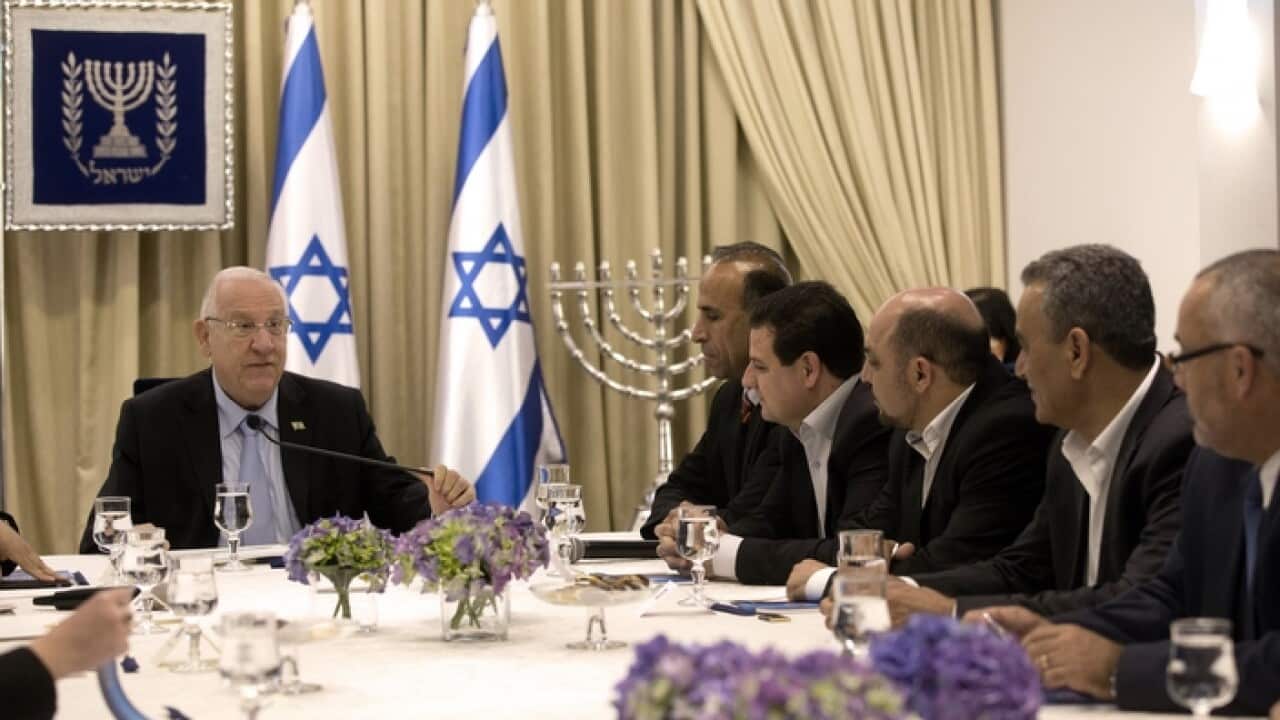
Israel's President Reuven Rivlin has begun consultations with political leaders, ahead of choosing who will form government.
The majority of them are expected to recommend Binyamin Netanyahu to head a new coalition after his decisive victory in the parliamentary elections.
News that makes sense
Your trusted source for staying up-to-date with the world around you. Get free daily news updates and analysis, straight to your inbox.
Brianna Roberts reports.
(Click on audio tab to listen to this item)
While the Israeli President performs a largely ceremonial role, one of his few powers is to choose the person with the best chance of putting together a coalition government after elections.
It's widely expected the President will hand the task to incumbent Prime Minister Binyamin Netanyahu, after his Likud (lih-KOOD) party won a resounding victory in the parliamentary elections.
At the start of his meetings with representatives of political parties, President Reuven Rivlin says has called for unity and healing, after a campaign that highlighted deep internal divisions.
(translated) "We've been through a stormy and passionate election season. This is the time to begin the process of fusing and healing Israeli society. The government that will be formed was chosen by the majority of Israel's citizens - but it will have to answer to all of Israel's citizens: Jews, Arabs, left, right, north, south, centre and periphery."
The coalition government will be formed amid growing tensions between the United States and Israel, deepened further by comments made by Mr Netanyahu in the lead-up to the election.
On the eve of the elections, Mr Netanyahu said there would be no Palestinian State established while he was in power.
However, Mr Netanyahu was quick to backtrack on his statement after the election, saying that he did want a two-state solution, but that the current situation did not allow for that to happen.
President Barack Obama says Mr Netanyahu's comments made it hard to find a path toward serious negotiations to resolve the issue.
"I did indicate to him that we continue to believe that a two-state solution is the only way for the long-term security of Israel, if it wants to stay both a Jewish state and democratic. And I indicated to him that given his statements prior to the election, it is going to be hard to find a path where people are seriously believing that negotiations are possible."
Further deepening the rift between the countries were Mr Netanyahu's election day comments accusing left-wing activists of working to get large numbers of Israel's minority Arab voters to sway the election.
Mr Netanyahu has denied trying to suppress the votes of Arab citizens or that his comments were racist.
Interior Minister Gilad Erdan, a close confidante of Mr Netanyahu, says the remark has been misinterpreted.
(translated) "We express deep sorrow over the wrong interpretation given to the Prime Minister's remark on election day to encourage voters of the national camp. Every person knows, in Israel and outside of it, that the state of Israel is a democratic state. We are proud of it. We act in order to keep the rights of minorities."
Mr Netanyahu's Likud party won the election by claiming 30 seats in the 120-member parliament.
Mr Netanyahu looks set to easily pull together a 61-seat majority along with its nationalist and religious allies.







