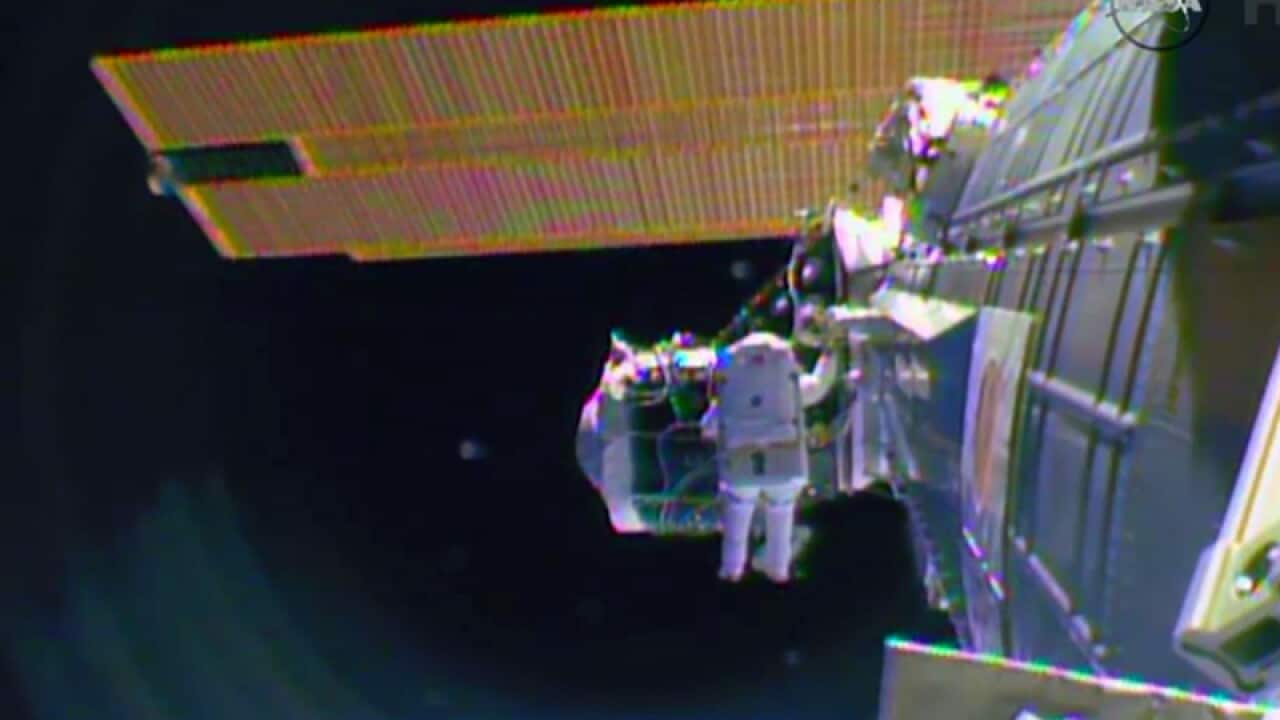
A pair of American astronauts have wrapped up the first of three spacewalks to route cables outside the International Space Station so commercial spaceships carrying crew can dock there in the coming years.
Saturday's spacewalk began when Barry "Butch" Wilmore and flight engineer Terry Virts placed their suits on internal battery power, NASA said.
Moments later, the pair - each carrying two suitcase-like bags of cables and tools - floated outside the airlock to begin the first of several spacewalks aimed at preparing the orbiting outpost for the arrival of US commercial crew capsules, bringing astronauts to low-Earth orbit in the coming years.
"Pretty cool," said Virts as he emerged, with the space station soaring about 435km over the South Pacific.
The spacewalk was Virts' first ever, and the second for Wilmore. It was also the 185th in the history of the space station.
News that makes sense
Your trusted source for staying up-to-date with the world around you. Get free daily news updates and analysis, straight to your inbox.
The team finished work after six hours and 41 minutes, and even managed one "get-ahead" task for their next spacewalk on Wednesday, which is to be followed by a third one on Sunday, NASA said.
"Welcome back, guys," said European Space Agency astronaut Samantha Cristoforetti, who helped orchestrate the spacewalk from inside the station.
The team routed 110 metres of cable. The total length of cable to be set up by next week is about 213 metres.
These spacewalks, along with several more outings in the coming months, are designed to prepare the station and the robotic arm for a pair of international docking adapters (IDAs), which will be delivered later this year.
When the new docking ports are eventually completed, up to two cargo ships and two crew ships will be able to latch on to the space station at the same time.
Boeing has said it hopes to send an astronaut and pilot for the first time in late 2017 to the International Space Station, aboard its crew capsule called CST-100.
NASA lost its ability to send astronauts to space when it closed the 30-year space shuttle program in 2011.
The world's astronauts must now rely on Russia's Soyuz capsules for transport to low-Earth orbit, at a cost of about $US70 million ($A89.89 million) per seat.







