The Indonesian capital's reputation as one of the world's most congested cities is typically not an advantage with investors.
But one company has become the country's most visible technology success with an app that relieves some of the pain of its maddening traffic.
The ride-hailing apps that are now part of daily life from New York to New Delhi and London are usually used to summon cars. Jakarta, the world's sixth-largest urban sprawl and by some measures the most car-clogged, needed something different.
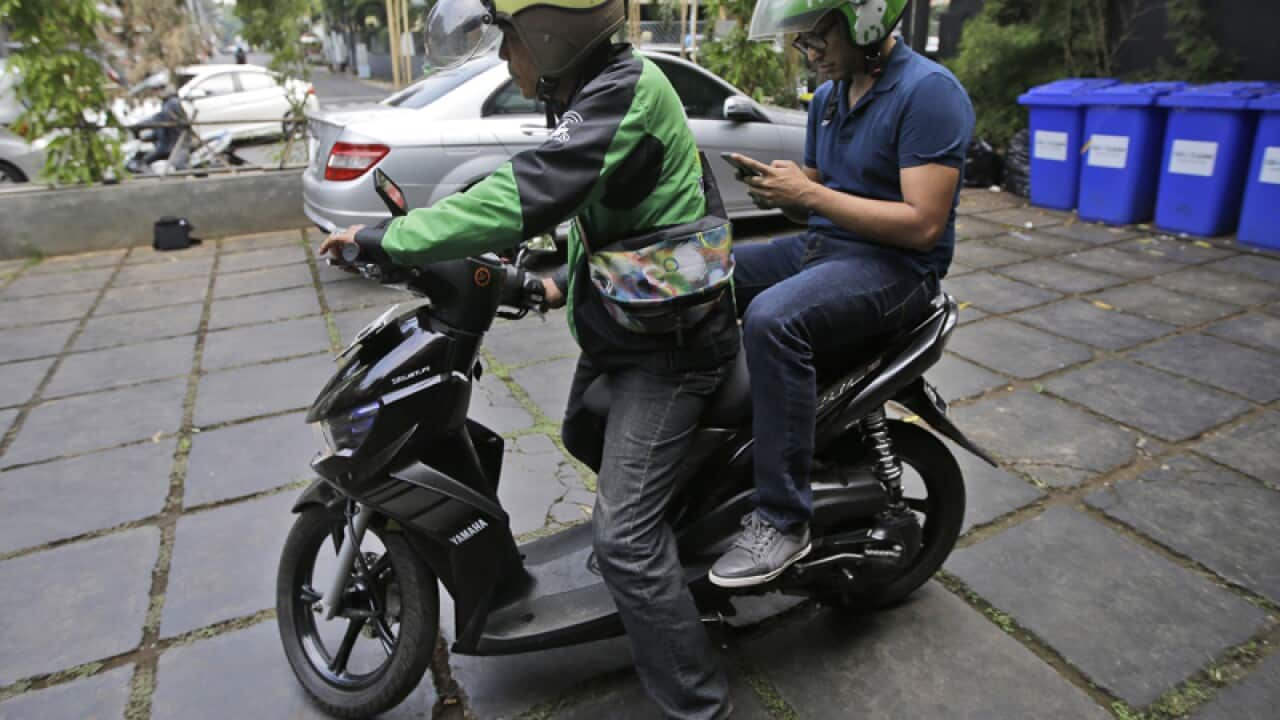
In hindsight, the Go-Jek mobile app for hailing rides on motorcycles, to dodge and weave through traffic, was a no-brainer.
But its sudden success over the past two years took even its founder by surprise.
The app's name is a play on "ojek," the Indonesian word for freelance motorcycle taxis, now a rare sight in Jakarta after many drivers joined Go-Jek's green-jacketed, GPS-coordinated ranks.
Makarim believes Jakarta's carmageddon had arrived at a "pain point" of huge unmet demand for a solution.
"Smartphone penetration was at an all-time high in Jakarta, traffic was at an all-time high," he said. "Getting yourself or your things from A to B in the quickest way possible could only be achieved by motorcycles."
As by far the biggest economy in Southeast Asia, making up a third of the region's gross domestic product, Indonesia has also attracted Uber and Go-Jek's fiercest competitor, Malaysia's Grab, which is headed by Makarim's Harvard classmate Anthony Tan.
Analysts say both Uber and Grab have greater scale and resources than Go-Jek, crucial for sustaining losses in the transport app industry's early stages and for keeping up investments in the behind-the-scenes technology that makes the apps easy for people to use.
Go-Jek has built on the usual strategy of providing rides to introduce a slew of additional Go- services to the app, including delivering food, groceries, cleaners, massage therapists and beauticians to homes.
Florian Hoppe, a partner at consulting company Bain who specialises in technology, said Go-Jek's approach is "fairly unique" but fits the situation in Jakarta and other Indonesian cities where service businesses are hobbled by transportation problems.
Like elsewhere, ride hailing apps are drawing an angry backlash from taxi drivers as their incomes drop. In March, a protest by thousands of taxi drivers that paralysed the capital turned violent, with cabbies brawling in the streets with green-jacketed drivers from Go-Jek and Grab.
Go-Jek says it has more than 200,000 drivers around Indonesia but the pain for taxis seems most acute in Jakarta, where all the ride hailing services are battling fiercely for customers, pushing fares to rock bottom.
Since a Go-Jek trip within the city costs only about 12,000 rupiah ($A1.22) outside of peak hours, the company is burning through its investment cash because in Jakarta the fares are lower than what it pays drivers.
Share


