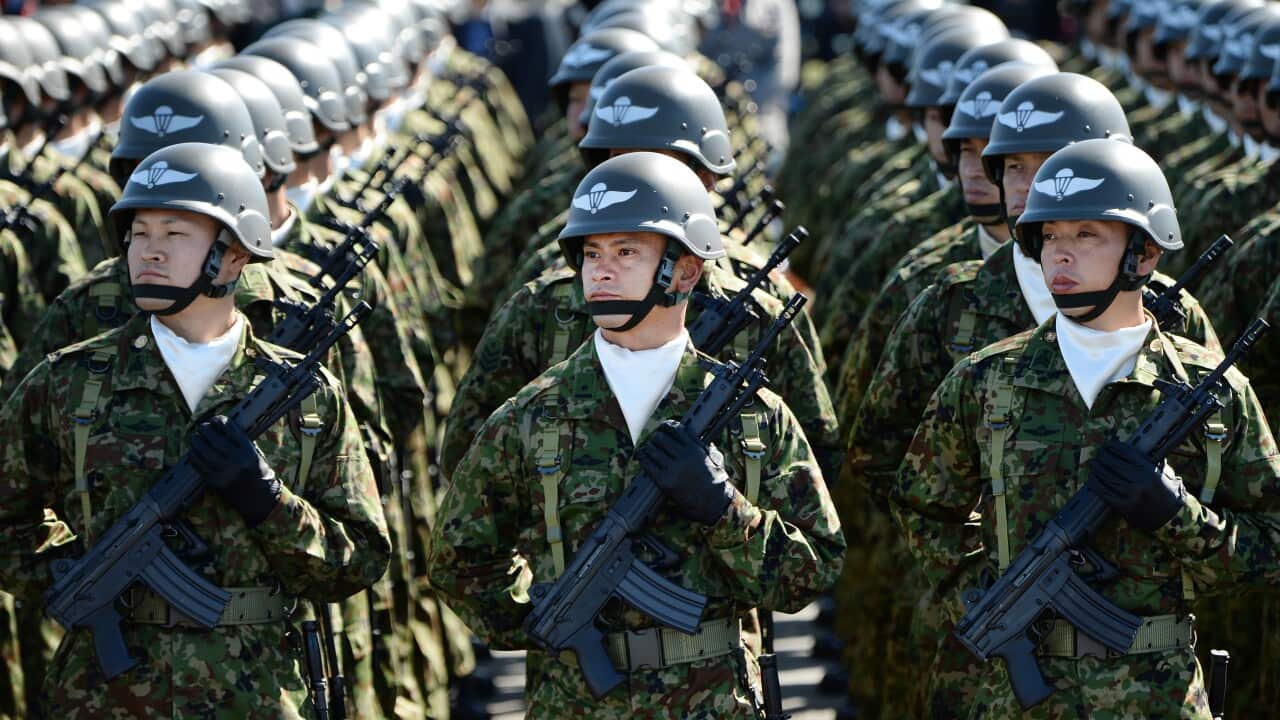
Though it conducts joint exercises with the United States, if war struck the Korean peninsula Japan could not so much as refuel an American plane heading into the fight.
Prime Minister Abe wants Japan's military to have a bigger role, to be able to come to the aid of its allies under attack.
"There's a misassumption that Japan will become a country that goes to a war, but that's absolutely impossible,” he says. “We will continue to maintain the pacifism that the Japanese constitution is advocating."
Change could be on the cards after an advisory panel backed reinterpreting the constitution.
Dr Yongwook Ryu, Regional Analyst at Australian National University, says a change in the military’s role could create significant backlash.
News that makes sense
Your trusted source for staying up-to-date with the world around you. Get free daily news updates and analysis, straight to your inbox.
"I don't think the Japanese deliberately are trying to pick a fight but the unfortunate consequence of this new change will be that there will be greater military tensions and conflict in the region,” he says.
The region is already unnerved by a Sino-Japanese territorial dispute over islands in the East China Sea.
And when Prime Minister Abe visited the Yasakuni shrine - spiritual home to several convicted war criminals - he reinforced his reputation as a hawk.
"This would probably be the most tense moment since the end of the Second World War"
Masato Takaoka, Japan's Consul-General in Sydney says there is nothing to fear.
"If you look at the Japanese record, over the past nearly 70 years after the end of the war, Japanese orientation as a country committed to peace and trying to make create is very much established,” he says.
“There is no doubt that Japan has never tried to be a sort of a country waging war again. That is not going to take place in our future. That is for sure."
Japan is to significantly increase defence spending over the next five years.
At 49 billion dollars its defence budget is eighth highest in the world, the highest being the United States with a $640 billion annual budget, and China in second, spending $188 billion a year.
China is asking Japan to keep neighbouring countries in mind when developing a new military strategy.
“We call upon Japan to respect the reasonable and deep concerns of the other regional countries," says China’s Foreign Ministry spokeswoman Hua Chungying. "Maintain a path of peaceful development, earnestly face up to and deeply reflect upon history."
It’s history that lies at the heart of the matter - Japan's pacifist constitution, which constrains its military, was written in the aftermath of Japan's years of rampant aggression.
Dr Ryu says the changes wouldn’t be doing Japan any favours.
“Honestly I think this would probably be the most tense moment since the end of the second world war,” he says.
Prime Minister Abe's determination is clear but the conclusion is not. Opinion polls show a majority of Japanese are opposed to the change.







