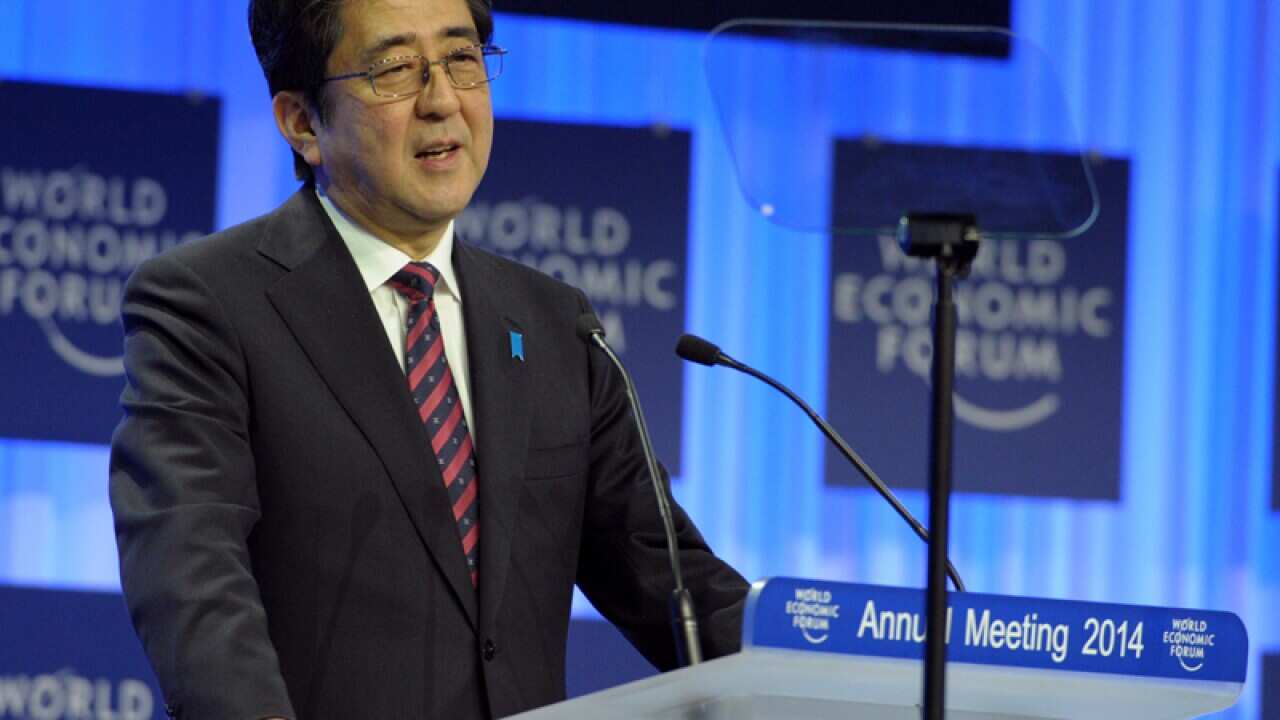
Japan has told the world it must stand up to an increasingly assertive China or risk a regional conflict with catastrophic economic consequences.
In a landmark speech to the World Economic Forum in Davos, Japanese Prime Minister Shinzo Abe issued what amounted to an appeal for international support in a potentially explosive dispute with its superpower neighbour over islands in the East China Sea.
"We must restrain military expansion in Asia ... which otherwise could go unchecked," Abe told the annual meeting of global business and political leaders, which Chinese Foreign Minister Wang Yi is due to attend on Friday.
"If peace and stability were shaken in Asia, the knock-on effect for the entire world would be enormous," Abe added.
"The dividend of growth in Asia must not be wasted on military expansion."
Although Abe did not explicitly mention China, his speech on Wednesday had been flagged up in advance by Japanese officials as an alarm call to an influential audience over what Tokyo sees as bullying by Beijing.
The dispute over the uninhabited but potentially mineral-rich islands is being played out against a backdrop of Japanese fears that China is seeking to exert control over lifeline shipping lanes around its vast coastline and that the United States' commitment to guarantee Japan's security is waning.
Tensions over the islands, which Japan calls Senkaku and China refers to as the Diaoyus, have come perilously close to boiling over into armed clashes on several occasions in recent years.
They resurfaced last month when Abe visited the Yasukuni shrine, a memorial to Japan's war dead which is controversial because a handful of convicted war criminals are among those commemorated.
China and South Korea seized on the visit as fresh evidence of Japan's perceived failure to sincerely repent for its 20th-century record of military aggression, and the visit has also been criticised as unhelpful by Britain and the US.
Much of Abe's speech was given over to a review of the progress of "Abenomics", his bid to end two decades of deflation which he said was on the verge of bearing fruit.
Describing Asia as a region of limitless potential and the engine driving world economic growth, Abe urged China to join a revitalised Japan in creating systems to prevent disputes from destroying their mutual prosperity.
Share


