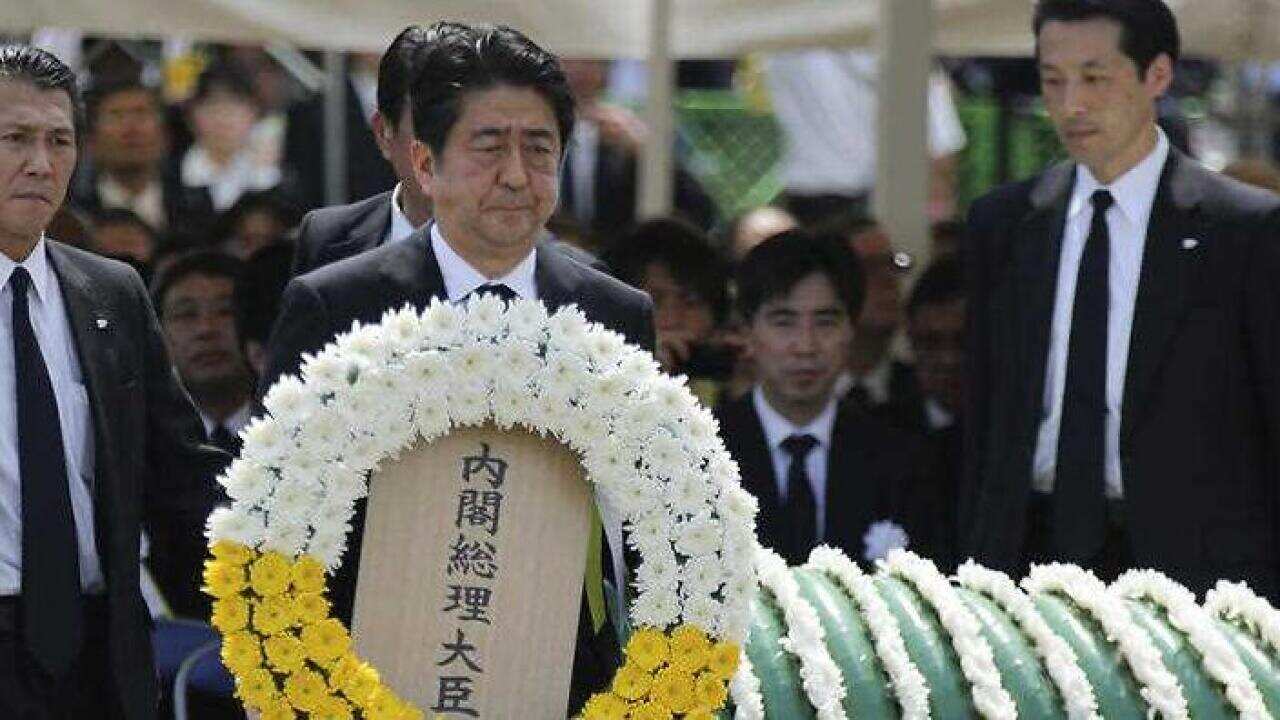
Prime Minister Shinzo Abe on Friday expressed "utmost grief" for the suffering Japan inflicted in World War Two and vowed that Japan would never again use force to settle international disputes, but he said that future generations of Japanese should not have to keep apologising for the mistakes of the past.
Abe, marking the 70th anniversary of the end of World War Two, also said he upheld past official apologies including a landmark 1995 statement by then-premier Tomiichi Murayama, but the conservative leader offered no new apology of his own.
The legacy of the war still haunts relations with China and South Korea, which suffered under Japan's sometimes brutal occupation and colonial rule before Tokyo's defeat in 1945.
Beijing and Seoul had made clear they wanted Abe to stick to the 1995 "heartfelt apology" for suffering caused by Tokyo's "colonial rule and aggression".
"Upon the innocent people did our country inflict immeasurable damage and suffering," Abe said in a statement.
"When I squarely contemplate this obvious fact, even now, I find myself speechless and my heart is rent with the utmost grief."
The remarks by Abe, who is seen by critics as a revisionist who wants to play down the dark side of Japan's wartime past, will be closely analysed in China and South Korea, and parsed by ally the United States, which wants to see an easing of tensions in the region.
CYCLE OF APOLOGIES
Abe's conservative political allies, however, have urged him to end what they see as a humiliating cycle of apologies that distracts from Japan's post-war record of peace.
"In Japan, the post-war generations now exceed 80 per cent of its population. We must not let our children, grandchildren, and even further generations to come, who have nothing to do with that war, be predestined to apologise," he said. "Still,
even so, we Japanese, across generations, must squarely face the history of the past."
Abe, who referred to the wartime sufferings of the Chinese in his statement, said he hoped Beijing would recognise Japan's "candid feelings" and that he hoped to meet Chinese President Xi Jinping if the opportunity arose.
But he told the news conference that attempts to "change the status quo by force" were unacceptable. Tokyo and Beijing are feuding over tiny East China Sea isles, while Japan is also wary of China's military assertiveness in the South China Sea.
Abe said Japan should "never forget that there were women behind the battlefields whose honour and dignity were severely injured".
But he made no direct reference to "comfort women", as the women, many of them Korean, forced into prostitution at Japanese wartime military brothels are euphemistically known.
Tokyo and Seoul have long been at odds over the issue of comfort women, with South Korea saying Japan has not done enough to atone for their suffering despite a 1993 apology that recognised authorities' involvement in coercing the women.
Abe said that Japan took the "wrong course and advanced along the road to war", but his statement did not specifically refer to what a report by his own advisers had called Tokyo's "aggression" in China after 1931.
Abe told the news conference that the question of whether a specific act was "aggression" should be left to historians.
Abe's statement comes as he pushes for a more robust defence policy through measures domestic critics say violate Japan's pacifist constitution. Public doubts about the bills have triggered a slide in Abe's ratings to below 40 percent.
Washington has welcomed the changes, which Abe says are needed to meet new challenges, including a more assertive China.
Share


