

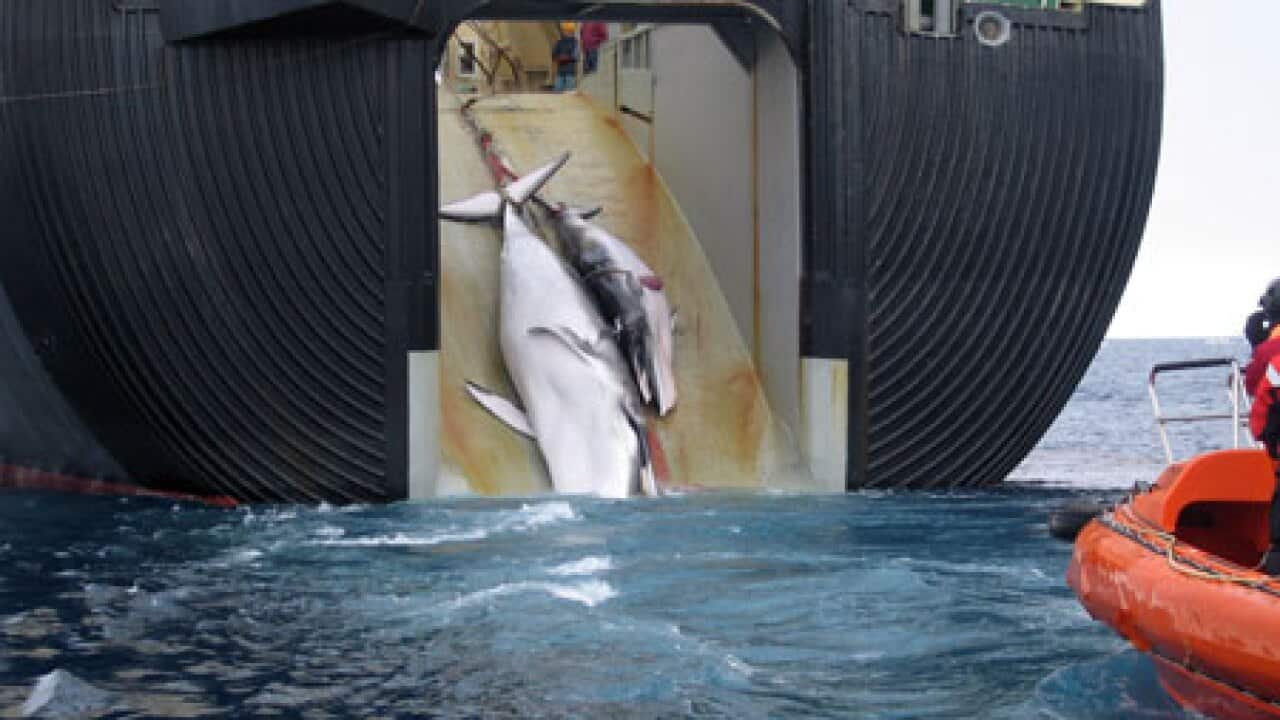
Japan's whaling fleet left port Tuesday for the country's annual hunt in Antarctica, press pictures showed, with security measures beefed up amid simmering international protests.
Three ships, led by the 720-tonne Yushin Maru, set sail from Shimonoseki in western Japan on a mission officially said to be for "scientific research", according to local media reports.
In past years, a mother ship has joined them later.
The government's fishery agency declined to confirm the reports, citing security reasons.
"In consideration of safety, we cannot make public the timing of the fleet's departure and its operational plans," Shinji Hiruma, an official of the agency's international division, told news agency AFP.
He only confirmed that in "usual years" the fleet left port in November or December and returned around March.
In February, Japan cut short its hunt for the 2010-2011 season by one month after bagging only one fifth of its planned catch, blaming interference from the US-based environmental group Sea Shepherd.
The fleet aims to catch around 900 minke and fin whales this season, according to a plan submitted by the government to the International Whaling Commission.
COMMERICAL BAN
Commercial whaling is banned under an international treaty but Japan has since 1987 used a loophole to carry out "lethal research" on the creatures in the name of science.
Japan has claimed it is necessary to substantiate its view that there is a robust whale population in the world. It makes no secret of the fact that whale meat from this research ends up on dinner tables and in restaurants.
Anti-whaling nations and environmentalist groups routinely condemn the activity as a cover for commercial whaling.
In October, Australia and New Zealand renewed their demands that Japan abandon its plan to return to the Antarctic Ocean.
New Zealand Foreign Minister Murray McCully said at the time the plan is "entirely disrespectful of the strong concerns expressed by Australian and New Zealand people for whom the Southern Ocean is our neighbourhood."
ANTI-WHALING ACTIVISTS
During the last whaling season, militant environmentalist group Sea Shepherd pursued the Japanese fleet for months in icy waters near Antarctica, seeking to stop the slaughter, as they had also done for the previous six years.
Activists hurled paint and stink bombs at whaling ships, snared their propellers, and moved their own boats between harpoon ships and their prey.
Japan stopped the hunt after killing 172 whales.
Sea Shepherd founder Paul Watson says his fleet will continue harassing Japanese whalers if they returned to the Antarctic sanctuary.
SECURITY BOOSTED
Japan's coastguard said on Monday that it will deploy an unspecified number of guards in the fleet for protection against obstruction by anti-whaling activists. It did not give any further details.
Coastguard officers travelled aboard the fleet in the 2007-2008 and 2010-2011 seasons, but did not announce their presence beforehand.
"We have decided to beef up security as never before," a coastguard official told Japanese media.
Environmentalist group Greenpeace condemned the annual hunt, saying money spent on protecting the whaling fleet would be better directed to helping the recovery from the March 11 earthquake and tsunami that devastated Japan's northeast.
Greenpeace said the government was spending an extra 2.28 billion yen ($30 million), on top of its normal $10 million annual subsidy, in helping the hunt this year.
"Not only is the whaling industry unable to survive without large increases in government handouts, now it's siphoning money away from the victims of the March 11 triple disaster, at a time when they need it most," said Junichi Sato, executive director of Greenpeace's Japan branch.
PRESSURE MOUNTS IN JAPAN
Citizens groups and non-governmental organisations in Japan last week urged the government to implement a fundamental review of whaling.
The groups criticised the government for earmarking money in its budget for whaling, which is subject to a 1986 international moratorium and is opposed by many other countries.
Japan approved a ¥12.1 trillion ($A152.63 billion) supplementary budget in late November, which would fund reconstruction in the north-east, which was ravaged by the March earthquake and tsunami. About ¥2.28 billion ($A28.76 million) of the money is going for whaling, the groups pointed out.
"That is inexcusable," said Nanami Kurasawa, executive director of the Dolphin and Whale Action Network. "We believe many of the public hope the money would be spent on the regeneration of the coastal communities and disaster victim support."
Japan's whaling is not supported by international agreements, Junichi Sato, executive director of Greenpeace Japan, said in a statement. "It is not something into which the government pumps large amounts of taxpayers' money," he said.
Tatsuya Nakaoku, a fisheries agency official, said it was aware that Japan's whaling has been criticised.
"But that does not mean Japan has been isolated," Nakaoku insisted. "Japan's scientific research whaling has been supported by many International Whaling Commission member nations."