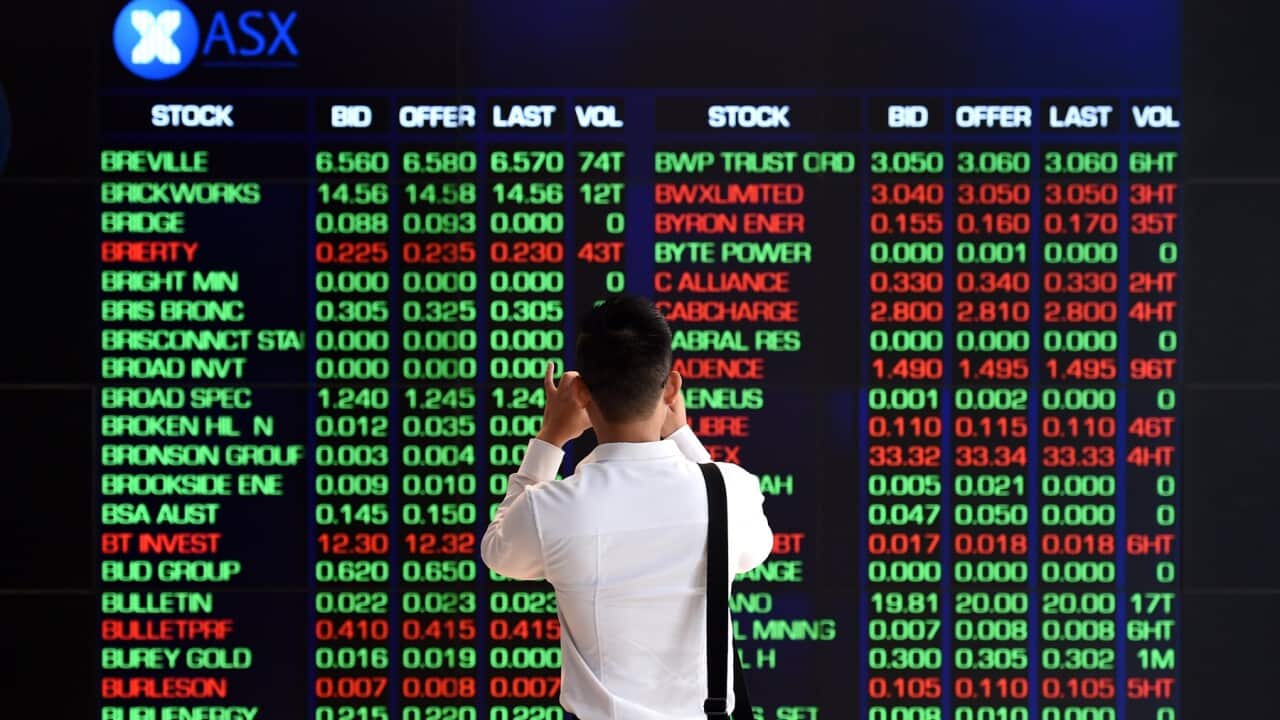
The falls on share markets around the world on Tuesday may have been dramatic, but analysts were not, pointing out that the record bull market in the US seen in the past 12 months or so was never going to last forever.
'A big correction'
“I think what we’re seeing particularly in the US is a big correction,” Francesco De Stradis, an investment advisor from Sydney stockbroker Ord Minnett told SBS News. “The US market got a bit overvalued. Even today it’s 20 per cent higher than it was 12 months ago. It got a bit ahead of itself.”
News that makes sense
Your trusted source for staying up-to-date with the world around you. Get free daily news updates and analysis, straight to your inbox.
Asian shares fell sharply on Tuesday after Wall Street suffered its biggest decline since 2011. Japan's Nikkei dropped 4.6 per cent. Australian shares dropped 3.0 per cent to their lowest level since October while South Korean shares dropped 2.0 per cent. All three broke below their 100-day moving average.
Mr De Stradis said that investors were moving out of equities and into bonds with interest rates rising in the US. “That’s ultimately not a bad thing because people are seeing signs of their economy improving, job numbers are strong.”
Australia 'just following suit'
Mr De Stradis downplayed the implications of the Australian market tumble.
“What we're seeing here in Australia is just following suit, but we’re not seeing it as extreme as we’re seeing in the US … our market got a bit overvalued as well. We’re still trading higher than we were 12 months ago by about 5 per cent.
“It’s always concerning to see the market fall in these large movements, but I think from a longer-term perspective the focus should be on how the world economy is performing and how it will be impacting on business. There will be opportunities to buy bargains coming up.”
US economy 'improving'
Mr De Stradis said he would be advising his clients to be patient.
"If the world economy was still struggling I’d have some serious concerns, but it doesn't seem to be that way. We’re seeing the US economy improve, tax cuts in the US which is positive for business over there ... but we're also seeing signs of an improving economy in Europe as well, which all goes good for global growth."
It came after US stocks plunged in highly volatile trading on Monday, with the Dow industrials falling nearly 1,600 points during the session, its biggest intraday decline in history, as investors grappled with rising bond yields and potentially higher inflation.
"Since last autumn, investors had been betting on the Goldilocks economy - solid economic expansion, improving corporate earnings and stable inflation. But the tide seems to have changed," said Norihiro Fujito, senior investment strategist at financial security company Mitsubishi UFJ Morgan Stanley Securities.
The S&P 500 ended 7.8 per cent down from its record high on January 26. Before Monday's fall, the index had not seen a pullback of over 5 per cent for more than 400 sessions, which analysts say was the longest such streak in history.
The trigger for the sell-off was a sharp rise in US bond yields following Friday's data that showed US wages increasing at the fastest pace since 2009, raising the alarm about higher inflation and with it potentially higher interest rates.
'Markets are volatile': Scott Morrison
Australian Treasurer Scott Morrison also downplayed the significance of the stock market moves.
"Markets are volatile - when they recalibrate in relation to events like this you do see a bit of these events happening," Mr Morrison told reporters in Canberra.
"But people who watch these markets more and participate in them more closely than I do, I think, will see this for what it is and understand the forces behind it."
Mr Morrison later told the Coalition party room that the fundamentals of Australia’s economy were very strong. He said Australia's record jobs growth is better than any year under former Liberal Prime Minister John Howard, adding 403,000 new jobs in 2017, significantly higher than the best year under Howard (343,000) or Labor (282,600).







