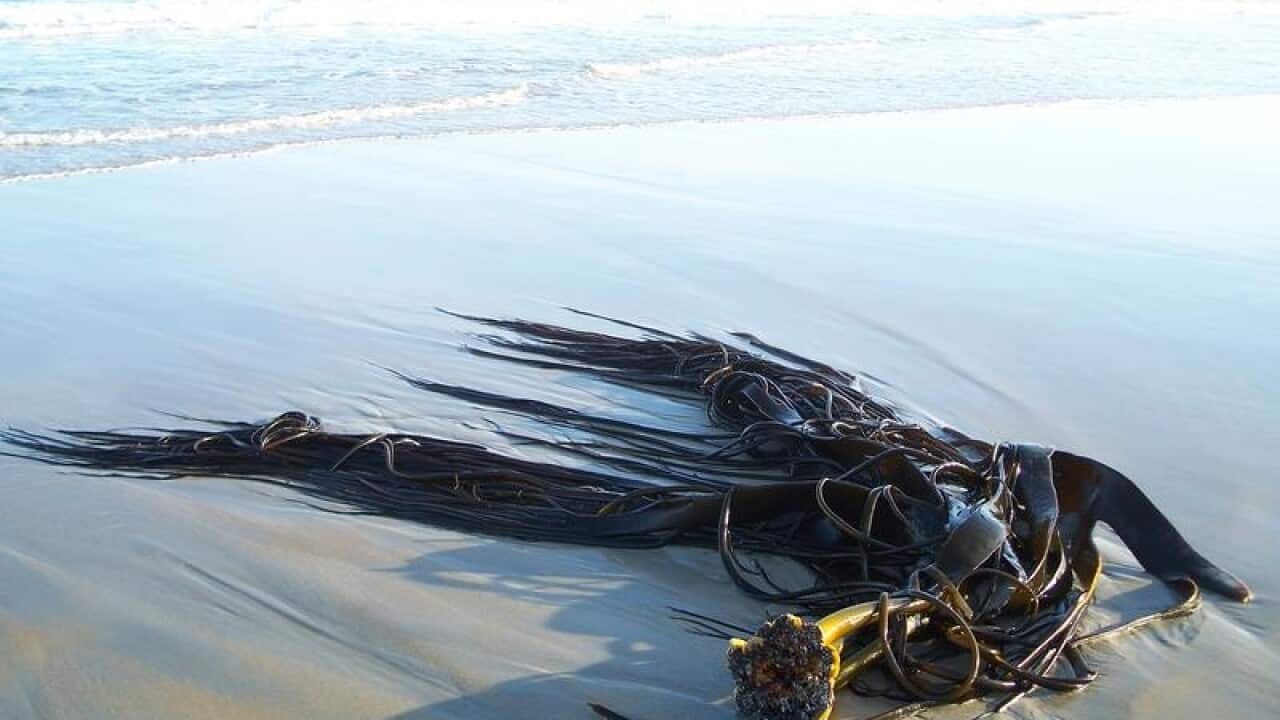
The mysterious discovery in Antarctica of a type of kelp not known to exist in its icy waters has scientists wondering whether the frozen continent is as biologically isolated as they have long believed.
Using genomic tests, Australian and Chilean scientists identified the kelp as a species native to the remote South Georgia islands off the coast of Argentina and the Kerguelen Islands, southwest of Western Australia.
They believe the kelp "surfed" 20,000km to King George Island, just off the Antarctica Peninsula, after getting caught up in storms that helped it breach the Southern Ocean's strong polar winds and currents.
Scientists have long thought those winds and currents act as natural barriers to stop plants and most animals from reaching the frozen continent.
Lead researcher Dr Crid Fraser, of ANU's Fenner School of Environment and Society, says the fact the kelp made it to Antarctica - in what is being hailed as the longest biological rafting event ever recorded - overturns theories about how its unique plants and animals evolved because of their isolation.
News that makes sense
Your trusted source for staying up-to-date with the world around you. Get free daily news updates and analysis, straight to your inbox.
Instead she argues that Antarctica's flora and fauna are distinct purely because they can cope with the extreme weather conditions.
Dr Fraser warns that if global warming continues and Antarctica's conditions moderate, its unique species could be threatened by tiny foreign marine creatures and insects that surf there on "rafts" like kelp and adapt to life there.
"Anything that's floating right at the surface, plastics, floating seeds, driftwood with insects on it, those things should be able to surf to Antarctica," Dr Fraser told AAP.
"The modelling we've done suggests ... somewhere between a handful to up to several thousand pieces of floating kelp are probably reaching the Antarctic coast every month.
"So that's constant bombardment. We are talking possibly as many as thousands of rafts of kelp reaching the coast every month, so that's an ongoing supply of plants and animals."
The research, published in the journal Nature Climate Change on Tuesday, suggests that kelp can make it to Antarctica from South Georgia within two years.
Dr Fraser recently began to doubt long-held theories about Antarctica's biological isolation after noticing kelp floating in the Southern Ocean while she sailed to the frozen continent.
"There isn't any evidence of anything biological except large whales or birds, things that swim or fly really strongly, being able to get into and out of Antarctica. So we've thought that it's not possible," she said.
"But I think that's starting to be reversed. We are starting to see it's not as isolated as we thought.
"It's just really cold and inhospitable so things can't establish there. They can get there though.
"I don't think it'll be a long time until we see natural invasions."
The study comes after separate research released by Greenpeace in June found microplastics and chemicals had been detected in Antarctica's water and snow.







