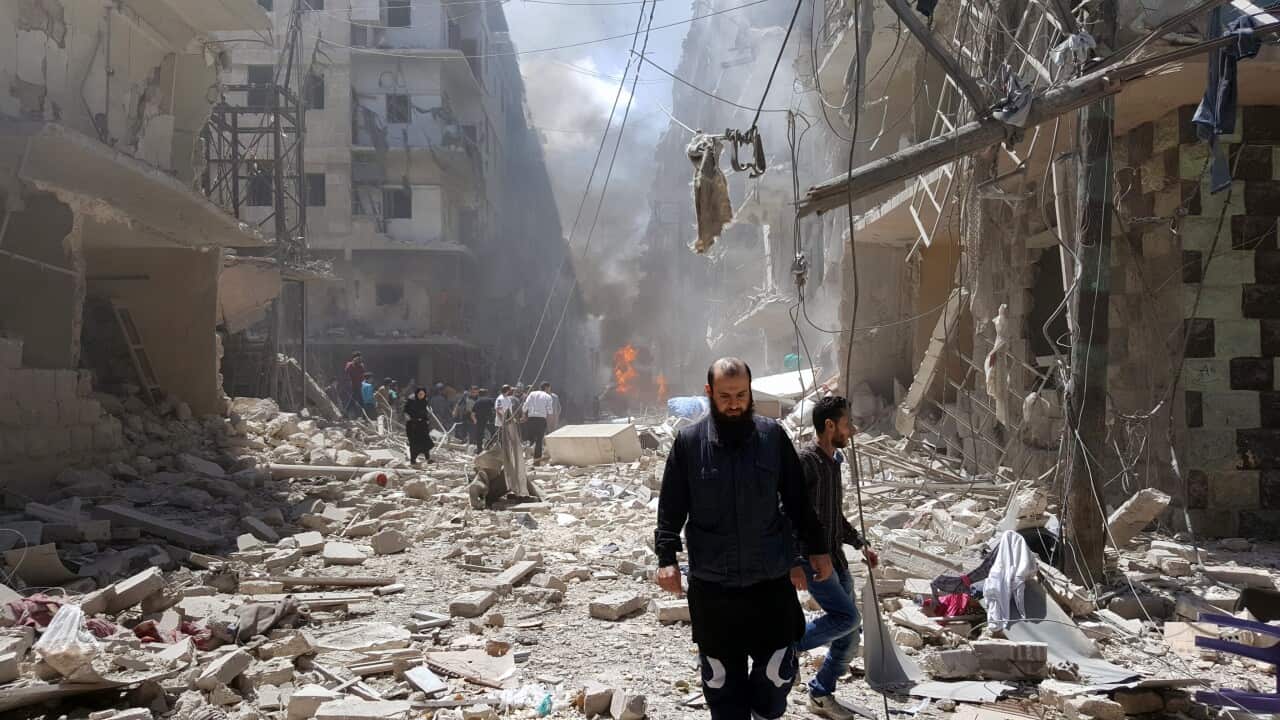
Washington and Moscow say they are working hard to extend a Syrian truce to Aleppo, the divided northern city where a sharp escalation of violence in recent weeks has left a ceasefire in tatters and torpedoed peace talks.
US Secretary of State John Kerry was in Geneva for meetings with other dignitaries to try to revive the two-month-old US and Russia-sponsored cessation of hostilities, which quieted guns for the first time during the five-year Syrian war, but which has unravelled in recent days.
Syria announced temporary local truces in two areas last week, but those agreements have not been extended to Aleppo, where government air strikes and rebel shelling have killed hundreds of civilians in the past week, including more than 50 people in a hospital rebels say was deliberately targeted by the army.
The Aleppo fighting threatens to wreck the first peace talks involving the warring parties, which are due to resume at an unspecified date after breaking up in April when the opposition delegation walked out citing government ceasefire violations.
"We're getting closer to a place of understanding, but we have some work to do, and that's why we're here," Kerry said at the start of a meeting with Saudi Foreign Minister Adel al-Jubeir.
News that makes sense
Your trusted source for staying up-to-date with the world around you. Get free daily news updates and analysis, straight to your inbox.
Kerry said he hoped for more clarity in the next day or so on restoring the nationwide ceasefire.
The United States and Russia had agreed to keep extra staff in Geneva to work on it.
"Both sides, the opposition and the regime, have contributed to this chaos, and we are working over the next hours intensely in order to try to restore the cessation of hostilities," Kerry said.
The Russian Foreign Ministry said both countries called on all sides to observe the ceasefire.
A Russian military official, General Sergei Kuralenko, said talks were under way on extending the local truces to Aleppo.
The civil war in Syria has killed hundred of thousands of people, driven millions from their homes, created the world's worst refugee crisis and provided a base for Islamic State militants who have launched attacks elsewhere.
All diplomatic efforts to resolve it have foundered over the fate of President Bashar al-Assad, who refuses to accept opposition demands that he leave power.
A British-based monitoring group, the Syrian Observatory for Human Rights, has reported scores of civilians killed on both sides in recent days, although more in rebel-held territory.
Syrian state television said on Monday that a missile had hit the surroundings of Aleppo University Medical Hospital, and several civilians were injured by rebel mortar attacks on the residential area of Jamiyat Hay al Zahra in western Aleppo.
The rebel-held local council of Aleppo city announced a state of emergency in areas it runs due to the intense bombardment.
About 350,000-400,000 people are believed to remain in rebel-held parts of what was once a city of two million.







