Thailand's recent years of political turmoil have been dominated by a group of key figures defined by their links to ousted PM Thaksin Shinawatra.
The main players involved are:
THAKSIN SHINAWATRA: Telecoms tycoon-turned-politician Thaksin came to power in elections 2001.
News that makes sense
Your trusted source for staying up-to-date with the world around you. Get free daily news updates and analysis, straight to your inbox.
The former policeman's policies won over the poor but also launched controversial crackdowns on drug traffickers and separatist militants in the south that left thousands dead.
Thaksin also faced opposition from elite circles in the palace, military and bureaucracy.
Allegations of corruption and accusations that he had insulted the revered monarchy eventually led to his ousting in a 2006 coup, after months of protests by the yellow-shirted People's Alliance for Democracy (PAD).
He fled into exile in August 2008 before a court sentenced him in absentia to two years in jail for corruption. Thailand has also frozen his two-billion dollar fortune.
ABHISIT VEJJAJIVA: Educated at Britain's elite Eton College and Oxford University, Abhisit came to power in December 2008 in a parliamentary vote after a court forced Thaksin's allies from power.
Abhisit leads the Democrat Party, which was in power before Thaksin's rise to the top. The party is the biggest in a fragile coalition government that also includes defectors formerly loyal to Thaksin.
His failure to prevent protesters from wrecking a key summit of Asian leaders has weakened his backing from the influential military.
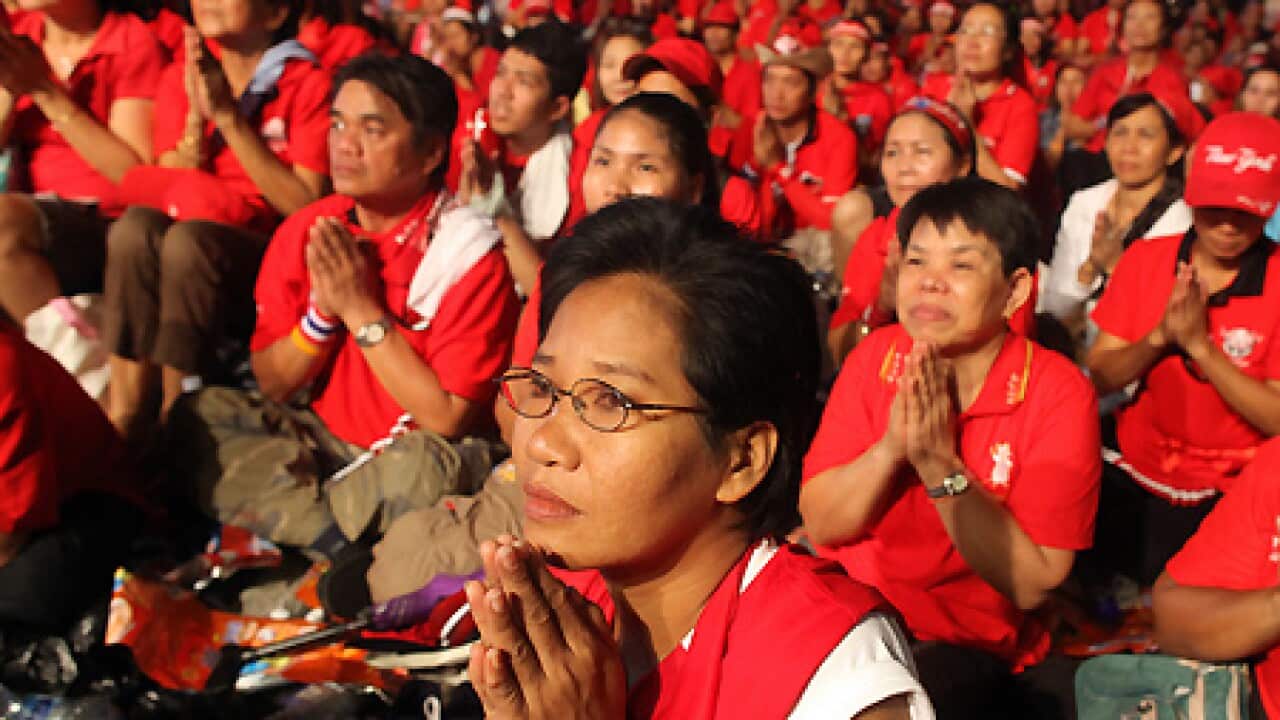
RED SHIRTS (United Front for Democracy against Dictatorship): The group behind the current protests in Bangkok, it supports Thaksin and was formed last year to hit back against the rival, yellow-clad PAD.
The red shirts want Abhisit to resign and call elections, saying that his rise to power was illegitimate.
Their base is drawn from the poorest sections of society, in particular the north and northeast of Thailand.
Trademarks include their scarlet shirts and plastic clappers shaped like hearts and feet which they wave at rallies.
YELLOW SHIRTS (People's Alliance for Democracy): Formed in late 2005 to oppose Thaksin, the group claims allegiance to the throne and is backed by the country's Bangkok-based elite.
Its rallies in 2006 helped trigger the coup that unseated Thaksin, but after a year of military rule the PAD was dismayed to see Thaksin's allies re-elected and it reformed in early 2008.
Its campaign of street protests escalated to a four-month siege of government offices and finally a nine-day blockade of Bangkok's airports.
It stood down after Thaksin's allies lost power in December.
BLUE SHIRTS: A shadowy pro-government militia linked to politician Newin Chidchob, the son of the parliamentary speaker, whose defection from Thaksin's allies was vital for Abhisit to form a government in December.
The mob was first seen in March protecting Bangkok airport from a possible seizure by the Red Shirts.
They reappeared in the beach resort of Pattaya at the weekend, clashing with the pro-Thaksin protesters who later derailed the Asian summit.
ARMY: The military constantly looms in the background of Thailand, which has seen 18 coups since 1932 when the country became a constitutional monarchy.
Anger against the army's role in politics peaked with the bloody suppression of protests against a military-run government in 1992.
A new constitution formed in 1997 was meant to usher out the era of coups, but that collapsed with Thaksin's ouster nine years later.
The army remained in charge for a year after the coup until elections in December 2007.
The military has since seemed unwilling to intervene, failing to stop the PAD protests last year and doing little to prevent the storming of the Pattaya summit.
THE KING: Thailand is a constitutional monarchy nominally headed by revered King Bhumibol Adulyadej.
King Bhumibol has presided over more than 25 prime ministers and 18 constitutions during his rule.
The king does not publicly arbitrate in times of crisis, but during the 1992 uprising he chastised both the military and protest leaders, effectively bringing an end to the violence.







