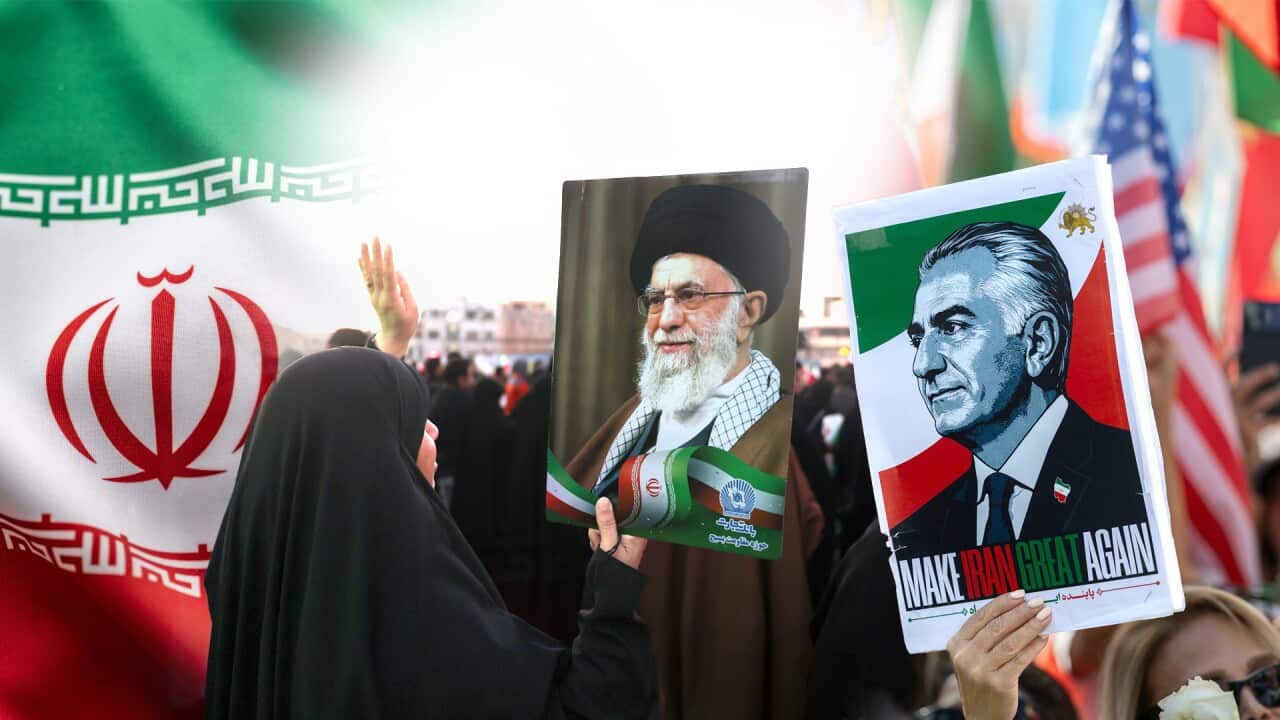
Iran has only had two supreme leaders since the 1979 revolution — and with the death of Ayatollah Ali Khamenei, the country's future looks increasingly uncertain.
The recent killing of Khamenei by United States and Israeli strikes also raises domestic questions about the continuation of clerical rule in the Islamic Republic.
For now, Iranian state TV on Sunday announced a transition period will be led by President Masoud Pezeshkian, judiciary chief Gholamhossein Mohseni Ejei and another official from the country's legal council.
The complexities of Iran's ruling system, the ideological nature of its support base, and the power of the Islamic Revolutionary Guard Corps (IRGC) make it hard to predict what might come next.
Australian National University expert George Lawson, who specialises in revolutions and radical change, said it's too early to tell whether the US-Israeli attacks spell the end of the regime as we know it.
News that makes sense
Your trusted source for staying up-to-date with the world around you. Get free daily news updates and analysis, straight to your inbox.
A US-Israeli 'decapitation' strategy to remove the leader will not necessarily mean the regime's demise, he said.
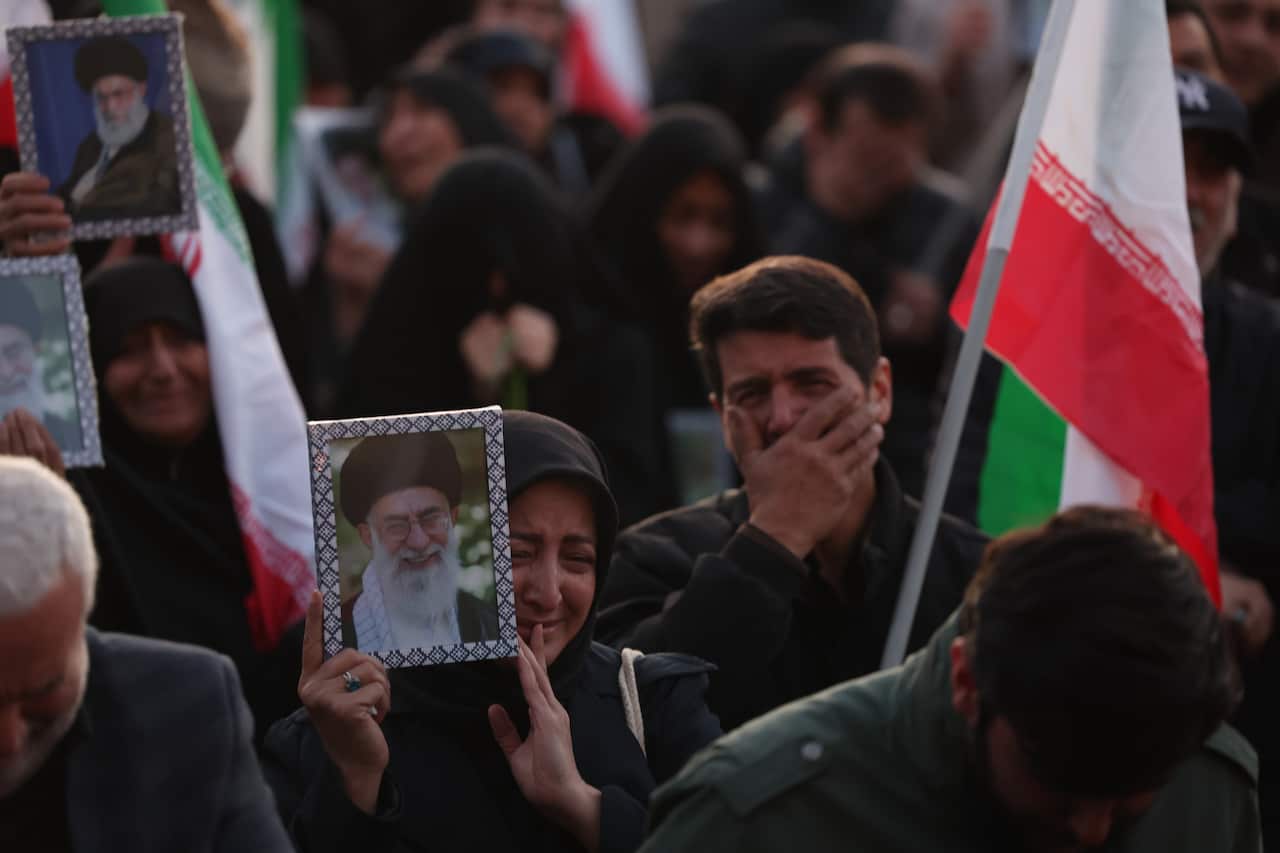
"With a regime like this that's so deeply embedded and so bound up with common fate, what you really have is a kind of protection pact, or even kind of survival pact amongst the constituent parts of the state," Lawson told SBS News.
"It's not like a monarchy where you take out the royal family and there's not much left behind it. This is a state and a regime that's deeply, deeply embedded and deeply bound up with each other bit."
Trita Parsi from the US think tank the Quincy Institute for Responsible Statecraft suspected "the hope on the American and Israeli side is that the killing of the supreme leader ... is essentially that the regime as a whole moves much closer towards collapse and then regime implosion".
But Iran expert Dara Conduit from the University of Melbourne does not believe Khamenei's death spells the end of the regime.
With the IRGC having hundreds of thousands of members, and the Iranian political elite stationed across the economy and all sectors of society, she said the regime was far from being "hollowed out" and was firmly institutionalised.
"I think there are still far too many people in the Iranian regime that stand to lose more with the fall of the regime than they would if there was regime change," she said.
"So I think this regime isn't going to go down without a fight."
Will the US send soldiers to Iran?
Conduit said regime change cannot be achieved through airstrikes alone, and does not believe that the United States and Israel have the capacity to mount a ground war.
"That takes enormous preparation, a build-up of troops," she said.
"And I don't think President Trump has the political support for that kind of war, either."
Only around one in four Americans approve of the military operation, according to a Reuters/Ipsos poll on Sunday.
Nonetheless, Lawson said the domestic legitimacy of the Iranian regime has been waning.
"The regime is desperately, extraordinarily unpopular," he said.
"Any legitimacy they built up has been systematically eroded. We see that from the amount, quantity and quality [and] extent of protests that have built up over the years.
"The second thing is that legitimacy now only really has the power of the gun left behind."
Who will replace Khamenei?
Under Iran's system of vilayat-e fa'ih — the guardianship of the Islamic jurist — the supreme leader must be a cleric.
In theory, the Assembly of Experts, a body of senior ayatollahs elected every eight years, appoints the leader and even has the constitutional authority to dismiss one. In practice, as analysts note, transfer of power is rarely so procedural.
Conduit said succession has long been under quiet discussion, given Khamenei's age and health.
But she added "it's a question that they've never actually been able to clearly answer".
The most obvious contender, former president Ebrahim Raisi, was killed in a helicopter crash in 2024.
Names circulating publicly include Ali Larijani, who is secretary of Iran's Supreme National Security Council, though Conduit stressed he "is actually not qualified to take the position because he's not a scholar".
Whoever emerges may lack popular standing — as she noted, "Khamenei never had a large popular following" — but in a system sustained by clerical networks and the Revolutionary Guards, charisma may be less decisive than consolidation.
Who is Mohammad Reza Pahlavi?
Speculation about Iran's future has also revived discussion of the monarchy overthrown in 1979 — and of figures linked to it.
US-based Iranian opposition figure Reza Pahlavi has lived outside Iran since before his father was toppled in the Islamic Revolution and has become a prominent voice in protests abroad.
Associated with monarchist factions that favour restoring the pre-revolutionary order, the 65-year-old is among the most recognisable opposition figures outside the country.

But Iran's opposition is fragmented among rival groups and ideological factions — including the monarchists who back Pahlavi — and appears to have little organised presence inside the Islamic Republic.
Lawson was sceptical that restoration carries deep roots inside the country.
"There's a desperation to see the regime go and see there as being something different," he said.
While some demonstrators have invoked monarchical symbols, Lawson described the idea of installing an external figure as fraught.
"This is a guy who spent almost none of his life there, who’s really certainly as American as he is Iranian," he said, adding: "I'm not clear that many people want to replace one dictatorship with another".
He drew parallels with Iraq and Afghanistan, where figures returning from exile struggled for "legitimacy on the ground".
In that context, Lawson argued, any attempt to impose a preferred leader would be "extremely unlikely" to generate enduring authority inside Iran.
— With additional reporting by the Reuters news agency.
For the latest from SBS News, download our app and subscribe to our newsletter







