
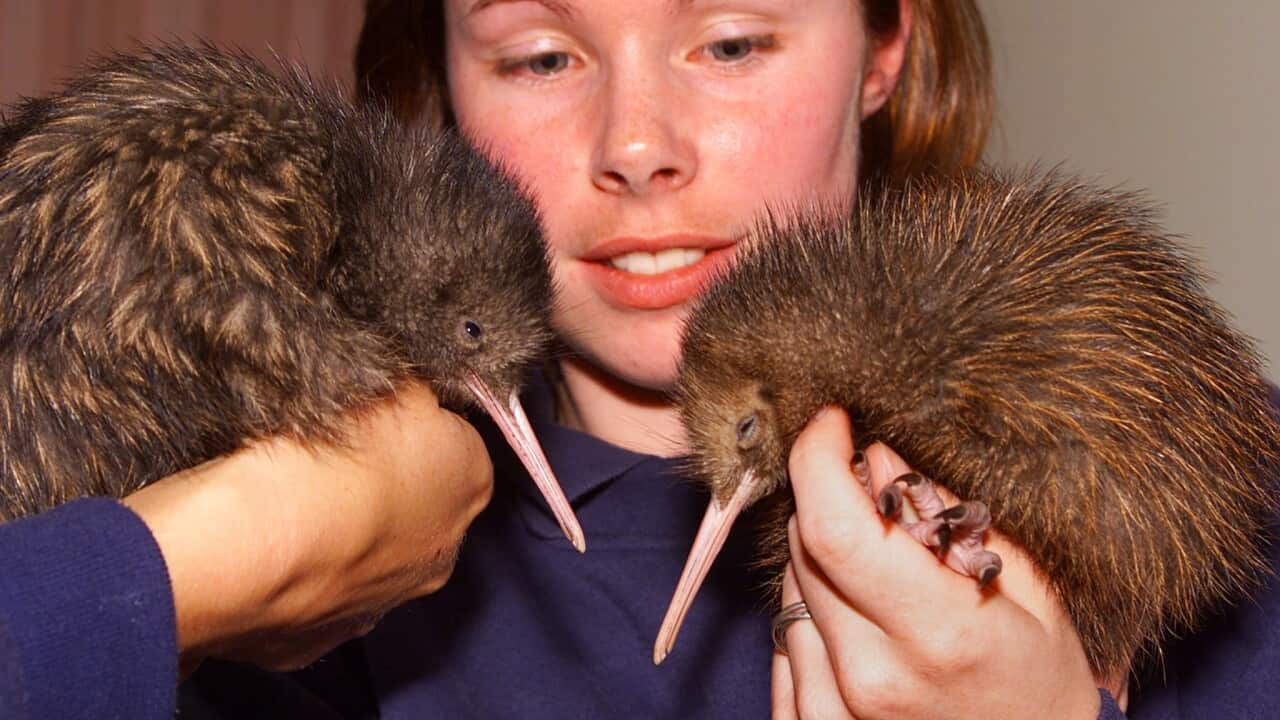
The tiny, flightless kiwi doesn't share its closest ancestors with the Australian emu as previously thought, but with the massive Madagascan elephant bird which weighed in at up to 275kg and stood as high as three metres.
New DNA research at the University of Adelaide, published in the journal Science on Friday, overturns previous thinking on the ancestry of New Zealand's national bird.
Research published late last year suggested the kiwi - which weighs up to 3.3kg - may have descended from the same bird as the emu, raising hackles among patriotic New Zealanders.
However, one of the authors of the new study, Professor Alan Cooper, a New Zealander who has been researching kiwi for about 25 years, says advances in DNA techniques meant they could finally map the entire genome of mitochondrial DNA taken from bones of the elephant bird, Aepyornis.
That showed the Madagascan giant, the largest bird ever to have lived and which became extinct in about the 17th Century, was actually the closest relative of the diminutive kiwi.
"Which is about as bizarre a finding as we could get," Prof Cooper said.
"If I had to guess of all the ratite birds which one the Madagascan elephant bird was going to be closely related to the kiwi would have been the last, by a mile."
The finding also offers new insight on the evolution of ratites, which have puzzled scientists for about 150 years.
Ratites are found only in the southern hemisphere and include ostriches, emus, cassowaries, rhea, kiwi and the extinct moa.
Prof Cooper said the flightless birds had been the "poster child for continental movement", where it was believed they originated in the southern supercontinent Gondwana, before it began to break up about 130 million to 50 million years ago and the birds then evolved separately.
However, recent research suggests ratite species - then about the size of a partridge - were able to fly.
There was a window of time - maybe about 10 million years - between the disappearance of the dinosaurs and the emergence of mammals, when the ratites seized the opportunity to become big herbivores.
They dispersed around the southern hemisphere and evolved into the similar forms that are seen today.
"When you look at them now - we have always thought of the ratites as being of a large, flightless form slightly divergent from one another - but they actually had completely independently come up with that idea," Prof Cooper said.
"That's why it's been so difficult to work out their history, they all look exactly the same but they started with something completely different."
That 10-million year window was also the only time birds could become so big, because after that they were easy prey to mammals - unless they evolved on islands, such as the dodo and moa.
While most ratites became large, the kiwi remained small because it arrived in New Zealand after the moa and couldn't compete - so evolved to eat insects at night.
Prof Cooper said his initial Phd work in the 1990s had shown the kiwi was closer to the cassowary and emu than it was to its compatriot, the moa.
"It's taken me 20 years to fix the picture, for which I am obviously very apologetic."
Prof Cooper said he had been to nearly 20 museums around the world unsuccessfully trying to extract useful DNA from elephant bird bones.
But the technology advance in DNA extraction meant he was able to go back to the elephant bird bones he had first tested at Wellington's Victoria University in 1994.
The bones have been held at the national museum, Te Papa. It has nine of them - between 1000 and 3000 years old - but incomplete records mean the museum doesn't know how it got them.
One had the year 1933 written on it. Some may have arrived in New Zealand in the 19th Century and could have been traded for moa bones with overseas museums, says vertebrates curator Alan Tennyson.
"The New Zealand kiwi is an integral part of this country's culture and heritage. It's fitting that Te Papa's scientific collections have been used to resolve the mystery of its origins."





