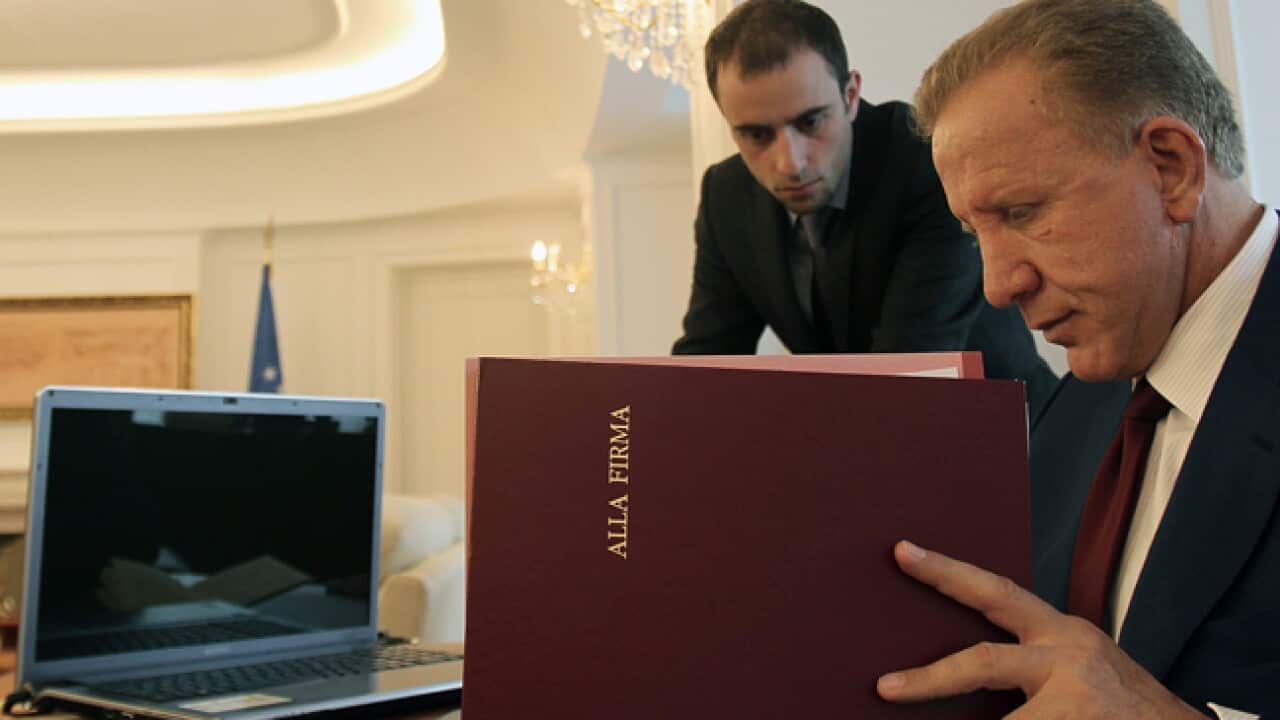
Kosovo's government is scrambling to avoid new snap general elections, as president Behgjet Pacolli is expected to resign after a court said he was elected unconstitutionally.
The constitutional court ruling announced Monday has plunged Kosovo into another political crisis just months after the previous polls in the breakaway former Serbian province.
In his first reaction to the court decision prime minister Hashim Thaci expressed his hope that "the parliament of Kosovo will find a quick constitutional solution" and appealed to the opposition for help.
News that makes sense
Your trusted source for staying up-to-date with the world around you. Get free daily news updates and analysis, straight to your inbox.
"I believe in a positive and active role of the opposition and call on them for an active participation in democratic life," he said.
The full text of the court decision, published Wednesday, said that Pacolli's election by parliament, which was boycotted by the opposition, violated the constitution on two points.
The judges said at least two-thirds of the members of parliament had to be present for the February vote, and there should have been at least two candidates.
By a majority verdict the nine-judge panel issued no guidance about what should happen next, leaving parliament room to try to re-run the presidential vote.
In a dissenting opinion the two international judges on the court said the consequences of the ruling should be the dissolution of parliament and new elections within 45 days.
Observers said this was probably inevitable as Thaci was unlikely to obtain enough support for Pacolli's re-election.
Thaci could also propose another presidential candidate to woo the opposition but that could cost him Pacolli's party as a coalition partner.
Meanwhile the opposition can aggressively push for new elections, refusing to back any of Thaci's candidates.
Given the results of the last elections in December -- Kosovo's first since declaring independence from Serbia in 2008 -- no party is likely to win an outright majority, leading to more months of difficult coalition talks.
However Thaci's position has significantly weakened since the last elections after the Council of Europe adopted a report linking him and other high ranking former Kosovo Liberation Army leaders to organ trafficking and organised crime in the aftermath of the 1999 war.
The report has tarnished his reputation internationally, with a likely knock-on effect as many Kosovans saw Thaci as the only politician capable of dealing effectively with the international community.
Koha Ditore daily said Wednesday that Pacolli would hand over his presidential post provisionally to parliament speaker Jakup Krasniqi after being officially served with the court decision.
Kosovo has been in political turmoil since last September when the previous president Fatmir Sejdiu suddenly resigned after the court ruled he had violated the constitution by occupying the presidency and heading a political party at the same time.
The resignation led to the fall of the government and early elections in December, marred by a number of irregularities.
The February 22 election of president, prime minister and government was long awaited as a precondition for EU-brokered talks with Serbia on a number of disputes that emerged after Kosovo unilaterally proclaimed independence three years ago.







